Every project that lands on my desk tells a story, and this one came all the way from the island of Sri Lanka. My client is a tea producer and trader who had designed a custom tea table for personal use and needed three types of precision pin fasteners to complete it.
Customers need to balance cost and practicality, so I need to carefully select materials, meticulously control tolerances, and work closely with them.
Reviewing the Drawings
The first thing I did after receiving the inquiry was go through the client's drawings carefully. There were three parts in total: Part No. 3, Part No. 17, and Part No. 25. Each had different structural requirements, and it became clear right away that a one-size-fits-all approach to material selection wasn't going to work here.
Part No. 3 was a custom steel dowel pins with no threading designed to fit precisely into pre-drilled holes in the table structure. Part No. 17 required an M3 tapped thread, and Part No. 25 required an M5 tapped thread. These differences would drive the entire material discussion.
Material Selection — Balancing Cost and Function
When I got on a call with the client to discuss requirements, cost control came up early. That's completely understandable, and it's something I always try to address head-on rather than dance around.
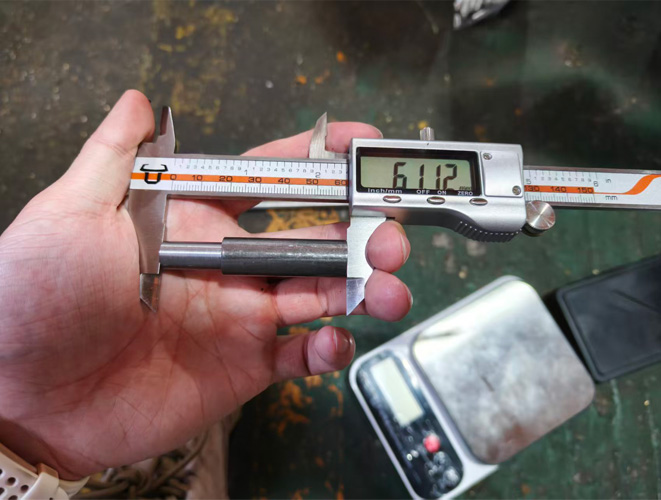
For Part No. 3, since it has no threaded features, we agreed on Q235 carbon steel. Q235 is an economical and widely used structural steel, and for this type of custom steel dowel pin, the material performs reliably in a fixed, load-bearing role. The client was aware that it can develop surface rust over time, but since this part plays a purely structural role inside the table assembly where appearance is secondary, rust wouldn't affect its functionality. The cost savings were meaningful.
 |
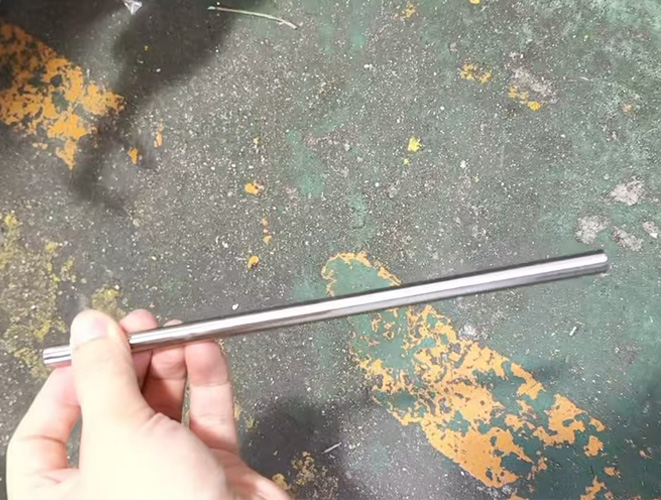 |
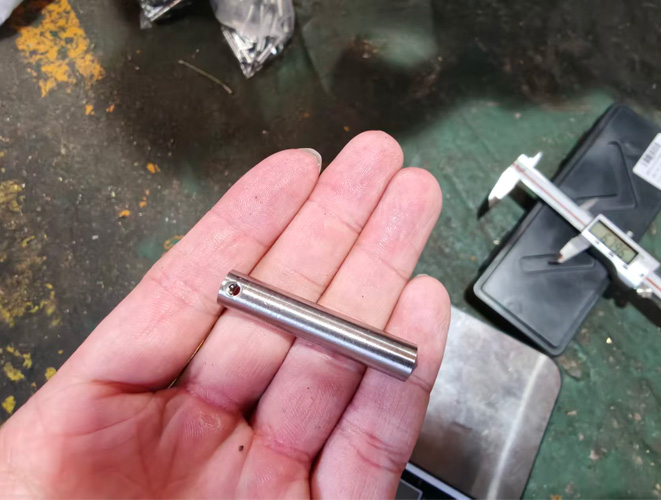
For Part No. 17 and Part No. 25, the situation was different. Both parts carry tapped threads — M3 and M5 respectively — and using Q235 here would have been a mistake. If rust develops inside a threaded hole, it can seize fasteners, compromise fit, and ultimately make the parts unusable. So I took Q235 off the table entirely for these two and instead offered the client a choice between SS304 and SS304F stainless steel.
I walked the client through the difference. SS304 is a standard austenitic stainless steel — corrosion resistant, with a clean, bright surface finish. SS304F is a free-machining variant of SS304, enhanced with a small addition of sulfur. That sulfur content makes the material significantly easier to cut, reduces tool wear during machining, and ultimately brings down the processing cost. The trade-off is a slightly duller surface appearance compared to standard SS304.
When I asked the client about surface finish requirements, the answer was clear: appearance wasn't a priority. The fasteners would be embedded in the table structure and largely out of sight. With that confirmed, SS304F was the obvious choice — same corrosion resistance where it matters most, lower machining cost, and no functional compromise.
Tolerance Control — Getting the Fit Right
Dimensional tolerance was the other key engineering discussion. These pins needed to fit snugly into pre-drilled holes in the tea table. Too tight, and they won't go in at all. Too loose, and they'll rattle or shift under load.
After reviewing the hole dimensions in the drawings, I recommended a negative tolerance of -0.1mm across all three parts. This approach ensures the pins can be inserted smoothly without force-fitting, while still maintaining enough contact with the hole walls to hold firm during use. It's a straightforward tolerance strategy, but getting it right upfront saves a lot of headaches — and return shipments — down the line.
Production and Delivery
Once the machine was set up and dialed in, production moved quickly. All three part types were completed and ready for shipment within two days — a turnaround made possible by our custom CNC milling service, which allows us to move from final drawing confirmation to finished parts without the delays that come with batch-based production scheduling. The package was then dispatched via sea freight, and arrived at the client's location in Sri Lanka approximately one week later.
Client Feedback
I followed up with the client after delivery. The response was exactly what I had hoped for — they were very satisfied with both the cost efficiency and the quality of the finished parts. They mentioned that the material recommendations in particular had given them confidence in the longevity of the assembly, and expressed a clear interest in working with LVMA CNC again on future projects.
Spending a few extra minutes at the start of a CNC milling service project on material selection and tolerance planning can determine whether it's a one-off transaction or the beginning of a long-term partnership.
Media Contact
Company Name: Zhejiang LVMA Co., Ltd.
Email: Send Email
Country: China
Website: https://www.lvma-cnc.com/