~Approximately 100 times faster, will accelerate solutions for drug discovery, finance, and other complex problems~
Toshiba Corporation has developed a breakthrough algorithm that dramatically boosts the performance of the Simulated Bifurcation Machine (SBM), its proprietary quantum‑inspired combinatorial optimization computer. The new algorithm significantly improves the probability of obtaining an optimal solution or a known best solution within a limited number of trials—referred to as the success probability, a key benchmark for evaluating combinatorial optimization technologies.
This press release features multimedia. View the full release here: https://www.businesswire.com/news/home/20260407918434/en/
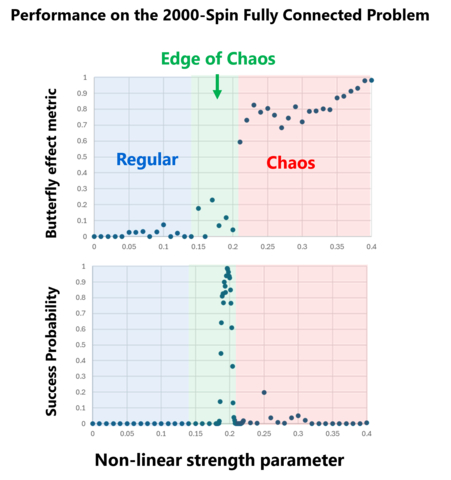
Figure 1: Results demonstrating that the newly developed third‑generation SB algorithm can find the known best solution with nearly 100% probability at the edge of chaos for a fully connected 2,000‑spin Ising problem.
The SBM is designed to solve large‑scale combinatorial optimization problems in a wide range of fields, including new drug discovery, delivery route optimization, and investment portfolio design. While previous algorithms could find optimal or known best solutions with a sufficiently large number of trials, large‑scale problems often trapped the search process in local optima, significantly lowering success probability under practical constraints that limit the number of trials.
Toshiba has overcome this challenge by developing a third‑generation simulated bifurcation (SB) algorithm. This ground-breaking advance builds on the original SB algorithm, announced in April 2019*1, and the second‑generation SB algorithm, released in February 2021*2, which delivered major boosts to computational speed and accuracy.
The new algorithm expands the bifurcation parameter that triggers the bifurcation phenomena*3—a defining feature of the SB algorithm—from a single global parameter to individual parameters assigned to each position variable*4. These bifurcation parameters are independently controlled according to the values of the corresponding position variables, enabling a more adaptive and effective solution search.
With the introduction of this advanced control mechanism, the algorithm exhibits either regular or chaotic behavior*5, depending on conditions. Crucially, Toshiba discovered that by effectively harnessing chaos at the edge of chaos—the boundary between regular dynamics and chaotic motion—the algorithm can escape local optima far more efficiently. As a result, the success probability of reaching the global optimum increases dramatically, approaching 100%.
The SBM based on the new algorithm is therefore much faster. It delivers a time to solution (TTS) required to obtain an optimal or known best solution that is approximately 100 times faster than the SBM based on the second‑generation algorithm. These advances are expected to accelerate the practical applications of combinatorial optimization across a broad range of challenges.
The research results were published in the April 6, 2026 issue of Physical Review Applied, a peer‑reviewed journal of the American Physical Society*6.
Note:
*1 https://advances.sciencemag.org/content/5/4/eaav2372
*2 https://advances.sciencemag.org/content/7/6/eabe7953
*3 In nonlinear dynamical systems, a phenomenon in which changes in system parameters (bifurcation parameters) cause the number of stable points to change from one to multiple.
*4 In the SB algorithm, the equations of motion of a classical dynamical system consisting of many oscillators are solved. A position variable represents the position of each oscillator, and these position variables correspond to the decision variables (discrete variables) of the combinatorial optimization problem.
*5 In nonlinear dynamical systems, a phenomenon in which even slight differences in initial conditions cause the subsequent trajectories of motion to diverge significantly, resulting in disordered (chaotic) behavior. This sensitivity of chaos to initial conditions is known as the butterfly effect, and the upper panel of Figure 1 provides a quantitative evaluation of this effect.
*6 https://doi.org/10.1103/2qd9-x6v8
About Toshiba
For over 150 years, guided by its corporate philosophy, “Committed to People, Committed to the Future.,” Toshiba Group has contributed to society through its business activities. Today, the Group continues to enhance its management structure, streamline operations, and invest in forward‑looking businesses in the energy, digital infrastructure, and electronic devices domains.
Annual sales in fiscal year 2025 were 3.5 trillion yen, with 95,000 employees worldwide. Find out more on our website or follow us on LinkedIn.
View source version on businesswire.com: https://www.businesswire.com/news/home/20260407918434/en/
Breakthrough algorithm dramatically boosts SBM performance—up to 100× faster. https://doi.org/10.1103/2qd9-x6v8
Contacts
Toshiba Corporation
Media Relations Office
Ryoji Shinohara/Naoko Oura
media.relations@toshiba.co.jp