New national survey finds 79% of Americans don't believe physical security has significantly improved since 9/11 and 73% call upgrading physical security technology at least somewhat urgent.
Twenty-five years after 9/11 reshaped aviation security, a new national survey finds most Americans believe the buildings where they work never got a comparable upgrade. The data lines up with what security directors have said for years. Only 21% of Americans believe physical security has significantly improved since 9/11. 76% say everyday office buildings never got investment on par with aviation and a majority of Americans say addressing upgrades is urgent.
This press release features multimedia. View the full release here: https://www.businesswire.com/news/home/20260910870100/en/
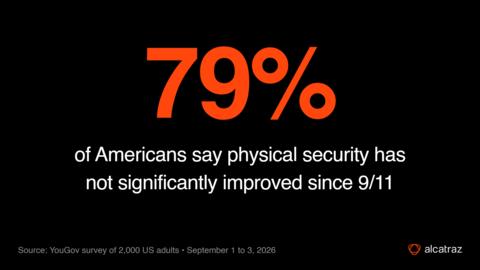
79% of Americans say physical security has not significantly improved since 9/11
“We have spent 25 years upgrading aviation security with the latest technologies but have not kept pace in the spaces where most of us live and work. Keycard and badge technology is 30 years old. It is completely unintelligent. These headline breaches this summer are a warning about the need to upgrade physical security in our buildings, and Americans are saying it is urgent,” — Tina D’Agostin, CEO of Alcatraz AI, who helped shape physical security efforts for Chase Center and Salesforce Tower while at Johnson Controls, a $23.6 billion company and the global leader in physical security solutions
The YouGov survey arrives as the industry heads into GSX 2026 in Atlanta, September 14 to 16, and follows a summer of security breaches at Harvard, UCLA, the Empire State Building and 30 Rockefeller Center. Three of the four incidents involved tailgating: an unauthorized person following someone with a valid credential through a secured door. In each of those cases, the access-control system did exactly what it was built to do. The badge had no way to register the second unauthorized entry. The Empire State Building case was different: two intruders defeated a physical lock rather than a credential, and a security camera did not catch them on a restricted floor hours before anyone responded. They weren't apprehended until they livestreamed the breach to nearly two million followers.
The data behind the doubt
- 73% call upgrading physical security technology at least somewhat urgent, including 39% who call it extremely or very urgent.
- 43% of Americans wrongly believe that a standard badge or key-card system already logs who entered, which door, and alerts security in real time if something unusual occurs - a misconception directly at odds with how access control actually works.
- Asked specifically how quickly security would be alerted to a tailgater, 68% say detection would only happen during a later review of footage, wouldn't happen at all, or they're not sure — only 32% believe it would be immediate or within a few minutes.
- 58% of Americans are already aware that key cards and badges can be duplicated or shared, and 48% say they would want biometric verification in place of key cards, either “definitely” or “most likely.”
- 64% support requiring high-population buildings to detect and report a breach in real time — support that holds across party lines, at 69% among Democrats and 72% among Republicans.
“On September 11, I was installing access control systems in Los Angeles; today, decades later, the systems going into buildings haven't fundamentally evolved, while the vulnerabilities have gotten more complex. The advanced tools to close these security gaps already exist, but too many companies still underinvest in physical protection. We have the capability to prevent the next major catastrophe—we just need the will to implement it,” said Bobby Louissaint, Head of Business Development, Alcatraz.
Louissaint, a security expert who has spent decades testing security systems and technologies for Fortune 20 companies, says leadership often considers security a one time investment in technology. “Most companies go in thinking they’re going to pay for the security when they stand up the building and they’re never going to have to pay for it again. Unfortunately, the equipment gets old like everything else does and until something goes wrong, they don’t make another investment to enhance or keep up the existing security system they have. Security directors understand the urgency behind upgrading technology but struggle to get allocation in the budget where security is often an afterthought.” says Louissaint.
Alcatraz at GSX 2026
Alcatraz will be at GSX 2026 in Atlanta at booth #1339, September 14–16, where the company's team will be showcasing new real time tailgating analytics, visitor profiles, and Rock Cortex platform.
About the Research
This survey was conducted by YouGov among 2,000 U.S. adults (18+), September 1–3, 2026. Results were weighted to U.S. Census benchmarks on age, gender, race/ethnicity, education and 2024 presidential vote choice, using a sampling frame built from the American Community Survey. The credible interval is +/-2.62 percentage points.
About Alcatraz
Alcatraz is known as the Face ID of physical spaces. Alcatraz is an AI-powered physical access control company headquartered in Cupertino, California. Its flagship product, the Rock, replaces badge-based and legacy biometric security with fully anonymized facial authentication and real-time tailgating detection. Alcatraz is trusted where security standards are highest and certifications hardest to earn: hyperscale data centers, financial institutions, airports, and nuclear and energy infrastructure. Its technology protects professional sports teams from the NBA to the NFL, Fortune 100 companies, universities, stadiums, and private individuals. Of the 17 hyperscale operators headquartered in the U.S., over half use Alcatraz to help secure their spaces.
View source version on businesswire.com: https://www.businesswire.com/news/home/20260910870100/en/
76% of Americans say office buildings never got the security investment airports did.
Contacts
Media Contact
press@alcatraz.ai