Today’s Date: March 20, 2026
Introduction
In the high-stakes world of global energy, few companies have undergone a transformation as radical or as consequential as Cheniere Energy, Inc. (NYSE American: LNG). Once a speculative venture betting on the need for natural gas imports into the United States, Cheniere has evolved into the undisputed titan of American energy exports. As of March 2026, the company stands as a linchpin of global energy security, providing the critical bridge that links the prolific shale basins of North America to energy-hungry markets in Europe and Asia. With its stock trading near all-time highs and a massive expansion project at Corpus Christi nearing completion, Cheniere is no longer just a pipeline and terminal operator—it is a geopolitical asset.
Historical Background
The story of Cheniere Energy is one of the greatest "pivots" in corporate history. Founded in 1996 by Charif Souki, the company originally spent billions constructing regasification terminals—facilities designed to import liquefied natural gas (LNG) into a U.S. market that was thought to be running dry. However, the "Fracking Revolution" of the mid-2000s fundamentally changed the math, flooding the U.S. with domestic shale gas.
Facing potential obsolescence, Cheniere made a bet-the-company move: it would flip its business model to export gas instead. Under the later leadership of Jack Fusco, who took the helm in 2016, the company moved from a period of chaotic development to one of disciplined operational excellence. Over the last decade, Cheniere successfully operationalized the Sabine Pass and Corpus Christi terminals, becoming the first company to export LNG from the lower 48 states in 2016. Today, it celebrates ten years of reliable delivery and a reputation for finishing massive infrastructure projects on time and on budget.
Business Model
Cheniere’s business model is built on the bedrock of "Take-or-Pay" contracts. Unlike traditional commodity companies that are highly sensitive to daily price swings in natural gas, Cheniere functions more like a high-margin utility with an infrastructure overlay. The company signs long-term (often 20-year) agreements with global utilities and state-owned enterprises. These customers pay a fixed "liquefaction fee" to reserve capacity, regardless of whether they actually take the gas or not.
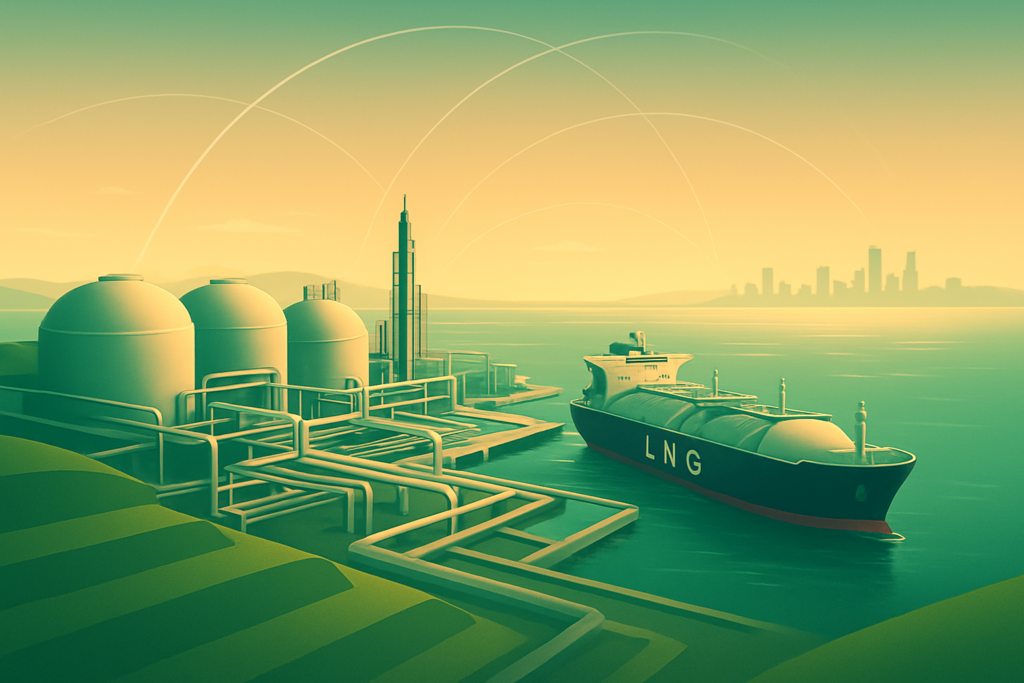
This "infrastructure-as-a-service" model provides Cheniere with highly predictable cash flows. The company operates two primary hubs:
- Sabine Pass (Louisiana): Currently the largest LNG production facility in the Western Hemisphere.
- Corpus Christi (Texas): A state-of-the-art facility undergoing a massive multi-year expansion.
Revenue is further bolstered by Cheniere’s marketing arm, which optimizes "excess" cargoes in the spot market, capturing lucrative spreads during periods of global supply tightness.
Stock Performance Overview
As of March 20, 2026, Cheniere (LNG) has been a standout performer in the energy sector.
- 1-Year Performance: The stock is up approximately 18% over the past twelve months, recently touching a new all-time high of $292.15. This rally has been fueled by the successful start-up of the first few trains of the Corpus Christi Stage 3 expansion.
- 5-Year Performance: Long-term shareholders have seen a total return of nearly 240%. Since the post-pandemic lows of 2021, Cheniere has effectively tripled its valuation, transitioning from a growth story to a "Total Return" vehicle.
- 10-Year Performance: Over the last decade, the stock has surged over 580%. This reflects the company’s evolution from a $15 billion market cap "project developer" to an $80 billion+ industry leader.
Financial Performance
Cheniere’s FY 2025 results, released in February 2026, were nothing short of historic. The company reported a net income of $5.33 billion on revenues of $19.98 billion. A key highlight was the massive EPS beat in Q4 2025, where the company delivered $10.68 per share against an analyst consensus of $3.86.
The company’s "20/20 Vision" capital allocation plan reached its conclusion ahead of schedule in late 2025, leading to the announcement of a new $10 billion share repurchase authorization through 2030. With a current dividend yield of approximately 0.8% ($2.22 annualized), the company is increasingly attractive to institutional "income and growth" funds. Management has also aggressively de-leveraged, moving toward an investment-grade balance sheet that lowers its cost of capital for future expansions.
Leadership and Management
CEO Jack Fusco, who recently celebrated his 10th anniversary at the helm in February 2026, is widely credited with "professionalizing" the company. Under his tenure, Cheniere moved away from the flamboyant, high-debt strategies of its early years toward a focus on execution and shareholder returns. Fusco’s leadership team, including CFO Zach Davis, has been praised for navigating the 2024-2025 regulatory "LNG pause" with diplomatic tact and strategic patience. Fusco remains one of the most respected voices in Washington D.C. and Brussels, often serving as an informal advisor on transatlantic energy policy.
Products, Services, and Innovations
Cheniere’s primary "product" is super-cooled natural gas, but its competitive edge lies in its Midscale Train technology. Unlike the massive, bespoke liquefaction trains of the past, Cheniere’s Corpus Christi Stage 3 uses modular, midscale units. These are faster to build, easier to maintain, and allow for incremental capacity additions.
Furthermore, Cheniere has pioneered "Cargo Emissions Tags." These provide customers with verified data on the carbon intensity of each cargo, from the wellhead to the delivery point. In a 2026 market where European buyers face strict ESG mandates, these "Green LNG" certificates allow Cheniere to command a premium price.
Competitive Landscape
While Cheniere is the king of the Gulf Coast, it is not without rivals:
- Venture Global: Known for its rapid "plug-and-play" construction model, Venture Global is Cheniere’s most aggressive domestic competitor.
- ExxonMobil/QatarEnergy (Golden Pass): This massive joint venture is ramping up production in 2026, directly competing for Texas gas supplies.
- QatarEnergy: Globally, Qatar is the low-cost producer. Their North Field expansion project, slated for full operation by 2027, poses a long-term threat to U.S. exporters on a pure price-per-MMBtu basis.
However, Cheniere’s scale and established long-term contract portfolio give it a defensive moat that smaller upstarts lack.
Industry and Market Trends
The "Golden Age of Gas" remains in full swing in 2026. Two major trends are driving the sector:
- European Decoupling: Europe’s permanent shift away from Russian pipeline gas has created a structural "floor" for LNG demand for the next two decades.
- Asian Coal-to-Gas Switching: In China, India, and Southeast Asia, the push to improve air quality and meet 2030 climate goals is driving a massive shift from coal-fired power to natural gas.
Despite the rise of renewables, LNG is increasingly viewed by policymakers as the "reliability partner" for intermittent wind and solar power.
Risks and Challenges
Despite its dominance, Cheniere faces several headwinds:
- Operational Risk: With Corpus Christi Stage 3 in the middle of a multi-train commissioning phase, any mechanical failure or construction delay could impact 2026 guidance.
- Feedgas Prices: While Cheniere passes most costs to customers, extreme volatility in Henry Hub prices or pipeline bottlenecks in Texas can impact trading margins.
- Environmental Policy: While the 2024 export pause was lifted in 2025, the potential for future "regulatory whiplash" remains a risk if U.S. political winds shift again toward a fossil-fuel phase-out.
Opportunities and Catalysts
The immediate catalyst for 2026 is the completion of Trains 5, 6, and 7 at Corpus Christi. As each train comes online, it immediately begins generating cash flow under pre-signed contracts.
Beyond this, the Final Investment Decision (FID) for the Sabine Pass Stage 5 expansion is a major event looming on the horizon for late 2026. If approved, this would solidify Cheniere’s path to becoming a 100+ MTPA (million tonnes per annum) producer, rivaling entire nations in total output.
Investor Sentiment and Analyst Coverage
Wall Street sentiment on Cheniere remains overwhelmingly bullish. Analysts currently hold a "Moderate Buy" consensus, with several top-tier firms raising price targets to the $310 – $350 range following the Q4 earnings beat.
Institutional ownership is high, with giants like Vanguard and BlackRock holding nearly 18% combined. Activist-turned-ally Carl Icahn remains a significant presence, often seen as a validator of the company’s disciplined capital return strategy. Retail sentiment on social media platforms remains positive, focusing on the company's "cash cow" status.
Regulatory, Policy, and Geopolitical Factors
The regulatory environment has shifted dramatically in Cheniere's favor since early 2025. The Department of Energy (DOE), under the current administration’s "Energy Dominance" policy, has fast-tracked export permits that were previously stalled. This has cleared the way for Cheniere to maximize its current footprint.
Geopolitically, Cheniere is a primary tool of U.S. "soft power." By providing a reliable alternative to autocratic energy supplies, Cheniere’s exports are a key component of NATO’s energy security strategy in 2026.
Conclusion
Cheniere Energy enters the mid-2020s in its strongest position ever. By successfully navigating the transition from a builder to an operator, and from a borrower to a returner of capital, the company has de-risked its investment profile. While competition from Qatar and domestic rivals like Venture Global is intensifying, Cheniere’s massive scale and contractual "moat" provide a level of stability rare in the energy sector.
For investors, the story in 2026 is one of execution. As the final trains of the Stage 3 expansion go live, Cheniere is set to unlock a new level of free cash flow that could support even more aggressive buybacks and dividend hikes. In a volatile world, Cheniere has positioned itself as the reliable, indispensable heart of the global energy trade.
This content is intended for informational purposes only and is not financial advice.