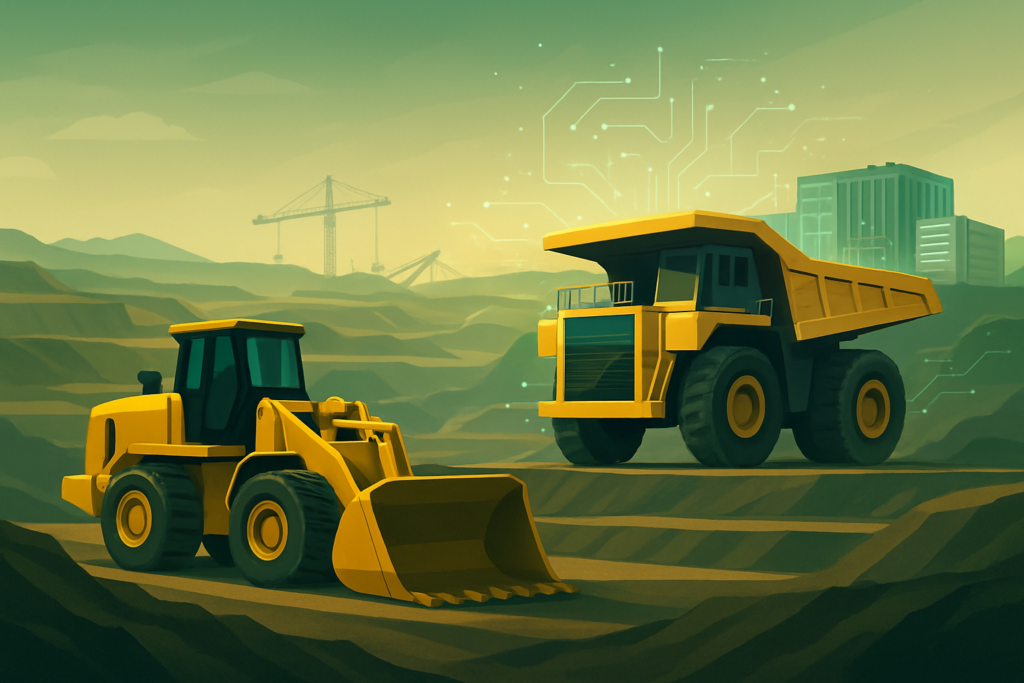
As of April 2, 2026, Caterpillar Inc. (NYSE: CAT) stands at a historic crossroads. Fresh off its centennial anniversary in 2025, the world’s leading manufacturer of construction and mining equipment has transformed itself from a traditional "heavy iron" manufacturer into a high-tech powerhouse. While the iconic "Caterpillar Yellow" machines remain ubiquitous on job sites globally, the company's recent focus on autonomy, AI-driven power solutions for data centers, and the energy transition has redefined its market position.
Today, Caterpillar is no longer just a bellwether for global industrial activity; it is a critical player in the technological infrastructure of the 21st century. With a record backlog of $51 billion and a stock price that has seen triple-digit gains over the last year, CAT is currently one of the most closely watched stocks on the New York Stock Exchange.
Historical Background
Caterpillar’s journey began in 1925 with the merger of the Holt Manufacturing Company and the C. L. Best Tractor Co. Benjamin Holt had pioneered the continuous-track tractor—the "Caterpillar"—which replaced wheels to prevent heavy machinery from sinking into soft soil.
Over the past century, the company has weathered the Great Depression, played a vital role in World War II (providing engines and tractors for the Allied effort), and became synonymous with the post-war global infrastructure boom. In the 21st century, Caterpillar transitioned through several strategic eras, most recently shifting its headquarters from Peoria, Illinois, to Deerfield, and finally to Irving, Texas. This move signaled a leaner, more globalized approach. Under the "Operating & Execution (O&E) Model" introduced in the late 2010s, the company focused on higher-margin services and technology-integrated products, setting the stage for its current record-breaking performance.
Business Model
Caterpillar operates through three primary segments, supported by a massive global dealer network that remains its most significant competitive moat.
- Construction Industries: Providing machinery for infrastructure, forestry, and building construction. This remains the "stability anchor" of the company.
- Resource Industries: Focused on the mining and quarrying sectors. This segment is currently riding the wave of the "mining super-cycle" as global demand for copper, lithium, and nickel surges.
- Energy & Transportation (E&T): The fastest-growing arm of the company. It provides reciprocating engines, turbines, and generators for the oil and gas, marine, and power generation industries. In 2026, the demand for backup power in AI data centers has turned E&T into Caterpillar's most lucrative segment.
A key pillar of the business model is the target to reach $28 billion in service-related revenue by late 2026. By leveraging telematics and predictive maintenance, Caterpillar captures high-margin recurring revenue long after the initial equipment sale.
Stock Performance Overview
Caterpillar’s stock performance has been nothing short of exceptional, reflecting its evolution from a cyclical play to a secular growth story.
- 1-Year Performance: The stock has surged approximately 121% since April 2025, driven largely by the massive uptick in Energy & Transportation orders and the resilience of the U.S. infrastructure market.
- 5-Year Performance: With a return of roughly 214% (a CAGR of ~25%), CAT has significantly outperformed the broader industrial sector.
- 10-Year Performance: Long-term investors have seen returns of over 851%, vastly outpacing the S&P 500.
As of early April 2026, CAT trades near all-time highs of approximately $730 per share, with a market capitalization exceeding $340 billion.
Financial Performance
In its latest full-year report for 2025, Caterpillar posted record-breaking sales and revenues of $67.6 billion, a 4% increase over 2024. However, the financial picture is a nuanced one:
- Earnings: FY 2025 adjusted EPS came in at $19.06, down slightly from the $21.90 reported in 2024.
- Margins: Operating profit margins were 17.2% in 2025, a contraction from the 20.7% seen in 2024. This compression was primarily attributed to a $1.7 billion headwind from trade tariffs and rising manufacturing costs.
- Backlog: The company enters Q2 2026 with a $51 billion backlog, providing high revenue visibility for the next 18 to 24 months.
- Cash Flow: Caterpillar remains a cash machine, returning billions to shareholders through dividends and aggressive share buybacks, even while increasing R&D spend.
Leadership and Management
Caterpillar recently completed a significant leadership transition. On April 1, 2026, Joseph (Joe) E. Creed officially added the role of Chairman of the Board to his CEO responsibilities. Creed, who succeeded Jim Umpleby as CEO in May 2025, is a 29-year company veteran who previously led the Energy & Transportation division.
Creed’s leadership style is defined by a "technology-first" philosophy. He has been the primary architect of the company’s push into AI-integrated power solutions and autonomous mining. Governance under Creed remains conservative regarding the balance sheet but aggressive regarding market share and technological dominance.
Products, Services, and Innovations
Caterpillar’s R&D focus is currently centered on three "megatrends": autonomy, electrification, and alternative fuels.
- Autonomy: Caterpillar’s "MineStar" command system is the industry leader. As of 2026, over 800 autonomous haul trucks are in operation globally, having moved over 11 billion tonnes of material without a single lost-time injury. The company is now expanding this Level 4 autonomy into mid-sized construction equipment.
- The C13D Engine: This fuel-flexible platform, production-ready in 2026, allows customers to run on 100% renewable diesel (HVO), biodiesel, or hydrogen-hybrid configurations.
- Hydrogen Fuel Cells: In partnership with Microsoft and Ballard Power Systems, Caterpillar has successfully demonstrated hydrogen fuel cell backup power for data centers, a critical innovation as AI campuses look for carbon-free reliable energy.
Competitive Landscape
Caterpillar maintains a dominant ~17% share of the global heavy machinery market.
- Komatsu (KMTUY): CAT’s primary rival. While Komatsu is highly respected for its precision engineering in high-capacity mining, Caterpillar’s superior dealer network and integrated software ecosystem often give it the edge in total cost of ownership.
- Sany and XCMG: These Chinese competitors have made inroads in emerging markets by competing on price. However, Caterpillar has successfully defended its premium position by focusing on resale value and "uptime" guarantees that lower-cost rivals struggle to match.
- Deere & Co (NYSE: DE): While a formidable competitor in North American construction, Deere is more heavily exposed to the volatile agricultural cycle, whereas Caterpillar’s diversified exposure to mining and energy has shielded it from the recent downturn in the farming sector.
Industry and Market Trends
The machinery sector in 2026 is being shaped by two divergent forces:
- The Mining Super-Cycle: The transition to electric vehicles and renewable energy requires massive amounts of copper, lithium, and rare earth minerals. This has decoupled the mining equipment market from traditional economic cycles, as miners must invest in new capacity regardless of short-term GDP fluctuations.
- The AI Infrastructure Build-out: Data centers require immense amounts of primary and backup power. Caterpillar has secured multi-gigawatt generator contracts for AI "hyper-scale" campuses, making it an accidental but major beneficiary of the generative AI boom.
Risks and Challenges
Despite the record backlog, Caterpillar faces significant headwinds:
- Geopolitical and Trade Risks: The company is highly sensitive to trade policy. In 2026, Caterpillar expects to absorb roughly $2.6 billion in tariff-related costs. This has forced aggressive pricing actions that could eventually dampen demand.
- Interest Rates: While rates have stabilized from their 2023–2024 peaks, they remain "higher for longer." This has slowed the residential construction market, though large-scale infrastructure projects have largely compensated for the dip.
- Supply Chain Complexity: The shift toward electric and hydrogen engines requires a completely different supply chain for minerals and components, introducing new vulnerabilities.
Opportunities and Catalysts
- The IIJA Tailwinds: The U.S. Infrastructure Investment and Jobs Act is hitting its peak spending phase in 2026, providing a steady stream of demand for construction equipment through 2028.
- Electrification of the "Mid-Range": As municipalities mandate zero-emission construction sites, Caterpillar’s new battery-electric mini-excavators and loaders are seeing rapid adoption in Europe and North America.
- M&A Potential: With a strong cash position, analysts expect Caterpillar to pursue acquisitions in the software and AI space to further boost its services revenue.
Investor Sentiment and Analyst Coverage
Wall Street remains generally optimistic but cautious about Caterpillar's high valuation. The consensus rating is "Moderate Buy" or "Outperform."
- Target Prices: Median analyst targets sit around $765, with some bulls looking toward $878 based on E&T growth.
- Sentiment: Institutional investors are increasingly viewing CAT as a "technology and energy play" rather than a "cyclical industrial." However, some retail chatter suggests concerns that the stock may be overextended after its 121% run over the past year.
Regulatory, Policy, and Geopolitical Factors
Regulatory pressure is intensifying. While the EPA Tier 4 Final remains the current standard, 2026 marks the beginning of formal industry preparation for "Tier 5" standards, expected by 2029. These standards will mandate a 90% reduction in Nitrogen Oxides (NOx).
Furthermore, the "Buy American" provisions in the U.S. and similar "sovereignty" policies in the EU and India are forcing Caterpillar to localize more of its manufacturing, which provides security against trade wars but adds complexity to its global cost structure.
Conclusion
Caterpillar Inc. enters its second century as a fundamentally different company than the one that dominated the 20th century. By positioning itself at the center of the mining super-cycle, the AI infrastructure boom, and the push for autonomous job sites, Caterpillar has successfully shed its reputation as a purely cyclical stock.
For investors, the key to the next 12 months will be Caterpillar’s ability to manage margin compression from tariffs while continuing to scale its high-margin services. While the valuation is currently at the higher end of its historical range, the $51 billion backlog and the non-discretionary nature of data center and mining demand provide a significant safety net. Caterpillar remains the definitive "heavyweight" champion of the industrial sector, now with a high-tech engine driving its future.
This content is intended for informational purposes only and is not financial advice.
4/2/2026