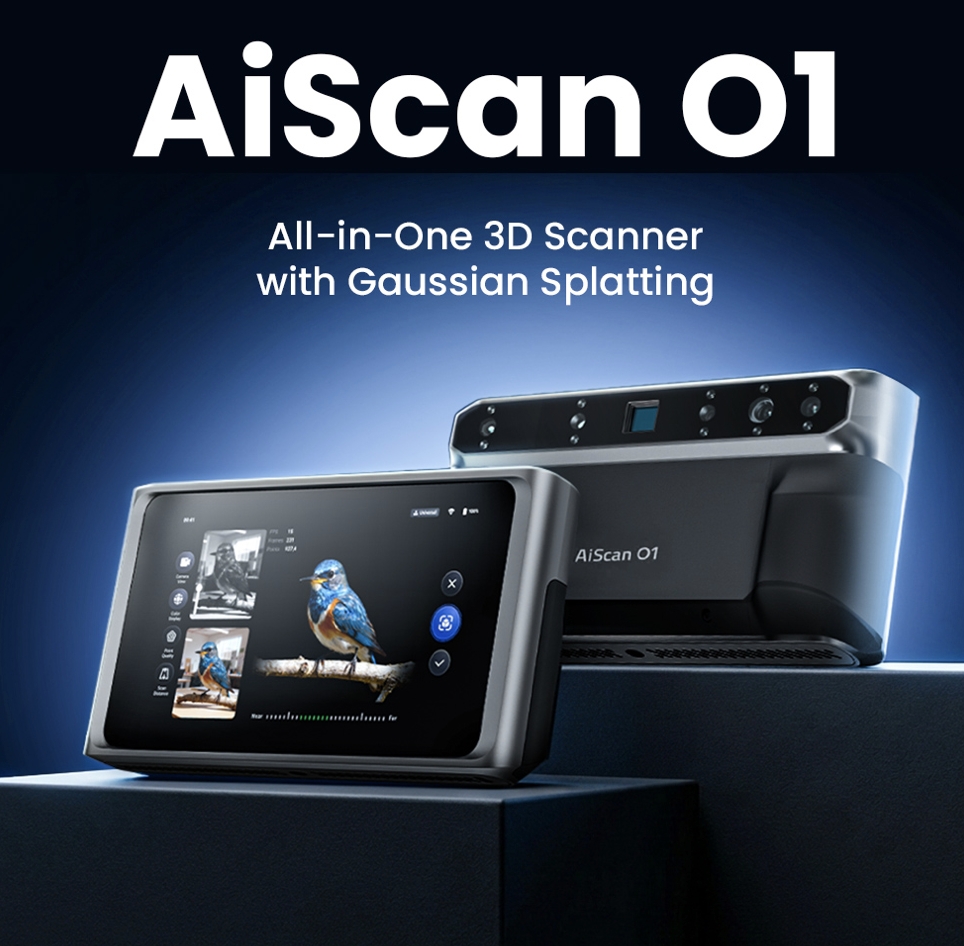
Hong Kong - Every 3D scanner on the market makes the same tradeoff: accuracy or portability. Geometric fidelity or visual realism. Professional workflow or beginner accessibility.
AiScan O1 refuses to choose.
Developed by ChaoXiLi — a 3D vision technology company specializing in high-precision scanning solutions — AiScan O1 is the first handheld 3D scanner to integrate blue-light MEMS structured-light scanning with on-device 3D Gaussian Splatting. Two fundamentally different capture technologies, unified in a single 770g standalone device.
The result: 0.03mm metrological accuracy for engineering applications, and photorealistic 3DGS rendering for visual applications — from the same hardware, in the same session, with no PC required.
An 8-core processor, 32GB RAM, and 7-inch 2K AMOLED touchscreen handle the entire pipeline — scan, edit, mesh, export — on-device. Two built-in AI features eliminate manual parameter configuration and prevent incomplete captures.
This is not an incremental update to existing 3D scanning technology. It is a structural advancement.
Why Gaussian Splatting Changes the Game
Conventional 3D scanners reconstruct surfaces as triangulated meshes with UV-mapped textures. This approach is well-suited for CAD and manufacturing workflows, but fundamentally limited in visual fidelity — mesh rendering cannot accurately represent translucency, sub-surface scattering, anisotropic reflections, or fine volumetric structures like hair and fabric.
3D Gaussian Splatting (3DGS) is a different representation entirely. Instead of polygon surfaces, 3DGS encodes a scene as a collection of oriented 3D Gaussian primitives — each carrying position, covariance, color, and opacity. The result is a continuous, differentiable representation that captures how light actually interacts with materials.
Blue-Light MEMS Structured-Light Engine
The primary scanning system uses a MEMS (Micro-Electro-Mechanical System) phase-shifting projector emitting coded blue structured-light patterns onto the target surface. A dual-camera depth system — one near-range, one far-range — captures the deformed patterns and triangulates surface geometry with 0.005mm single-frame precision.
Why blue light. Blue wavelengths (≈450nm) have shorter wavelength than infrared alternatives, enabling finer fringe patterns and higher spatial resolution. Blue light also exhibits lower interference from ambient lighting conditions — direct sunlight, fluorescent overhead, mixed indoor/outdoor environments — making AiScan O1 reliable across diverse scanning environments without controlled lighting.
Why dual-range cameras. A single depth camera forces a compromise between near-field detail and far-field coverage. AiScan O1’s dual-camera architecture scans objects from 100mm (close detail work on small parts, jewelry, dental models) to 1000mm (large assemblies, furniture, human bodies), covering a scan volume from 10 × 10 × 10mm up to 4 × 4 × 4m — without swapping lenses or reconfiguring hardware.
Performance benchmarks:
- Near-field accuracy: 0.03 mm (comparable to desktop-class metrology scanners)
- Far-field accuracy: 0.1 mm
- Scan speed: up to 15 frames per second
- Point cloud density sufficient for reverse engineering, dimensional inspection, and rapid prototyping workflows
AI-Powered Scanning Intelligence
3D scanning has historically required operator expertise — selecting scan modes, adjusting exposure, configuring alignment parameters, evaluating coverage completeness. AiScan O1 automates the two most failure-prone steps.
A range of preset scanning modes is available - Universal (Standard), 3DGs (Lifelike Visual), Low Glossy (Metal/Paint), Relief (Engraving), and Dark (Dark/Black). Users can choose the most suitable mode based on their scanning needs, with full parameter control for advanced customization.
After a scan session ends, the AI evaluates the captured point cloud for coverage gaps. The system identifies up to three incomplete regions per evaluation cycle, highlights them on the 3D model, and provides directional guidance for targeted rescanning.
This eliminates the most common failure mode in handheld 3D scanning: discovering missing data only after returning to a desktop workstation, when rescanning is no longer possible.
The detection-and-rescan loop can be repeated until the model achieves full coverage. In testing, this typically requires 1-2 additional passes for complete reconstruction.
Industry-Leading Display
AiScan O1 integrates a 7-inch 2K resolution AMOLED touchscreen — the largest and highest-resolution display in any handheld 3D scanner currently available.
The AMOLED panel provides wide color gamut, high contrast ratio, and low power consumption — particularly suited for evaluating color-accurate texture captures and for outdoor use where high brightness is needed.
Screen mirroring via USB-C DisplayPort is supported for users who prefer working on a larger external monitor.
Full On-Device Processing Pipeline
AiScan O1 performs the full 3D scanning workflow on-device, without requiring a connected PC at any stage:
Hardware supporting this pipeline:
- 8-core 2.4GHz application processor
- 32GB DDR4 RAM
- 512GB onboard storage
- 25.9Wh battery (~2.5 hours continuous scanning)
- 65W USB-C fast charging
- Wi-Fi 6 connectivity
The on-device pipeline does not replace desktop software for advanced post-processing — it eliminates the requirement for it. Users who prefer desktop workflows can export raw point clouds and process in their software of choice.
About ChaoXiLi
AiScan O1 is developed by ChaoXiLi, a 3D vision technology company specializing in high-precision scanning solutions. Founded to integrate advanced AI and optical engineering capabilities for both consumer and professional 3D scanning applications, ChaoXiLi brings together deep expertise in MEMS optical systems, embedded AI inference, structured-light algorithms, and precision hardware manufacturing.
ChaoXiLi is a leading Chinese enterprise focused on the research and development of AI sensing instruments, with strong technical foundations in industrial AI fields such as AI acoustics and AI 3D vision. The company is dedicated to redefining sensing technologies through artificial intelligence, helping industries achieve safer and more efficient operations.
Backed by strong R&D and manufacturing capabilities, ChaoXiLi holds over 200 patents in 3D vision and AI processing, operates through ISO 9001-certified manufacturing facilities, and has established a reliable supply chain and mass-production infrastructure, supported by a dedicated global customer service team.
The company is also supported by China’s National Next-Generation Artificial Intelligence Open Innovation Platform and China’s National Key Laboratory of Cognitive Intelligence. In recent years, ChaoXiLi has demonstrated outstanding technical leadership by winning the DCASE Challenge Championship for four consecutive years (2022–2025), taking first place in the PHM Data Challenge, and setting a world record in 3D object detection on the nuScenes autonomous driving benchmark.
AiScan O1 is not a concept product or early-stage prototype. It is a production-ready product built by an established technology company with proven expertise in hardware development, AI engineering, and scalable manufacturing.
Campaign Information
AiScan O1 is launching on Kickstarter. Follow the campaign page to get notified and secure early bird pricing.
Kickstarter: https://www.kickstarter.com/projects/1059314484/aiscan-o1-3d-gaussian-all-in-one-3d-scanner
Product Website: https://www.aicxl3d.com/
Media Contact
Company Name: ChaoXiLi Technology
Contact Person: Media Manager
Email: Send Email
Country: United States
Website: www.aicxl3d.com