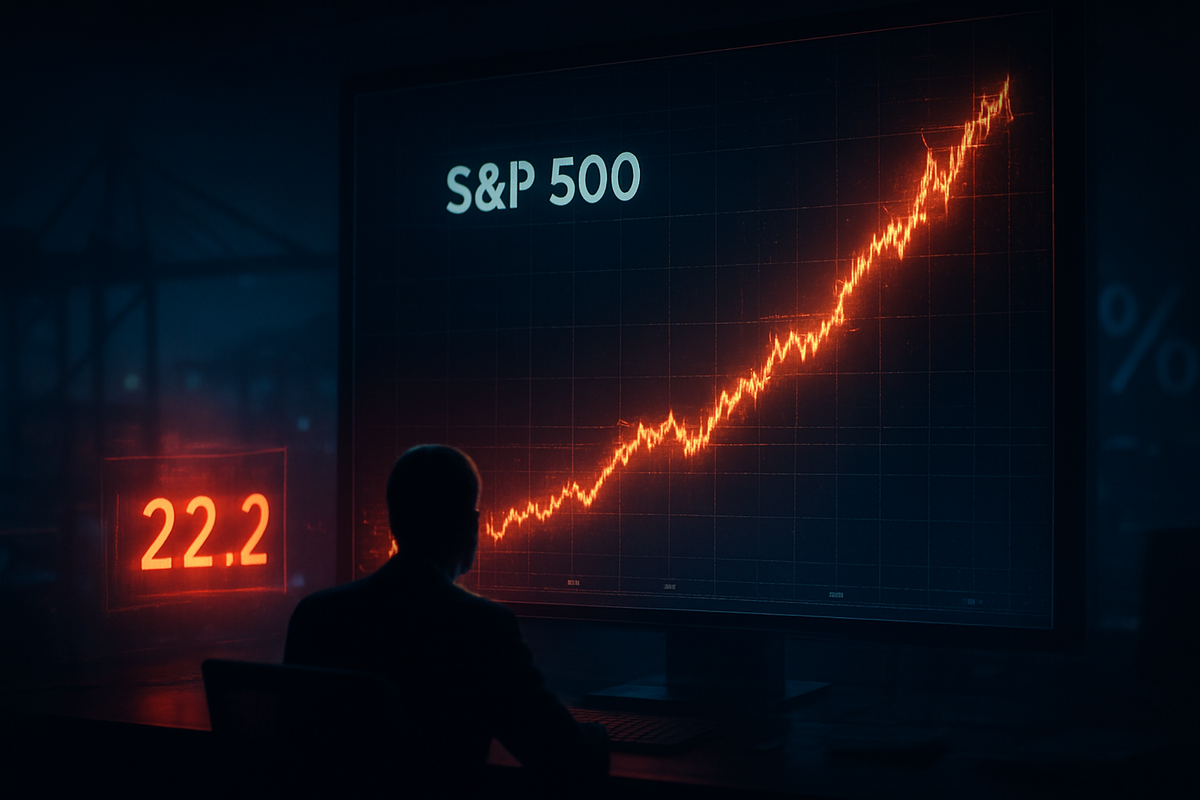
The Federal Reserve has issued a stark warning in its latest assessment of the nation’s financial health, characterizing the S&P 500 (SPX) as "very expensive" by historical standards. As of February 18, 2026, the benchmark index’s forward price-to-earnings (P/E) multiple has climbed to a precarious 22.2, a level that has historically preceded significant market corrections. The central bank's concerns center on the shrinking "equity premium"—the compensation investors receive for choosing stocks over safe-haven government bonds—which has fallen to levels not seen since the dot-com era.
This valuation red flag comes at a delicate moment for the U.S. economy. While the S&P 500 recently crossed the 7,000 threshold, the Federal Reserve’s Financial Stability Report suggests that this rally is built on a "perfection" narrative that ignores mounting macroeconomic headwinds. With trade tariffs reaching 90-year highs and interest rates remaining stubbornly elevated, the prospect of a "valuation reset" is no longer a fringe theory but a primary concern for central bankers and institutional investors alike.
The Growing Bubble: A Timeline of Warnings
The current climate of anxiety began to take shape with the Federal Reserve’s November 2025 Financial Stability Report, which first categorized asset valuations as being at the "high end of their historical range." Since then, the market has largely brushed off these warnings, fueled by continued AI optimism and the legislative tailwinds of the "One Big Beautiful Bill Act" (OBBBA) of 2025. However, by early February 2026, the disconnect between stock prices and economic reality became too large to ignore.
Key stakeholders, including the Federal Reserve's leadership and analysts at major institutions like Goldman Sachs (NYSE: GS) and JPMorgan Chase & Co. (NYSE: JPM), have pointed to a "15% growth mandate." Essentially, for the S&P 500 to justify a 22.2 P/E multiple, corporate earnings must grow by at least 15% annually. Yet, recent data suggests that new trade tariffs are already shaving 2% to 3% off total earnings per share (EPS). The market's initial reaction has been one of extreme volatility; January 20, 2026, marked the index's worst single-day drop in years, a 2.1% slide triggered by rising yields on Japanese government bonds and escalating trade tensions.
Winners and Losers in the Great Rotation
The Fed’s warning has accelerated a "Great Rotation" within the market, as investors flee richly valued mega-cap tech in favor of domestic-focused and cyclical plays. Microsoft Corp. (NASDAQ: MSFT), a primary driver of the index's gains over the last three years, recently saw a staggering $350 billion market cap wipeout following a "subdued" earnings reaction that failed to meet the market's sky-high expectations. Similarly, the healthcare sector has faced significant pressure, with UnitedHealth Group Inc. (NYSE: UNH) plunging roughly 13% year-to-date following a "Medicare rate shock" that has spooked long-term investors.
Conversely, some sectors are finding resilience amidst the broader valuation concerns. Energy and Materials have emerged as the surprise leaders of 2026, posting gains of 14.2% and 8.6%, respectively, as investors seek tangible assets in an inflationary tariff environment. Small-cap stocks, represented by the Russell 2000 (IWM), are also being viewed as a "coiled spring." Trading at an 18x forward P/E—a 31% discount to the S&P 500—small caps are increasingly seen as a safer haven for those betting on domestic growth without the "tariff-exposed" baggage of the multinational giants.
Wider Significance and Historical Precedents
The current situation bears a striking resemblance to the market peaks of 2000 and 2021. In both instances, high P/E multiples were sustained by a belief in a "new era" of productivity—the internet in 2000 and the post-pandemic digital shift in 2021. Today, that narrative is driven by Artificial Intelligence. However, the Federal Reserve specifically warned in its report that a sudden turn in AI sentiment could catalyze a systemic sell-off, given the index's heavy reliance on a handful of "hyperscalers."
Beyond technology, the regulatory and policy landscape is adding fuel to the fire. The "One Big Beautiful Bill Act" has provided some corporate tax relief, but this is being offset by an "effective tariff rate" rising toward 17%. Bank of America Corp. (NYSE: BAC) analyst Savita Subramanian has framed this as the "big story of 2026," arguing that investors are being forced to reconcile AI-driven dreams with the reality of tariff-driven margin compression. The ripple effects are already being felt in the Industrials sector, where rising input costs are eroding profit margins for manufacturing giants.
The Path Forward: Scenarios for a Valuation Reset
Looking ahead to the remainder of 2026, the market faces two primary paths. The "soft landing" scenario involves a gradual "valuation reset" where earnings catch up to prices without a catastrophic crash. This would likely require the Federal Reserve to provide a "turbo boost" in the form of interest rate cuts later this year to offset the inflationary drag of trade policy. Currently, the 10-year Treasury yield sits at a lofty 4.24%, and many analysts believe a move toward 3.5% is necessary to support a 22x multiple.
Alternatively, a sharper correction could be triggered by upcoming legal and political catalysts. Wall Street is keeping a close eye on the Supreme Court, which is expected to rule on the legality of certain 2026 tariff structures in the first quarter. A ruling that upholds the tariffs could spark a definitive pivot away from consumer discretionary stocks, while a strike-down could lead to a massive "relief rally." Regardless of the outcome, companies will likely need to engage in strategic pivots—onshoring supply chains and aggressive cost-cutting—to maintain profitability in a high-cost environment.
Market Outlook and Investor Strategy
The Federal Reserve’s Financial Stability Report serves as a sobering reminder that while the S&P 500 may be at record highs, its foundation is increasingly fragile. The convergence of a 22.2 P/E multiple, high interest rates, and trade-related earnings drags creates a "no-margin-for-error" environment. For the market to move higher from here, it will need more than just AI hype; it will need concrete evidence that corporate America can navigate the most restrictive trade environment in nearly a century.
Investors should watch for the upcoming Q1 2026 earnings season as a litmus test for the "15% growth mandate." Furthermore, the record surge in gold prices—now above $5,400 per ounce—suggests that institutional players are already hedging against a potential breakdown in equity valuations. While the bull market remains intact for now, the "valuation reset" warned of by central bankers is no longer a question of "if," but "when" and "how deeply" it will strike.
This content is intended for informational purposes only and is not financial advice.