As February 2026 draws to a close, the global financial landscape finds itself at a precarious crossroads. While the S&P 500 has been bolstered by its fifth consecutive quarter of double-digit earnings growth, these robust corporate fundamentals are being increasingly overshadowed by a rapidly escalating military and diplomatic standoff between the United States and Iran. The tension has introduced a significant "risk premium" to the markets, forcing investors to weigh the undeniable strength of the American corporate engine against the looming threat of a regional conflict that could disrupt global energy supplies.
The immediate catalyst for this market anxiety is a 10-to-15-day ultimatum issued by the Trump administration in mid-February, demanding a definitive nuclear agreement from Tehran or face "severe consequences." With the deadline fast approaching, safe-haven assets like gold and the US dollar have surged, while equity markets remain trapped in a tug-of-war between optimistic earnings reports and the sobering reality of a massive US military buildup in the Middle East.
The 15-Day Countdown: A Diplomatic and Military Brinkmanship
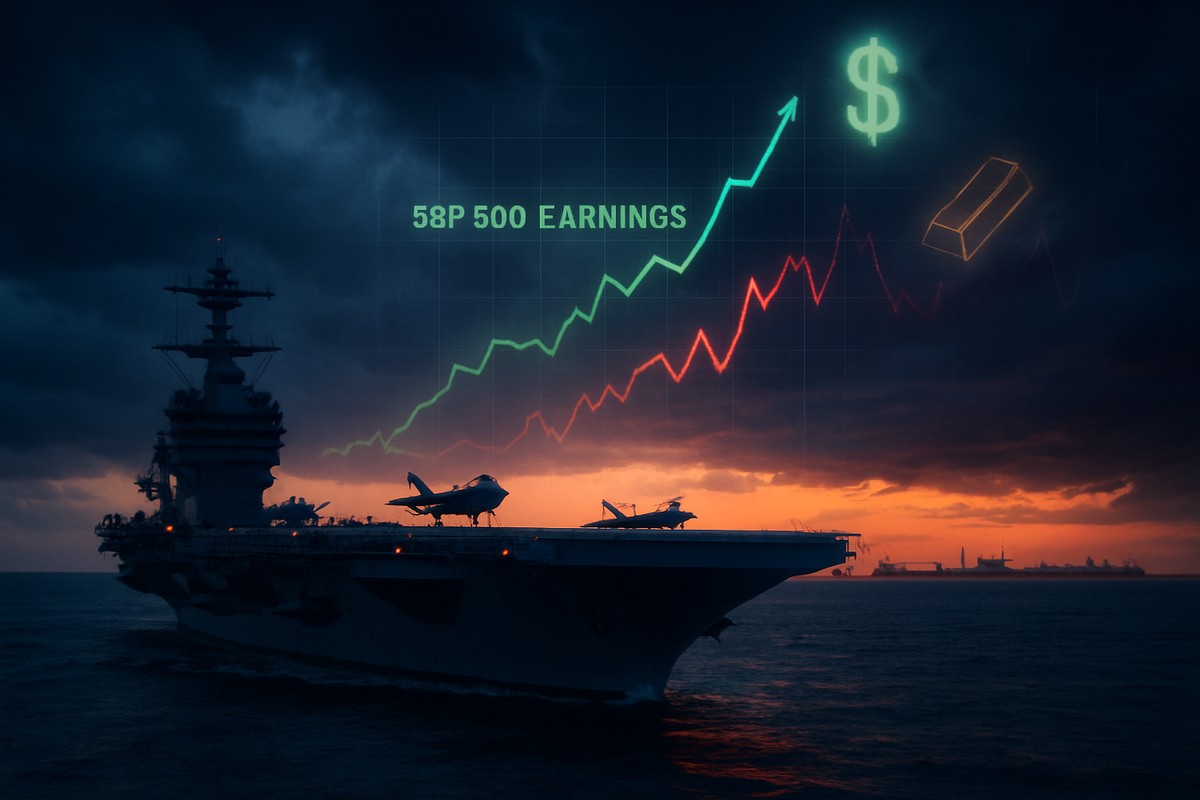
The current crisis traces its roots to a breakdown in indirect negotiations mediated by Oman earlier this year. By February 19, 2026, the diplomatic impasse led the White House to issue a stern ultimatum, demanding the permanent dismantling of Iranian enrichment facilities at Fordow. This was accompanied by the largest US military deployment to the region in decades, featuring two carrier strike groups led by the USS Gerald R. Ford. The presence of advanced fighter wings and refueling tankers in neighboring allied nations has signaled that the administration is prepared to move beyond sanctions if the Geneva talks fail to yield a "meaningful" breakthrough.
Market participants have been glued to every headline emerging from Geneva, where negotiators are reportedly haggling over "sunset clauses." The threat of a kinetic conflict has pushed Brent Crude to a seven-month high, trading as high as $72.88 per barrel. Analysts estimate that a $10 geopolitical risk premium is currently baked into every barrel of oil, reflecting fears that Iran might attempt to close the Strait of Hormuz, a vital artery through which approximately 20% of the world’s oil flows.
The reaction in the equity markets has been a study in volatility. While the CBOE Volatility Index (VIX) has spiked to levels not seen since the previous year's election cycle, the downward pressure on indices has been partially mitigated by the sheer force of corporate profitability. However, the "risk-off" sentiment has hit international markets hard, with the Nikkei 225 and Hang Seng indices seeing sharp declines as the February 27 deadline for a diplomatic resolution nears.
Winners and Losers: Defense, Energy, and the Private Equity Squeeze
In this climate of uncertainty, the defense and energy sectors have emerged as the primary beneficiaries of the heightened tensions. Major defense contractors like Lockheed Martin (NYSE: LMT) and Raytheon Technologies (NYSE: RTX) have seen increased buy-side interest, driven by expectations of prolonged military spending and the potential for a surge in demand for missile defense systems. Similarly, energy giants such as ExxonMobil (NYSE: XOM) and Chevron (NYSE: CVX) have benefited from the upward pressure on crude prices, providing a hedge for many diversified portfolios.
Conversely, the private equity sector has faced unexpected headwinds. Blue Owl Capital (NYSE: OWL) recently sent ripples through the market by halting redemptions in one of its major funds, citing liquidity concerns linked to the broader geopolitical instability. This move has dragged down peers like Blackstone (NYSE: BX) and Apollo Global Management (NYSE: APO), as investors worry about the impact of "higher-for-longer" energy costs and potential credit market disruptions.
Technology and consumer discretionary sectors are also feeling the heat. While companies like NVIDIA (NASDAQ: NVDA) and Microsoft (NASDAQ: MSFT) continue to post stellar results, the rising cost of energy and the strengthening US dollar act as a double-edged sword, potentially crimping international revenue and increasing operational costs. The luxury goods sector, heavily dependent on stability in Asian and European markets, has also seen a noticeable pullback as the "shadow of war" dampens consumer confidence.
Historical Precedents and the "Gray Area" of 2026
The current situation bears a striking resemblance to the 2020 Soleimani crisis and the 2024 regional tensions, yet the scale of the 2026 military buildup is unprecedented. Historically, geopolitical shocks tend to cause sharp, short-term sell-offs followed by rapid recoveries if the conflict remains localized. However, the potential for a full-scale blockade of the Strait of Hormuz represents a "tail risk" that could send oil prices toward $150, a scenario that would almost certainly trigger a global recession.
This event fits into a broader trend of "fiscal dominance," where geopolitical maneuvers dictate market direction as much as central bank policies. The Federal Reserve now finds itself in a difficult position: should it maintain its current stance to combat energy-driven inflation, or pivot to provide liquidity in the face of a geopolitical shock? This uncertainty has led to a "gray area" in market forecasting, where full-year earnings projections for the S&P 500 have been slightly trimmed from 15.5% to 15.1% to account for rising input costs.
Furthermore, the shift toward safe-haven assets has been more pronounced in this cycle. Gold has rallied nearly 18% in the first two months of 2026, reaching near-record levels. Unlike previous crises, gold is being treated not just as a temporary hedge, but as "portfolio insurance" against a fundamental shift in the Middle Eastern order and the potential devaluation of currencies in a high-conflict environment.
The Road Ahead: Scenarios for March 2026
As we move into early March, the market is bracing for two primary scenarios. The first, and most hoped for, is a last-minute "face-saving" deal in Geneva. Such an outcome would likely trigger a massive relief rally, as the $10 oil risk premium evaporates and capital flows back into high-growth tech and consumer stocks. In this scenario, the strong corporate fundamentals of early 2026 could propel the S&P 500 to new record highs as the geopolitical clouds part.
The second scenario is a failure of diplomacy followed by a "limited" military engagement. This would likely involve surgical strikes on Iranian nuclear and military infrastructure. While the initial market reaction would be a sharp drop, the long-term impact would depend on whether the conflict escalates into a maritime war in the Persian Gulf. Investors should be prepared for significant volatility and may need to pivot strategically toward defensive positions, treasury bonds, and liquid cash reserves to weather the potential storm.
Final Assessment: A Market Hostage to Politics
The closing days of February 2026 have proven that even the strongest corporate earnings cannot fully insulate the market from the realities of global politics. The divergence between 14% earnings growth and a 30% probability of war has created a bifurcated market where caution is the watchword. The fundamental health of the US economy remains a pillar of support, but it is a pillar currently being tested by the winds of war.
Moving forward, investors should keep a close eye on the price of Brent crude and the movement of the US dollar as lead indicators of the crisis's severity. The outcome of the Geneva talks will be the single most important factor for market direction in the coming weeks. While the urge to react to every headline is strong, the most successful investors will likely be those who maintain a balanced exposure, recognizing that while headlines create volatility, fundamentals ultimately drive long-term value—provided the global order remains intact.
This content is intended for informational purposes only and is not financial advice.