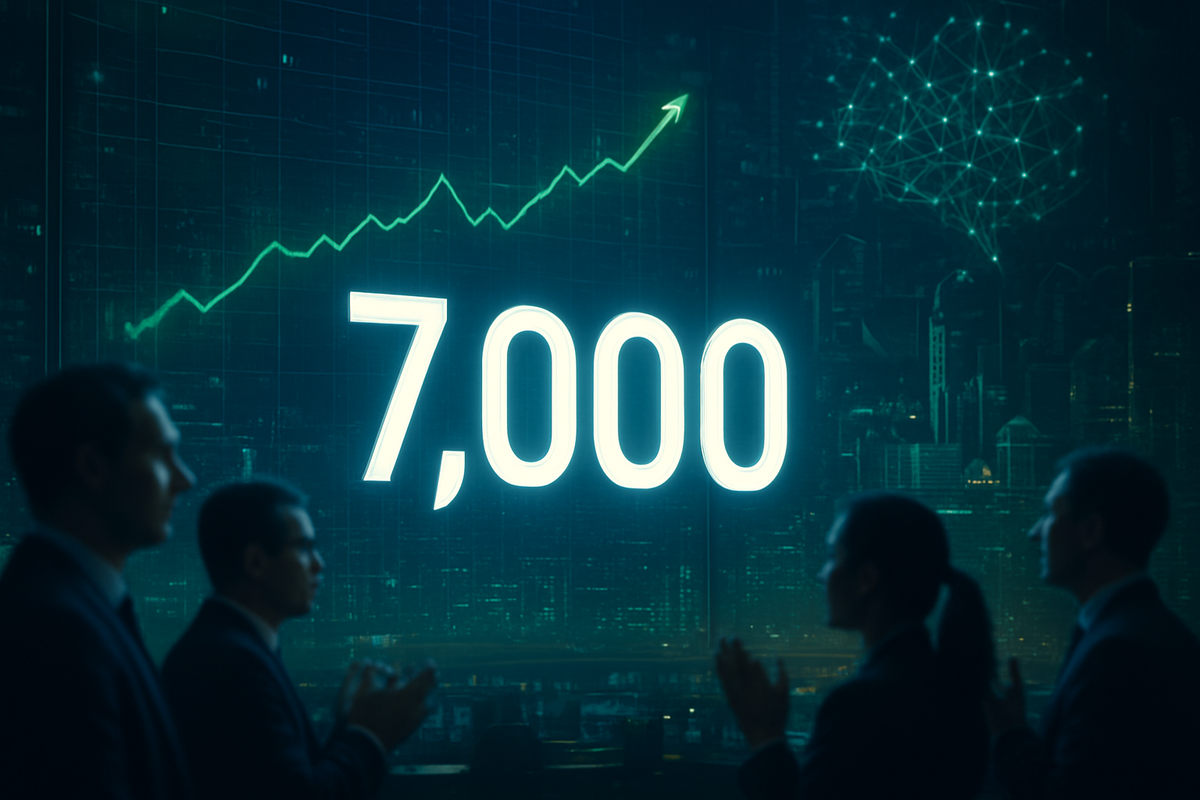
In a defining moment for global financial markets, the S&P 500 Index officially breached the 7,000-point mark for the first time in history on January 28, 2026. This monumental achievement underscores a multi-year bull run that has defied skeptics, survived geopolitical volatility, and transitioned from a narrow, tech-led surge into a broad-based economic expansion. While the index has slightly retreated to approximately 6,908.86 as of late February 2026, the psychological barrier of 7,000 has been shattered, signaling a profound shift in investor expectations and market structure.
The crossing of the 7,000 level represents more than just a numerical achievement; it is a testament to the "AI 2.0" era—the phase where the massive infrastructure investments of 2023 and 2024 finally translated into tangible productivity gains across the broader economy. This breakout occurs against a backdrop of a stabilizing interest rate environment, with the Federal Reserve maintaining a target range of 3.50% to 3.75%, and a resilient U.S. consumer base that has navigated inflationary pressures far better than many economists predicted at the start of the decade.
The Ascent to 7,000: A Timeline of Resilience
The journey to 7,000 was a steady "grind" rather than the explosive "melt-up" seen during the move from 5,000 to 6,000. While the index took only nine months to jump from 5,000 (February 9, 2024) to 6,000 (November 8, 2024), the path to 7,000 required roughly 14 months of sustained growth. This deceleration is viewed by many market technicians as a sign of a maturing and healthy bull market. The final push began in late 2025, buoyed by strong corporate earnings and a "reflation trade" sparked by renewed domestic manufacturing incentives and corporate tax policies.
Key stakeholders in this historic rise include the "Magnificent Seven" leaders, but the narrative has shifted toward the "Great Rotation." Throughout 2025, capital began flowing out of hyper-valued tech giants and into the "other 493" companies. By the time the index hit 7,000 on January 28, 2026, nearly 66% of the S&P 500 constituents were trading above their 200-day moving averages. Initial market reactions to the 7,000 breach were a mix of euphoria and "acrophobia," with retail inflows hitting $2 billion in a single week even as institutional desks moved to hedge against a potential "Gamma Wall" at the 7,020 resistance level.
The Beneficiaries of the New Market Regime
The clear victors in the march to 7,000 have been companies that successfully integrated artificial intelligence into their core operations. Nvidia Corp (NVDA:NASDAQ) remains the undisputed champion of this era, becoming the first company to achieve a $5 trillion market cap in late 2025 as its Blackwell and succeeding chip architectures remained in constant demand. Similarly, Microsoft Corp (MSFT:NASDAQ) and Apple Inc (AAPL:NASDAQ) have solidified their positions in the $4 trillion-plus club, driven by the mass adoption of generative AI in enterprise software and a massive "Apple Intelligence" hardware upgrade cycle.
However, the "Great Rotation" has also elevated stalwarts of the "real economy." JPMorgan Chase & Co. (JPM:NYSE) has benefited immensely from a resurgence in merger and acquisition activity and a favorable interest rate spread. Meanwhile, industrials like Caterpillar Inc. (CAT:NYSE) have seen record highs as domestic reshoring efforts and infrastructure spending reached their peak execution phase. On the healthcare front, Eli Lilly and Co. (LLY:NYSE) continues to be a primary driver of index growth, as its dominance in the metabolic health and GLP-1 market expanded into new therapeutic areas, maintaining its status as a cornerstone of the modern portfolio.
A Watershed Moment in Market History
The S&P 500 at 7,000 marks a significant departure from historical precedents. Unlike the tech bubble of 2000 or the pre-2008 era, this rally is supported by robust cash flows and a fundamental transformation in labor productivity. The "AI 2.0" phase is no longer about the companies selling the shovels (the chipmakers), but about the companies using the shovels to dig out new efficiencies. This shift has mitigated the "concentration risk" that plagued the market in 2024, creating a more balanced and durable index structure.
This milestone also carries heavy regulatory and policy implications. The second Trump administration’s focus on a 10% global tariff and domestic tax cuts has created a "reflationary" environment that favors U.S.-centric large caps. However, these same policies have introduced a new layer of volatility; the recent retreat from the 7,000 peak to the 6,900 range was triggered by a "hotter-than-expected" Producer Price Index (PPI) report and concerns that trade tensions could reignite core inflation. Historically, milestones like 5,000 and 6,000 were followed by periods of consolidation, and 7,000 appears to be following that script as the market digests its gains.
The Road Ahead: 8,000 or a Correction?
As we look toward the remainder of 2026, the primary question for investors is whether 7,000 will become a floor or a ceiling. Short-term technical indicators suggest the index is currently "overextended," with the 200-day moving average trailing nearly 7% below the current price at 6,500. A "healthy" correction to the 6,700–6,800 range could provide the necessary base for the next leg up. Strategically, fund managers are beginning to pivot toward "quality value" and "defensive growth," preparing for a scenario where inflation remains stickier than the Federal Reserve’s 2% target.
The potential for a "melt-up" toward 7,500 remains if corporate earnings for the first half of 2026 continue to surprise to the upside. However, the market must navigate the "milestone trap"—the tendency for retail investors to anchor to round numbers and trigger profit-taking. Scenario planning for the next 12 months involves monitoring the impact of global tariffs on multinational margins and the pace of further Fed rate cuts. If the "Great Rotation" continues, the index could reach 7,500 by early 2027, even if the tech giants begin to see their growth multiples compress.
Navigating the 7,000 Era: Final Thoughts
The S&P 500’s crossing of 7,000 is a historic validation of the American economy's capacity for technological evolution and structural resilience. For investors, the key takeaway is the broadening of the rally; the "Magnificent Seven" are no longer the only game in town, as Financials, Industrials, and Healthcare have re-emerged as vital pillars of index strength. The market is moving away from a speculative, narrative-driven phase and into an execution-driven era where earnings and productivity are the primary currencies.
Moving forward, the market's health will be measured not just by the index level, but by the stability of the "other 493" and the management of inflationary risks. While the psychological allure of 7,000 is significant, the underlying technicals suggest a period of consolidation is both likely and necessary. Investors should watch for the 6,880 support level (the 50-day moving average) and stay attuned to the Fed's commentary on inflation, as these will be the ultimate arbiters of whether 7,000 was a destination or merely a pit stop on the way to even greater heights.
This content is intended for informational purposes only and is not financial advice.