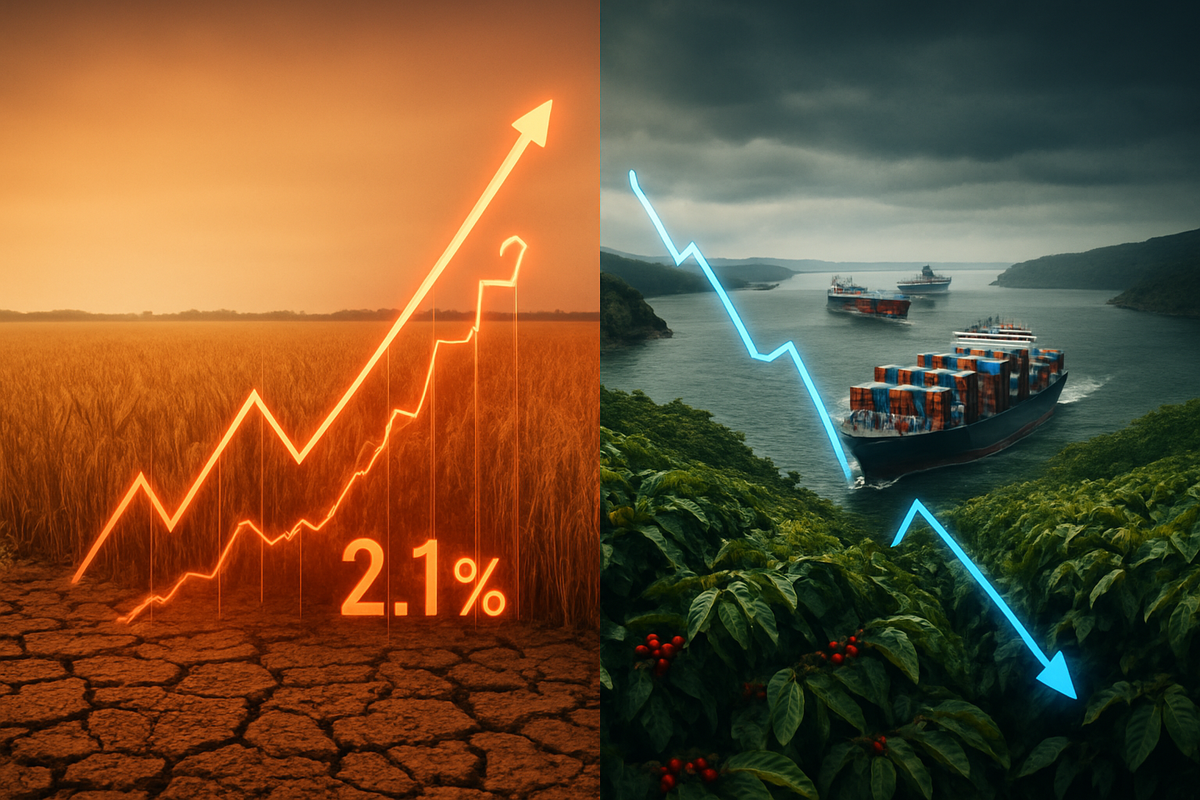
The global battle against inflation faced a significant setback in February 2026, as the World Bank reported a sharp 2.1% increase in its Food Price Index. This unexpected surge marks a definitive end to the relative price stabilization observed throughout much of 2025, signaling renewed pressure on global supply chains and consumer wallets. The uptick was primarily driven by a "perfect storm" of logistical disruptions and extreme weather, threatening to reignite food insecurity concerns in vulnerable regions.
While food costs climbed, a striking divergence emerged in the broader commodities market. The Beverage Price Index experienced a dramatic 15.6% decline over the same period, creating a polarized landscape for the consumer-packaged goods (CPG) industry. This split reflects a complex interplay between recovering harvests in coffee and cocoa and the immediate, sharp shocks hitting staple crops like wheat and vegetable oils. As of March 16, 2026, the market is bracing for a volatile spring as these conflicting trends reshape corporate strategies and national trade policies.
A "Perfect Storm" Hits the Global Breadbasket
The 2.1% rise in February was spearheaded by two specific sectors: vegetable oils and cereals. The Vegetable Oil Index saw a sharp 3.3% increase, fueled by a combination of declining palm oil production in Southeast Asia and an aggressive pivot toward biofuels in North America. Simultaneously, the Cereal Price Index rose 1.1%, with wheat prices jumping 1.8% following a series of severe frost events in the United States and Europe that damaged winter crops. This timeline of escalation began in early February when meteorologists confirmed that La Niña conditions would persist well into 2026, causing prolonged droughts in Argentina and the U.S. Gulf Coast during critical planting windows.
The most acute catalyst for the price spike, however, was the sudden eruption of geopolitical tensions in the Middle East. The launch of "Operation Epic Fury" in late February led to a partial blockade of the Strait of Hormuz, a critical artery for global trade. This blockade crippled the transit of nearly one-third of the world’s seaborne fertilizer components, specifically urea and phosphates. The resulting fertilizer supply shock, compounded by a major industrial explosion at a nitrogen plant in Yazoo City, Mississippi, in early March, has kept input costs for farmers at levels 18% higher than their five-year averages.
Initial market reactions have been swift and defensive. Commodity traders have baked in a "risk premium" for any goods transiting through the Black Sea or the Middle East, while governments in import-dependent nations have begun tapping into strategic grain reserves. The World Bank’s Commodity Markets Outlook suggests that while total agricultural production remains high, the logistical "chokepoints" created by these events are preventing supply from reaching demand centers, creating localized price spikes that aggregate into the 2.1% global increase.
Corporate Resilience and the "Affordability Limit"
The impact of this volatility has been felt unevenly across the corporate landscape. Large-scale agribusiness firms like Archer-Daniels-Midland (NYSE: ADM) and Bunge Global SA (NYSE: BG) have been forced into rapid strategic pivots. Both companies reported a massive diversification of their sourcing operations in late February, shifting focus away from Middle Eastern logistical hubs toward South American and North American corridors to bypass trade disruptions. While these moves protect supply, the increased transportation costs are expected to weigh on margins in the coming quarter.
In the protein sector, the news is particularly grim for Tyson Foods (NYSE: TSN). The company reported a staggering $319 million operating loss in its beef segment for the first quarter of 2026. Tyson is currently grappling with a 75-year low in U.S. cattle herds, a direct consequence of persistent drought conditions that have made grazing unsustainable in many regions. This has led to the idling or permanent closure of processing plants in Nebraska and Texas, further tightening the domestic meat supply and pushing retail prices higher for consumers.
Conversely, beverage and snack giants are facing a different set of challenges. While the decline in coffee and cocoa prices should theoretically help the bottom line of companies like Nestlé S.A. (OTC: NSRGY), The Coca-Cola Company (NYSE: KO), and PepsiCo, Inc. (NASDAQ: PEP), they are hitting what analysts call the "affordability limit." PepsiCo recently acknowledged that it has begun cutting prices on legacy brands like Lay’s and Doritos to regain volume sales after North American food sales dipped by 1%. Coca-Cola has similarly warned of sluggish revenue growth for the remainder of 2026, as consumers who have endured four years of cumulative price hikes are finally pushing back, opting for private-label alternatives or reducing consumption altogether.
Broader Implications and Historical Divergence
The current divergence between food and beverage prices is a rare market phenomenon. Typically, agricultural commodities move in relative tandem, but the "downward correction" in beverages is a result of record coffee harvests in Brazil and a stabilization of cocoa production in West Africa following the supply crises of 2024. This decoupling complicates the task for central banks attempting to measure "core" inflation, as the volatile swings in staples like wheat and oil offset the relief found in luxury commodities like chocolate and caffeine.
Furthermore, this event fits into a broader industry trend of "structural volatility" driven by climate change. The persistence of La Niña into early 2026 is no longer viewed as an anomaly but as a recurring risk factor that necessitates a permanent shift in agricultural infrastructure. We are seeing a move toward "climate-hardy" crop varieties and a massive investment in indoor farming technology, though these are long-term solutions that provide little relief to the immediate price pressures of today.
From a policy perspective, the Strait of Hormuz blockade has renewed calls for "onshoring" fertilizer production. The reliance on the Middle East for essential phosphates has proven to be a strategic vulnerability for Western food security. Governments are now looking at historical precedents, such as the 1970s energy crisis, to formulate new strategies for "Agri-Security," which may include increased subsidies for domestic fertilizer plants and stricter regulations on the export of essential food staples during times of crisis.
The Path Forward: Scenarios and Strategic Shifts
In the short term, the market's eyes remain fixed on the Strait of Hormuz. Should the blockade persist through the second quarter of 2026, the fertilizer shortage will begin to impact the spring planting season in the Northern Hemisphere, potentially leading to a much larger price spike in the autumn harvest. Companies will likely continue to prioritize supply chain "flexing"—the ability to move sourcing locations within weeks rather than months—as a core competitive advantage.
Long-term, the rise of GLP-1 weight-loss medications is emerging as a "wildcard" for the food industry. Both Nestlé and PepsiCo have cited the "GLP-1 effect" as a secondary factor cooling long-term demand for high-calorie snacks and sodas. This shift in consumer behavior could permanently alter the demand curves for sugar and vegetable oils, potentially easing some of the price pressures seen in 2026 but forcing a massive rethink of product portfolios for the world's largest food manufacturers.
Market opportunities may emerge for companies specializing in agricultural technology (AgTech) and alternative proteins. As traditional beef and cereal production face recurring climate and geopolitical headwinds, the value proposition for sustainable, localized food production becomes increasingly attractive to investors. Scenarios for the remainder of the year range from a "soft landing" if trade routes reopen quickly, to a "protracted crisis" if weather patterns continue to deteriorate.
Conclusion: Navigating a Fractured Market
The 2.1% rise in global food prices for February 2026 serves as a stark reminder that the global food system remains highly vulnerable to external shocks. The divergence between rising staples and falling beverage costs highlights a market that is no longer moving in unison, requiring a more nuanced approach from both investors and policymakers. Key takeaways include the critical role of fertilizer supply chains, the ongoing impact of La Niña, and the clear "price fatigue" being exhibited by global consumers.
Moving forward, the market is likely to remain in a state of "defensive positioning." Investors should watch for any resolution in the Middle East and monitor the U.S. Department of Agriculture's (USDA) upcoming planting reports for clues on how the fertilizer shock is affecting farmer intent. The ability of CPG giants to balance their pricing power against declining consumer volumes will be the defining theme of the 2026 earnings season.
Ultimately, the events of February 2026 underscore the fact that food security is now inextricably linked to geopolitical stability and climate resilience. As we move deeper into the year, the lasting impact of this price surge will be measured not just in percentage points, but in the structural changes it forces upon the global agricultural economy.
This content is intended for informational purposes only and is not financial advice