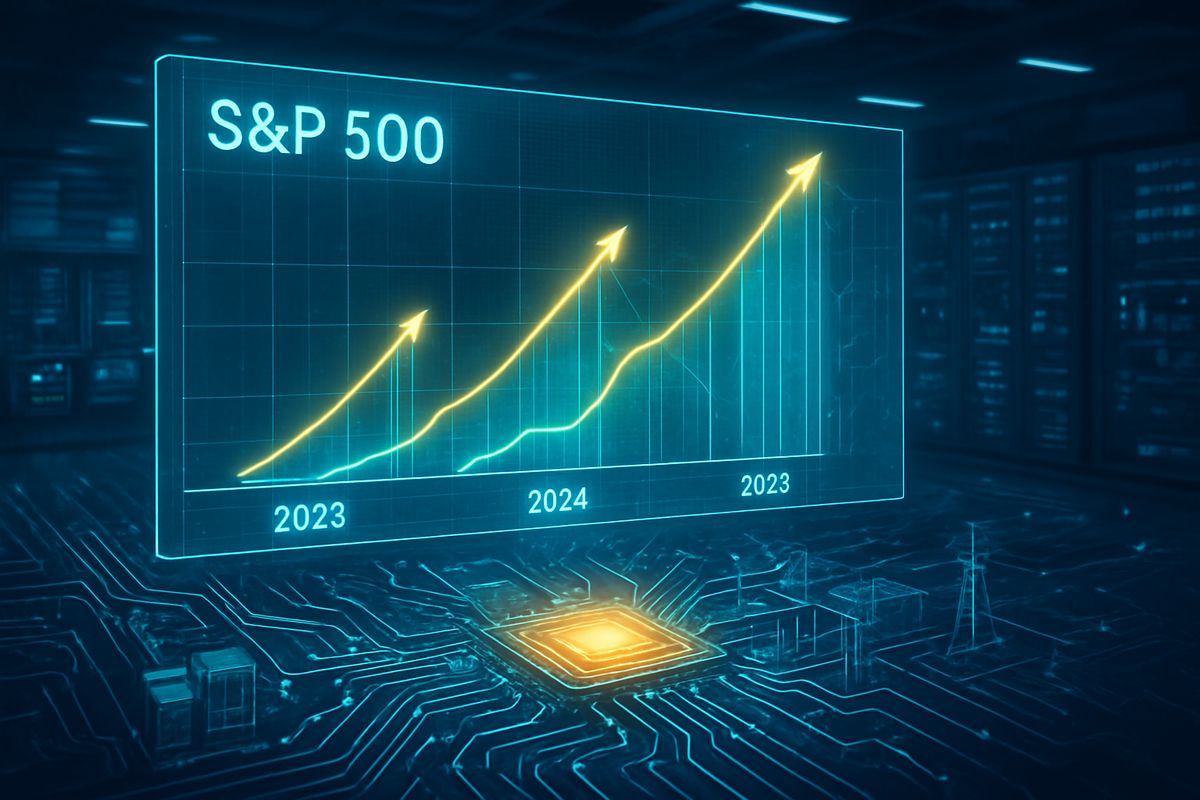
As of March 25, 2026, the S&P 500 stands at a critical crossroads. After a historic three-year run that saw the benchmark index post double-digit gains in 2023, 2024, and a robust 17.9% in 2025, investors are left wondering if the "AI Supercycle" has finally run out of steam. For the first time in years, the market has opened the calendar year on its back foot, with the index currently down approximately 4.1% year-to-date as it grapples with a cocktail of "sticky" inflation, geopolitical tensions in the Middle East, and the lingering effects of a brief government shutdown in February.
The immediate implications of this cooling period are profound. For a generation of traders who have known little but green screens and "buying the dip," the current volatility represents a significant reality check. While the 17.9% return in 2025 was fueled by the broadening of the artificial intelligence trade into physical infrastructure and energy, the first quarter of 2026 has been defined by a "flight to quality" and a re-evaluation of aggressive valuation multiples that many analysts now deem overextended.
The Triple Crown: How 2023–2025 Redefined Modern Markets
The journey to this moment began in the ashes of 2022’s bear market. In 2023, the S&P 500 defied recession predictions to gain roughly 24%, driven by the emergence of generative AI and the dominance of the "Magnificent Seven," led by NVIDIA (Nasdaq: NVDA) and Microsoft (Nasdaq: MSFT). This momentum accelerated in 2024, as the Federal Reserve began a long-awaited easing cycle, cutting rates in September 2024 and helping the index to another 25% gain. By the time 2025 arrived, the narrative had shifted from "if" AI would work to "how fast" it could be deployed, resulting in the 17.9% return that completed a rare three-year "triple crown" of double-digit performance.
Key stakeholders throughout this run have been the mega-cap tech giants and the institutional funds that rode their coattails. However, by late 2025, signs of fatigue began to emerge. The Fed’s cautious stance on inflation—which lingered near 2.5% throughout 2025—prevented the aggressive rate cuts that some bulls had anticipated. This caution has followed the market into 2026, where a PCE inflation reading of 2.8% in early March sent shockwaves through the bond market, putting a ceiling on equity valuations for the current quarter.
Infrastructure vs. Innovation: The Shifting Leaderboard in 2026
The market leadership in early 2026 looks vastly different than the software-dominated rally of 2023. The "winners" of this year are the companies providing the literal "bricks and mortar" of the AI era. Following its strategic split in February 2025, SanDisk (Nasdaq: SNDK) has emerged as a star performer, surging over 160% in early 2026 due to a global shortage of NAND flash memory. Its former parent, Western Digital (Nasdaq: WDC), has also remained a key player as a pure-play hard disk drive (HDD) company catering to massive data center expansions.
Other surprising victors include Texas Pacific Land (NYSE: TPL), which has seen its stock rise more than 75% this year as it leverages its massive Permian Basin acreage to provide land and water services for power-hungry AI data centers. Similarly, Corning Inc. (NYSE: GLW) has benefited from the insatiable demand for optical fiber. On the losing side, high-valuation software-as-a-service (SaaS) companies and consumer discretionary firms have struggled, as the "higher-for-longer" interest rate environment eats into their margins and dampens consumer spending.
Historical Echoes: Chasing the Ghosts of the 1990s
To find a precedent for the current market, historians point to the late 1990s. Between 1995 and 1999, the S&P 500 achieved an unprecedented five consecutive years of returns exceeding 20%. Much like the current AI-driven era, that period was sparked by a fundamental technological shift—the commercialization of the Internet. However, that streak ended in the spectacular "dot-com bubble" burst of 2000. Today's analysts are debating whether 2026 will be the "1999" of this cycle—the final, euphoric gasp—or if the market can find a sustainable "soft landing" that allows for a fourth year of double-digit gains.
The wider significance of this run extends to global policy. The U.S. government’s focus on "onshoring" chip manufacturing and securing energy independence has created a policy-driven tailwind for domestic industrials. However, this has come at the cost of renewed trade tensions and tariffs that contributed to the volatility seen in the first quarter of 2026. If the S&P 500 is to recover from its current 4% deficit and reach a 10%+ return for the year, it will require a delicate balance of cooling inflation and sustained corporate earnings growth, which is currently projected at a healthy 14% for the full year.
The Path to 8,100: Why Wall Street Isn’t Panicking Yet
Despite the rocky start to 2026, major financial institutions remain surprisingly bullish. Analysts at Oppenheimer & Co. (NYSE: OPY) have maintained an aggressive price target of 8,100 for the S&P 500, implying nearly 18% upside from current levels. The consensus among the "smart money" is that the first quarter’s slump is a necessary consolidation—a "breather" before the second-half recovery. The primary catalyst for this expected pivot is the anticipated transition of the Federal Reserve toward "accommodating balance sheet growth" to support the massive capital expenditure (capex) needs of the AI industry.
Short-term challenges remain, including the potential for further geopolitical disruptions in the Middle East and the fallout from the February government shutdown. However, the long-term potential of AI to drive productivity remains the central pillar of the bull case. If corporate earnings can meet the 14% growth targets, the index could easily erase its Q1 losses. The "scenarios for success" involve a stabilizing energy market and a gradual decline in the PCE inflation index toward the Fed's 2% target by autumn.
Conclusion: Watching the Wall of Worry
The S&P 500’s journey from 2023 to 3/25/2026 has been nothing short of legendary. While the 17.9% return in 2025 cemented the market's strength, the current year is proving that the "wall of worry" is higher than ever. Investors should take away two key points: first, the AI trade has matured from speculative software to essential hardware and infrastructure; and second, the path to a fourth consecutive double-digit year is narrow but still open.
Moving forward, the market will likely be sensitive to every inflation print and Fed commentary. Investors should keep a close eye on "picks and shovels" plays like Generac Holdings (NYSE: GNRC) for energy reliability and Moderna (Nasdaq: MRNA), which has shown that the AI revolution is finally yielding results in the biotech sector. Whether 2026 ends in the green or the red, the structural changes made to the economy during this historic run will likely have a lasting impact for decades to come.
This content is intended for informational purposes only and is not financial advice.