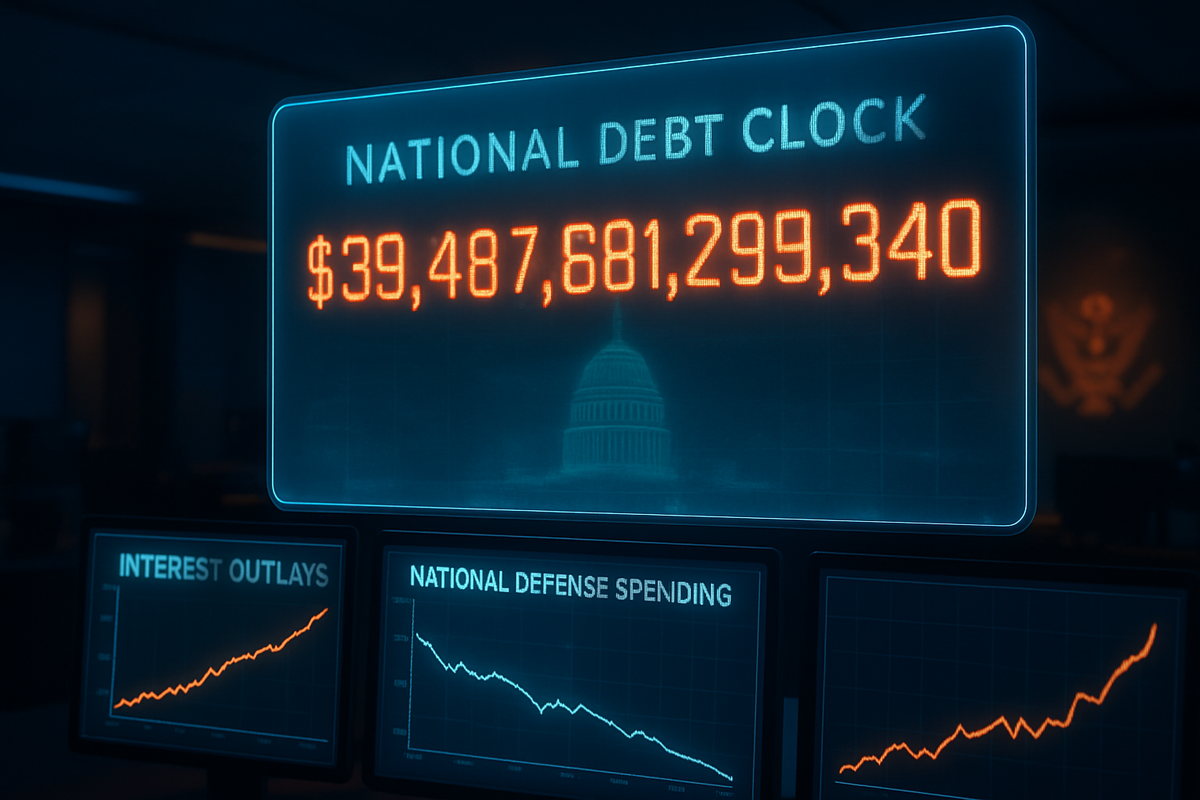
The United States has entered a precarious new chapter in its fiscal history. On March 17, 2026, the gross national debt officially surged past the $39 trillion mark, a milestone reached just five months after crossing $38 trillion. This rapid acceleration—averaging roughly $7.2 billion in new debt every day—comes at a time when the federal government is grappling with a "fiscal straitjacket" of its own making: the convergence of permanent tax cuts, a sudden revenue shortfall from judicial rulings, and interest payments that have finally breached the $1 trillion annual threshold.
The immediate implications for the market are becoming starkly visible in the Treasury pits. As the Congressional Budget Office (CBO) revises its 2026 deficit projections upward toward $2.1 trillion, investors are beginning to question the infinite elasticity of demand for U.S. sovereign debt. A series of "tepid" Treasury auctions in late March has sent the 10-year yield climbing toward 4.2%, signaling that the "term premium"—the extra compensation investors demand for holding long-term debt—is returning with a vengeance, threatening to dampen equity valuations and tighten credit conditions across the economy.
The Perfect Fiscal Storm: From OBBBA to the Supreme Court
The current crisis is the result of a legislative and judicial collision that few predicted would hit with such force in early 2026. The foundation was laid on July 4, 2025, when the "One Big Beautiful Bill Act" (OBBBA) was signed into law. This landmark legislation made permanent the individual income tax brackets and high estate tax exemptions from the 2017 Tax Cuts and Jobs Act, while adding new popular but expensive provisions, such as "No Tax on Tips" and "No Tax on Overtime." While these measures were aimed at stimulating labor participation, the CBO estimates they added a staggering $4.7 trillion to the 10-year cumulative deficit.
The fiscal math became even more complicated on February 20, 2026, when the Supreme Court ruled in Learning Resources Inc. v. Trump that the administration’s use of broad reciprocal tariffs was unconstitutional under the International Emergency Economic Powers Act. This ruling effectively erased approximately $1.6 trillion in projected revenue that the White House had intended to use as a "pay-for" for the OBBBA tax cuts. Now, the Treasury Department (NYSE: T) faces the daunting prospect of refunding up to $175 billion in tariffs collected during 2025, further bloating a deficit that is already 5.8% of the national GDP.
Stakeholders, from primary dealers to institutional pension funds, have reacted with visible anxiety. For the first time in the modern era, net interest outlays in fiscal year 2026 are projected to hit $1.05 trillion, surpassing the entire national defense budget. This "crowding out" effect means that nearly one out of every five tax dollars collected is now diverted toward servicing past debt rather than funding current infrastructure, research, or social programs. The initial market reaction has been a "bear steepening" of the yield curve, as investors sell off long-dated bonds in anticipation of a flood of new Treasury supply.
Winners and Losers in a High-Debt Environment
The financial sector finds itself in a complicated position. Large-cap banks like JPMorgan Chase & Co. (NYSE: JPM) and Bank of America Corp. (NYSE: BAC) initially benefited from the higher interest rate environment, which bolstered their net interest margins. However, the current volatility in the Treasury market and the threat of a "debt spiral" create systemic risks. If the 10-year yield continues to spike due to fiscal concerns rather than economic growth, the resulting increase in borrowing costs for mortgages and corporate loans could stifle credit demand, turning a tailwind into a headwind for these banking giants.
In the bond market, the iShares 20+ Year Treasury Bond ETF (NASDAQ: TLT) has become a barometer for fiscal fear. As long-term yields rise, the price of these bonds has plummeted, punishing conservative "60/40" portfolios that rely on Treasuries as a safe haven. Conversely, the "debasement trade" has seen a resurgence. SPDR Gold Shares (NYSEARCA: GLD) has seen significant inflows as investors seek assets that cannot be devalued by government printing presses or fiscal mismanagement.
The defense sector, long considered a bastion of safe government spending, is also facing a "fiscal ceiling." While contractors like Lockheed Martin Corp. (NYSE: LMT) and General Dynamics Corp. (NYSE: GD) continue to see robust orders, the fact that interest payments now exceed the total defense budget creates a political environment where future spending hikes may be cannibalized by debt service. For the first time in decades, defense lobbyists are competing directly with the "invisible hand" of the bond market for federal priorities.
A Historical Pivot: The End of "Infinite Demand"
The current situation marks a significant departure from the "Modern Monetary Theory" (MMT) optimism that dominated the early 2020s. For years, the prevailing wisdom was that as long as the U.S. controlled its own currency, deficits didn't matter. However, the 2026 reality of a 125% debt-to-GDP ratio—the highest since the aftermath of World War II—suggests that there are indeed limits to the market’s appetite for sovereign debt. Unlike the post-WWII era, when the U.S. was entering a period of massive demographic and industrial expansion, 2026 finds the nation facing an aging population and slowing productivity growth.
This event fits into a broader global trend of "fiscal fatigue," where investors are increasingly scrutinizing the balance sheets of G7 nations. The ripple effects are already being felt among U.S. trading partners and competitors. If the U.S. is forced to offer higher and higher yields to attract buyers for its $39 trillion debt, it could trigger a global "liquidity vacuum," pulling capital out of emerging markets and into the U.S. Treasury market, further destabilizing the international financial system.
Historically, periods of extreme debt-to-GDP ratios have been resolved in one of three ways: significant tax increases, drastic spending cuts, or "financial repression" (keeping interest rates below inflation to inflate the debt away). With the OBBBA making tax cuts permanent and entitlement spending proving politically untouchable, the market is beginning to price in the third option—sustained higher inflation—as the most likely path forward.
What Comes Next: The 2026 Midterm Crucible
In the short term, all eyes are on the upcoming Treasury refunding announcements. If the Treasury Department continues to increase auction sizes for the 10-year and 30-year bonds to cover the revenue hole left by the Supreme Court’s tariff ruling, we could see a "VaR shock"—a sudden, violent move in yields that forces institutional investors to liquidate positions. Market participants should brace for heightened volatility in the Cboe Volatility Index (INDEXCBOE: VIX) as the summer of 2026 approaches.
Long-term, a strategic pivot toward "fiscal sanity" appears unlikely before the 2026 midterm elections. Both parties are currently incentivized to continue "pre-election spending" to court voters, even as the fiscal house catches fire. A potential scenario involves a "Market-Mandated Austerity" event, similar to the 1990s bond vigilantes or the 2022 UK "mini-budget" crisis, where the market refuses to fund the government at reasonable rates, forcing an emergency legislative pivot toward deficit reduction.
Summary for the Cautious Investor
The milestone of $39 trillion in national debt is more than just a psychological barrier; it is a signal that the cost of government is becoming a primary driver of market volatility. The transition of interest payments into the trillion-dollar category represents a permanent shift in federal budget dynamics, where debt service is no longer a footnote but the main event.
Moving forward, the market will likely be defined by a "Fiscal Premium." Investors should expect higher baseline interest rates and a more sensitive Treasury market. The key takeaways for the coming months are to monitor Treasury auction "bid-to-cover" ratios and to watch for any legislative attempts to fill the $1.6 trillion tariff revenue gap. For the long-term investor, the message is clear: the era of "cheap debt" is over, and the era of "fiscal consequences" has officially begun.
This content is intended for informational purposes only and is not financial advice.