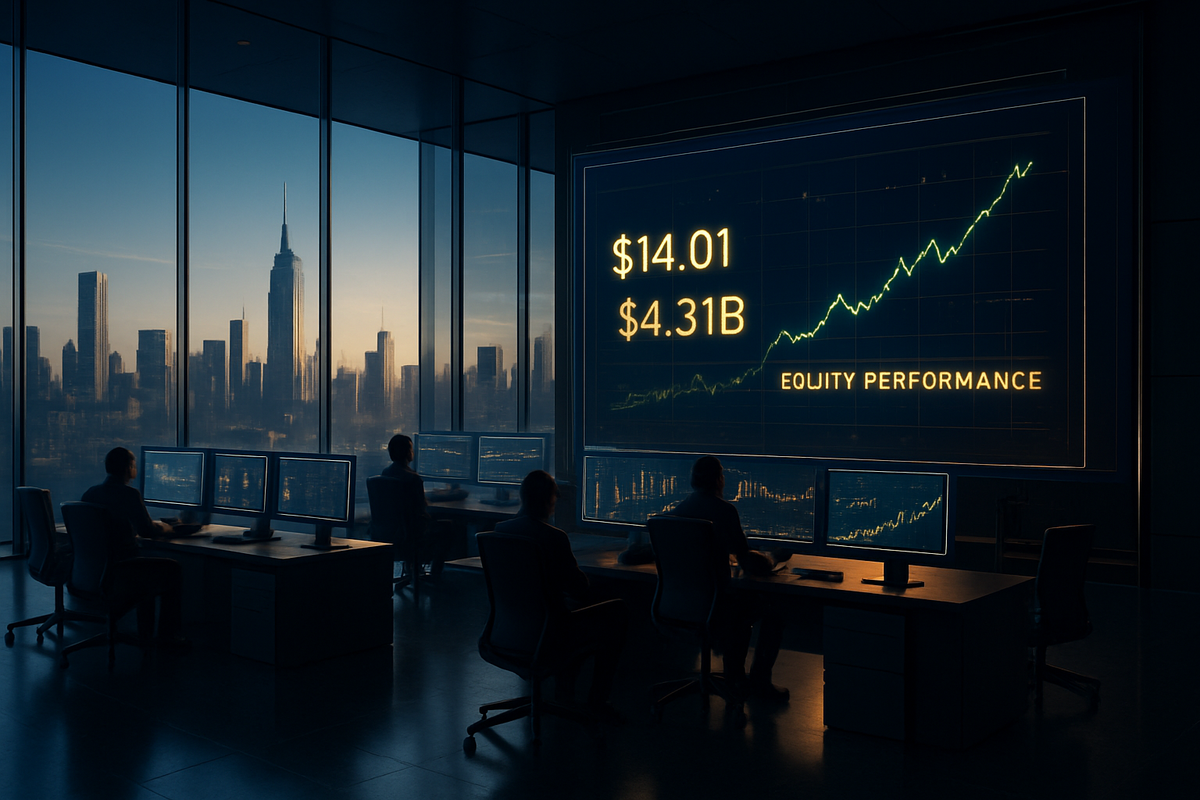
On January 15, 2026, the Goldman Sachs Group Inc. (NYSE: GS) delivered a financial performance that has fundamentally reshaped the narrative of Wall Street’s post-pandemic "renaissance." Reporting a staggering diluted earnings per share (EPS) of $14.01 for the fourth quarter of 2025, the firm decimated analyst expectations of $11.70. This 17% year-over-year surge was largely propelled by a record-breaking $4.31 billion in equity trading revenue—the highest single-quarter performance for any bank in history—solidifying Goldman’s successful pivot back to its institutional roots.
As of late March 2026, the implications of these results are still rippling through the markets. While the initial rally saw shares jump 4.6% on the day of the announcement, the firm’s strategic decision to increase its quarterly dividend by 12.5% to $4.50 per share has provided a robust floor for the stock. Even as broader markets face turbulence from geopolitical shocks in the Middle East, Goldman’s trading-heavy model is proving to be a formidable hedge against global volatility.
A Decisive Return to Wall Street Dominance
The Q4 2025 results represent the culmination of a multi-year strategic overhaul led by CEO David Solomon. After several quarters of grappling with the unwinding of its consumer banking ambitions, Goldman effectively cleared the decks in late 2025. A primary driver of the massive EPS beat was the finalized transition of the Apple Card portfolio to JPMorgan Chase & Co. (NYSE: JPM). This move allowed Goldman to release approximately $2.48 billion in loan loss reserves, which contributed roughly 46 cents to the quarterly EPS and signaled the definitive end of its retail lending era.
The highlight of the report, however, was the $4.31 billion generated by the equities trading desk. Fueled by surging client demand for derivatives and prime financing amid high market volatility, the division grew 25% year-over-year. Institutional clients, reacting to the shifting interest rate environment and a flurry of late-year corporate activity, turned to Goldman for liquidity and risk management at a scale never before seen in the banking sector. Total quarterly revenue reached $13.45 billion, and while this was a slight 3% dip from the previous year due to strategic divestments, the quality of earnings was vastly improved.
The timeline leading to this blockbuster quarter was marked by a steady "flight to quality." Throughout 2025, Goldman systematically divested its "Platform Solutions" segments, focusing instead on its core strengths in Global Banking & Markets. By the time the January 15 announcement hit the wires, investors were already optimistic about a "M&A super-cycle" beginning in 2026. The market reaction was immediate: institutional risk-taking surged, and Goldman’s stock became the clear bellwether for a new era of high-margin investment banking.
Winners and Losers in the Wake of the Surge
The primary winner of this financial feat is undoubtedly Goldman Sachs, which has successfully re-established itself as the dominant force in high-stakes trading. However, the ripple effects extend to its peers. Morgan Stanley (NYSE: MS) has faced increased pressure to match Goldman's trading performance, as its own focus on wealth management—while stable—lacked the explosive upside seen in GS's Q4 results. Meanwhile, JPMorgan Chase & Co. (NYSE: JPM) stands as a secondary winner; by taking over the Apple Card portfolio, it secured a premium credit asset, though the transition costs and associated risks have kept its immediate stock gains more muted than Goldman's.
In the broader market, the "losers" are increasingly found in sectors struggling with the capital-intensive nature of the current economy. The transition of reserves out of Goldman highlights the growing credit risk in the consumer sector, which has hit regional banks and low-cost airlines particularly hard. As of March 25, 2026, the energy crisis triggered by tensions in the Strait of Hormuz has sent Brent crude toward $100 per barrel, punishing fuel-sensitive stocks like United Airlines Holdings Inc. (NASDAQ: UAL) and Delta Air Lines Inc. (NYSE: DAL). These companies find themselves on the opposite end of the volatility spectrum that Goldman is currently profiting from.
Conversely, the same volatility that fueled Goldman’s trading record is now benefiting the energy titans. ExxonMobil Corp. (NYSE: XOM) and Chevron Corp. (NYSE: CVX) have emerged as 2026's top performers, with shares up over 30% year-to-date. Goldman’s commodity trading desks are reportedly seeing "off-the-charts" volume as these energy majors and their global clients rush to hedge against the $126-per-barrel oil spikes seen earlier this month.
Industry Shifts and the Return of the "Vol" Desk
Goldman’s performance fits into a broader industry trend of "specialization over diversification." For years, Wall Street giants attempted to become financial supermarkets for everyone from billionaires to suburban credit card users. Goldman's Q4 2025 results prove that, in an era of high volatility and rapid technological change, specialized institutional expertise is often more profitable. This shift is likely to lead to further consolidation in the banking sector, as smaller firms struggle to compete with the massive technological and capital scale required to run a $4 billion-a-quarter trading operation.
The regulatory landscape has also played a pivotal role. The "capital-neutral" framework for Basel III requirements, which became clearer in early 2026, provided major banks with the confidence to deploy capital more aggressively. This regulatory relief, combined with Goldman’s earnings beat, has set a historical precedent similar to the post-2008 recovery, where the largest "too big to fail" institutions emerged with even greater market share in liquidity provision.
Furthermore, the "M&A super-cycle" that CEO David Solomon predicted is beginning to materialize. With the IPO pipeline for 2026 reaching levels not seen since 2021, Goldman is positioned to capture massive advisory fees from rumored listings of AI and aerospace giants. This institutional shift is forcing competitors to reconsider their own retail-heavy strategies, as the "Wall Street" model once again proves its earnings power during times of global uncertainty.
The Road Ahead: Geopolitics and Volatility
Looking forward, the remainder of 2026 presents both a massive opportunity and a potential minefield for Goldman Sachs. In the short term, the ongoing conflict with Iran and the resulting energy price shocks will keep trading volumes elevated. As long as market volatility remains high, Goldman's trading desks will likely continue to outperform. However, the "higher-for-longer" interest rate stance adopted by the Federal Reserve to combat energy-driven inflation could eventually dampen the M&A and IPO activity the firm is counting on for long-term growth.
A significant strategic pivot may be required if the oil crisis leads to a broader global recession. While Goldman profits from the trading of volatility, a sustained economic downturn would hurt its advisory and asset management arms. The firm must now balance its aggressive trading posture with a cautious eye on credit quality in its remaining corporate loan books. If oil stays above $100 and consumer spending craters, the "K-shaped" recovery of early 2026 could turn into a more synchronized global slowdown.
Summary and Investor Outlook
Goldman Sachs' Q4 2025 report was a landmark event that signaled the return of the "King of Wall Street." With a $14.01 EPS beat and a record $4.31 billion in equity trading, the firm has proven that its pivot back to institutional banking was the right move at the right time. For investors, the key takeaways are clear: Goldman has the best-in-class trading infrastructure to monetize market chaos, and its dividend increase signals a new era of capital return.
Moving forward, the market will be watching the Federal Reserve’s reaction to the March 2026 inflation spike and the stability of the Strait of Hormuz. Investors should keep a close eye on Goldman’s "backlog" of investment banking deals; if the IPOs of major tech unicorns proceed despite the energy crisis, Goldman is likely to see another record-breaking year. However, if geopolitical tensions escalate into a wider conflict, even the most robust trading desks may find it difficult to outrun a global contraction.
This content is intended for informational purposes only and is not financial advice.