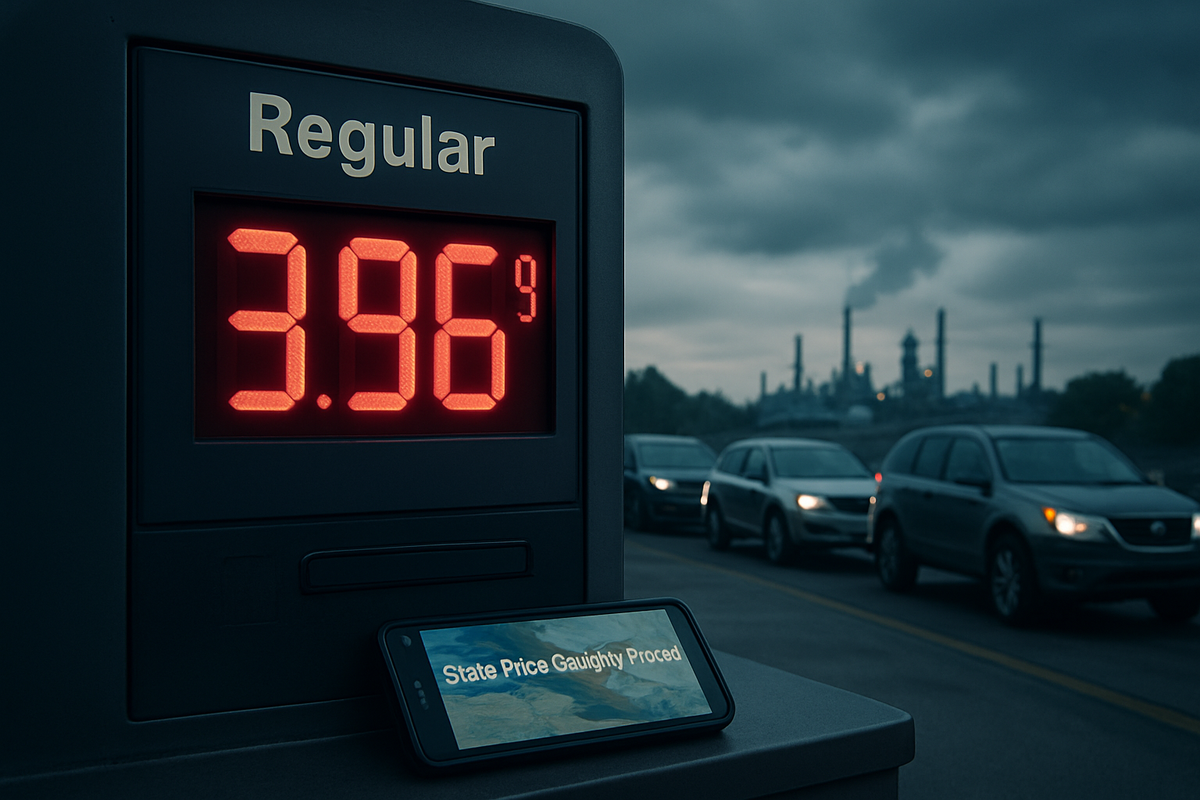
As of March 30, 2026, the American consumer is facing a staggering reality at the service station. The national average for regular unleaded gasoline has climbed to a historic high of $3.96 per gallon, a level that has sent shockwaves through the domestic economy and reignited fierce debates over energy independence and corporate responsibility. This rapid escalation, representing a nearly $1.00 increase in less than a month, has immediate implications for household budgets, inflation metrics, and the upcoming political cycle, as the cost of commuting becomes a primary concern for millions of families.
The surge has not been uniform across the country, however, leading to a fragmented and volatile market. While the $3.96 figure serves as the national benchmark, Western states are seeing far more aggressive pricing, with California recording averages well above $5.80 per gallon. This disparity has triggered a wave of public outcry and prompted state-level regulators to launch aggressive investigations into potential price gouging, as the gap between crude oil costs and retail pump prices widens to levels that many officials describe as "unconscionable."
The Path to $3.96: Geopolitics and Supply Disruptions
The current crisis traces its origins back to late February 2026, when escalating geopolitical tensions culminated in the effective closure of the Strait of Hormuz on February 28. This critical maritime corridor, through which roughly 20% of the world’s petroleum liquid consumption passes, became a flashpoint in a military conflict involving the U.S., Israel, and Iran. The resulting supply disruption—the largest in modern history—sent Brent Crude prices screaming past the $110 per barrel mark, a jump of nearly 60% in a thirty-day window.
As the conflict intensified throughout March, the domestic refining industry struggled to adapt. Key players like Exxon Mobil (NYSE: XOM) and Chevron (NYSE: CVX) have navigated a landscape of skyrocketing input costs and shipping redirected around the Cape of Good Hope. By mid-March, the national average for regular gasoline hit the $3.96 milestone, fueled not just by the crude rally, but by a "perfect storm" of seasonal refinery maintenance and the transition to more expensive summer-blend fuels. Market participants and industry analysts initially reacted with alarm, as the rapid pace of the price hike outstripped even the most pessimistic forecasts from the beginning of the year.
The response from the public sector has been swift. In California, the Division of Petroleum Market Oversight (DPMO) issued an emergency enforcement bulletin on March 19, following reports of "outlier" retail stations in Los Angeles and San Bernardino charging as much as $9.00 per gallon. The DPMO, established under California’s landmark SB X1-2 transparency law, is currently utilizing its subpoena powers to investigate whether these spikes are justified by market fundamentals or represent opportunistic profit-taking during a national emergency.
Market Winners and Losers in an Energy Crisis
In the equity markets, the reaction to $3.96 gasoline has been sharply bifurcated. The primary beneficiaries have been the integrated oil majors. Exxon Mobil (NYSE: XOM) is projected to report an incremental Q1 2026 profit of approximately $4.5 billion due to the surge in upstream realizations. Similarly, Chevron (NYSE: CVX) has seen its stock price bolstered as investors bet on continued high margins for its domestic production assets. However, these companies are walking a fine line, as record profits in the face of consumer suffering often invite legislative backlash and windfall profit taxes.
Conversely, the refining sector is facing a more complex "margin squeeze." While high pump prices generally benefit refiners, those heavily dependent on imported crude, such as Valero Energy (NYSE: VLO) and PBF Energy (NYSE: PBF), are grappling with the soaring costs of securing non-Middle Eastern oil. Phillips 66 (NYSE: PSX) has also faced scrutiny following its decision to close its Los Angeles refinery late last year, a move that critics argue has reduced the regional supply cushion and exacerbated the current price spikes in California.
The automotive sector is also seeing a dramatic shift. While pure electric vehicle sales from manufacturers like Tesla (NASDAQ: TSLA) had previously cooled in late 2025 due to the expiration of federal tax credits, the March gas spike has reignited consumer interest. Used EV prices are approaching parity with internal combustion engines for the first time. Meanwhile, traditional automakers like Ford (NYSE: F) and Toyota Motor Corp (NYSE: TM) are seeing a massive boom in hybrid vehicle demand. Toyota, in particular, has seen hybrid volumes rise 57% year-over-year, as consumers seek immediate relief from gas costs without the "charging anxiety" associated with a rapid transition to full electrification.
Regulatory Scrutiny and the California "Penalty" Debate
The broader significance of this event lies in the stress test it provides for California’s regulatory framework. The state’s SB X1-2 law was designed specifically to prevent the kind of price spikes seen this March. However, a controversial October 2025 vote by the California Energy Commission (CEC) to pause the "refinery profit-cap penalty" until 2029 has left the state’s watchdog with diminished teeth. The CEC argued at the time that the pause was necessary to keep refiners from fleeing the state entirely, but with prices now hitting historic levels, consumer advocacy groups are demanding the penalty be reactivated immediately.
This event also highlights a shifting trend in energy policy. The $3.96 national average is being viewed as a "tipping point" that may force the federal government to reconsider its strategic reserves and energy security posture. The ripple effects extend to the logistics and transport sectors, where companies like United Parcel Service (NYSE: UPS) and FedEx (NYSE: FDX) are already adjusting their fuel surcharges, which will inevitably lead to higher costs for consumer goods and further inflationary pressure across the broader economy.
Historically, gasoline prices of this magnitude have led to "demand destruction," where consumers significantly alter their behavior to avoid driving. In 2026, however, the lack of widespread public transit alternatives in many U.S. regions means the primary effect is a direct reduction in discretionary spending. This creates a challenging environment for the Federal Reserve, which must now balance the inflationary impact of energy costs against the cooling effect that high gas prices have on retail and hospitality sectors.
What Comes Next: Strategic Pivots and Scenarios
In the short term, the market is bracing for a potential release from the Strategic Petroleum Reserve (SPR) to stabilize prices, though experts warn that such a move may only provide temporary relief if the Strait of Hormuz remains closed. We are likely to see a "strategic pivot" from major logistics firms and airlines like Delta Air Lines (NYSE: DAL) as they accelerate their transition to sustainable aviation fuels and electric delivery fleets to hedge against future fossil fuel volatility.
Longer-term, this crisis may serve as the ultimate catalyst for the "Hybrid Era." If prices remain near the $4.00 mark through the summer travel season, the shift away from pure internal combustion engines could become permanent. Investors should watch for a surge in capital expenditures toward domestic energy infrastructure—not just in oil and gas, but in the electrical grid and hydrogen fuel cell development—as "energy sovereignty" becomes the new corporate and national priority.
Potential scenarios range from a diplomatic resolution in the Middle East, which could see prices retreat as quickly as they rose, to a protracted conflict that keeps the national average above $4.00 for the remainder of the year. The latter would almost certainly trigger a wave of new state-level price-gouging legislation and could potentially lead to the first federal "Gasoline Price Transparency Act."
Final Takeaways for the Road Ahead
The jump to a $3.96 national average is more than just a number on a sign; it is a signal of a world still deeply vulnerable to geopolitical shocks. The key takeaway for investors and the public is that the energy transition is not a linear path, and volatility is likely to be the "new normal" for the remainder of the decade. The investigation in California will be a bellwether for how much control the state can truly exert over global commodity markets, and its outcome will have lasting implications for the relationship between the energy industry and regulators.
Moving forward, the market will be closely watching weekly inventory reports and the rhetoric coming out of the DPMO in California. If regulatory bodies successfully prove price gouging, it could lead to significant fines and structural changes for how refiners operate in high-cost states. For now, the focus remains on the consumer, whose resilience is being tested by the most expensive spring in recent memory.
As we move into the second quarter of 2026, investors should keep a sharp eye on the intersection of geopolitics and energy policy. The winners will be those companies that can offer consumers a way out of the "petroleum trap," while the traditional oil and gas giants must find a way to justify their record earnings in a climate of increasing public and regulatory scrutiny.
This content is intended for informational purposes only and is not financial advice