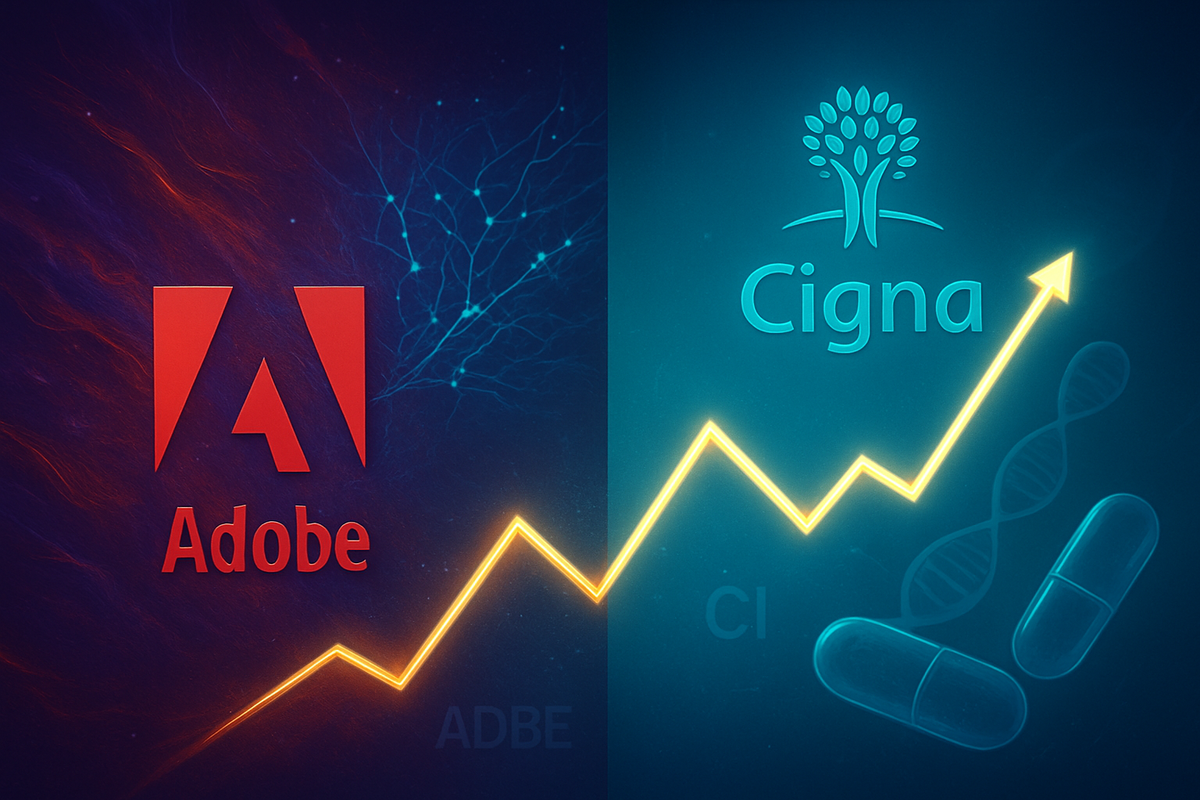
As of March 30, 2026, a peculiar divergence has emerged in the equity markets, where two of the most consistent cash-flow generators in the S&P 500 are trading at valuations reminiscent of a deep recession. Despite posting record earnings and successfully pivoting their business models to meet the demands of a new era, Adobe (NASDAQ: ADBE) and The Cigna Group (NYSE: CI) have found themselves sidelined by a market obsessed with short-term regulatory hurdles and the perceived threat of artificial intelligence disruption.
Financial analysts are now sounding the alarm—not of danger, but of opportunity. With quantitative models and "bull-case" price targets suggesting a fair value upside exceeding 45% for both firms, the current sentiment is being characterized as a "generational entry point." While the broader market remains fixated on Adobe's competition with AI-native startups and Cigna's navigate through a restructured Pharmacy Benefit Manager (PBM) landscape, the underlying financials of these large-cap titans tell a story of resilience and hidden growth that the ticker prices have yet to reflect.
The Valuation Gap: Fundamentals vs. Fear
In the final week of March 2026, Adobe (NASDAQ: ADBE) is trading in a range of $235 to $255 per share, a staggering retreat from its historical premiums. This places the software giant at a forward price-to-earnings (P/E) ratio of approximately 12x to 14x—a level not seen in a decade. Analysts at major firms like Kavout and InvestingPro have highlighted that this "AI-skeptical" valuation ignores Adobe’s record-breaking remaining performance obligations (RPO), which now exceed $22 billion. The skepticism stems largely from the "top-of-funnel" pressure from rivals like Canva and OpenAI’s Sora, yet Adobe's transition to a generative-credit monetization model has already begun to bear fruit, with AI-first annual recurring revenue (ARR) tripling over the last twelve months.
Cigna (NYSE: CI) faces a similar disconnect, currently priced at a modest 9.1x to 10.5x forward earnings. The market has applied a heavy "regulatory discount" to the stock following a landmark FTC settlement involving its Express Scripts division and new federal PBM reform legislation. However, this pessimistic pricing overlooks the fact that Cigna has consistently raised its 2026 earnings guidance, now targeting more than $30.25 per share. The intrinsic value for Cigna is pegged by analysts at $338 to $360, representing a potential upside of over 60%. The core of the thesis lies in Cigna’s ability to replace old rebate-heavy profit models with its new "Clearity" transparent plan, which is already seeing rapid enterprise adoption.
The timeline leading to this March 2026 standoff began in late 2025, when both companies faced a "perfect storm" of executive transitions and regulatory scrutiny. Adobe’s longtime CEO Shantanu Narayen announced his departure earlier this month, sparking temporary uncertainty about the company's creative direction. Simultaneously, the healthcare sector was rocked by the "de-linking" of PBM compensation from drug list prices. While these events initially triggered a sell-off, stakeholders who are looking closer see that both companies used these challenges to flush out inefficient legacy practices, emerging leaner and more focused on high-margin segments like Adobe’s Firefly Foundry and Cigna’s Accredo specialty pharmacy.
Initial market reactions have been bifurcated: retail investors have largely stayed on the sidelines, spooked by the headlines of "AI disruption" and "healthcare reform." In contrast, institutional accumulation has quietly increased. Large-scale fund managers are noting that while the "narrative" around these stocks is negative, the "math" is overwhelmingly positive. With Adobe's Firefly usage growing by 45% and Cigna’s Evernorth division delivering 17% revenue growth, the gap between price and value has reached a tension point that many believe must snap back in the coming quarters.
Winners and Losers in the Pivot to Value
The primary winner in this environment is the disciplined investor who recognizes that Adobe (NASDAQ: ADBE) has successfully defended its moat. By integrating generative AI directly into the workflows of the Creative Cloud, Adobe has prevented the mass exodus to AI-native tools that many feared. Furthermore, the launch of Adobe GenStudio has allowed the company to capture "enterprise-grade" AI budgets that smaller competitors like Canva (which recently hit a $4B ARR) cannot yet service. Adobe's ability to monetize compute-heavy tasks through its credit system ensures that its margins remain protected, even as it scales its infrastructure.
In the healthcare space, Cigna (NYSE: CI) is emerging as a winner by cannibalizing its own legacy PBM model before competitors could. Its Evernorth division has become a powerhouse in the $400 billion complex treatment market, particularly in biosimilars and behavioral health. While peers who relied solely on the old rebate-sharing model are struggling to find footing under new transparency laws, Cigna’s Accredo has captured a dominant share of the specialty pharmacy market. This strategic shift has turned a regulatory headwind into a competitive advantage, as Cigna now offers the transparency that corporate clients are demanding.
Conversely, the "losers" in this scenario are the traditional mid-tier PBMs and legacy SaaS companies that failed to integrate AI effectively. Companies like UnitedHealth Group (NYSE: UNH) and CVS Health (NYSE: CVS) are also navigating these regulatory shifts, but Cigna’s lack of a massive Medicare Advantage footprint—a segment currently plagued by rate cuts—has left it in a more flexible position. On the tech side, Adobe’s sheer scale in the enterprise sector has made it difficult for smaller AI startups to move beyond "prosumer" use cases, leaving many "Adobe-killers" struggling to find sustainable enterprise revenue.
The broader market impact of this valuation reset is also being felt by the S&P 500's technology and healthcare sectors. As Adobe and Cigna prove they can grow despite "disruption" narratives, it may signal a broader shift back toward "GARP" (Growth at a Reasonable Price) investing. For the past year, the market has been concentrated in a handful of "Magnificent" AI names, but as Adobe and Cigna begin to close their 45% valuation gaps, we may see a rotation of capital into these overlooked large-cap opportunities.
Navigating the Macro: AI Fatigue and Regulatory Reform
The undervaluation of Adobe and Cigna fits into a wider industry trend often called "Stage 2 AI Fatigue." Following the initial hype of 2023 and 2024, the market in 2026 has become hyper-critical of any legacy software company that hasn't seen an immediate, massive explosion in revenue from AI. This has created a "show me" market where even strong incremental growth, like Adobe’s, is ignored. This trend mirrors the "Dot-com" aftermath where established companies with real earnings were initially dumped alongside speculative startups, only to rebound spectacularly once their fundamental strength became undeniable.
In the healthcare sector, Cigna’s situation reflects the total reimagining of the American pharmacy benefit landscape. The push for transparency and the delinking of fees from drug prices is the most significant policy shift since the Affordable Care Act. Cigna's proactive settlement with the FTC and its move toward a fee-based "pass-through" approach represents a historical precedent similar to the shift from "commission-based" to "fee-based" financial planning in the early 2000s. While the transition period is painful for stock sentiment, it ultimately creates a more sustainable and predictable earnings stream.
The ripple effects of these moves are significant. Competitors are now being forced to follow Adobe's "Generative Credit" model to protect their own margins, effectively standardizing how the world pays for AI. In healthcare, Cigna’s "Clearity" model is becoming the blueprint for a new generation of health plans, potentially forcing a total market restructuring that favors large-scale integrated players who can control the entire supply chain from pharmacy to patient. These changes are not just corporate pivots; they are systemic evolutions that redefine how value is captured in the modern economy.
Historically, periods of high innovation and regulatory change create "valuation pockets" where the market misprices the survivors. In the late 2010s, Microsoft underwent a similar period of skepticism during its cloud transition, trading at a discount before its eventual ascent to a multi-trillion-dollar valuation. Analysts today are drawing direct comparisons between Adobe’s current "AI-pivot" discount and Microsoft’s "Azure-pivot" discount of 2013, suggesting that the long-term rewards for patience could be substantial.
The Path Forward: Strategic Pivots and Scenarios
Looking ahead to the remainder of 2026 and into 2027, Adobe (NASDAQ: ADBE) must navigate a leadership transition that will define its next decade. The search for a successor to Shantanu Narayen is likely to focus on an executive who can further merge the worlds of creative artistry and enterprise marketing automation. A potential strategic pivot could involve Adobe making a major acquisition in the video generation space to consolidate its lead over Sora and other emerging threats. The short-term risk remains "execution lag," where the costs of AI infrastructure might temporarily outpace revenue growth, but the long-term scenario favors Adobe as the "operating system" for the generative era.
Cigna (NYSE: CI) faces a dual challenge of maintaining specialty pharmacy growth while completing its PBM restructuring. The next 12 to 18 months will be a "transitional bridge" as legacy contracts expire and new, transparent contracts take their place. If Cigna can maintain its $30+ EPS guidance through this shift, the market will likely be forced to re-rate the stock, potentially leading to a sharp price appreciation toward the $350 level. A key opportunity lies in the further expansion of Accredo, as more high-cost gene therapies and biosimilars hit the market, requiring the specialized handling that only a few players can provide.
Market participants should also consider the possibility of a "value-unlocking" event, such as a spin-off. There has been persistent speculation that Cigna could eventually spin off its Evernorth division to highlight its value as a high-growth services business, separate from the more regulated insurance arm. For Adobe, the scenario of a "stock buyback acceleration" is highly likely, as the company uses its record cash flows to retire shares at these suppressed prices—a move that would further amplify earnings per share and eventually force the market's hand.
In the most bullish scenario, the "Great Disconnect" of March 2026 will be remembered as the point where the market's fear of the future was finally outweighed by the reality of the balance sheet. For both Adobe and Cigna, the challenges of 2025 have provided the catalyst for a more efficient, transparent, and technologically advanced business model. As these companies prove they can not only survive but thrive in their respective "new normals," the 45% upside identified by analysts may eventually prove to be a conservative estimate.
Conclusion: A Generational Entry Point?
The current market positioning of Adobe (NASDAQ: ADBE) and The Cigna Group (NYSE: CI) serves as a stark reminder that even the strongest companies are subject to the whims of sentiment and regulatory noise. However, for the discerning investor, the combination of a 12x P/E for a dominant tech firm and a 9x P/E for a diversified healthcare giant is an anomaly that rarely persists in a rational market. The key takeaways for the end of March 2026 are clear: Adobe has successfully weaponized AI to defend its creative moat, and Cigna has proactively restructured its model to thrive in a post-reform world.
Moving forward, the market will likely remain volatile as the "AI-skepticism" and "regulatory-fear" narratives play out. However, the sheer volume of cash flow and the consistency of earnings beats from these two companies provide a floor that is increasingly difficult for the bears to ignore. Investors should watch for Adobe's next quarterly update on Firefly Foundry adoption and Cigna's progress in transitioning its PBM client base to transparent fee models. These will be the primary signals that the valuation gap is beginning to close.
Ultimately, the significance of this moment lies in the resilience of large-cap growth. While the headlines focus on the "new" and the "disruptive," the "established" and the "profitable" are quietly building the infrastructure of the future. Whether or not these stocks reach their 45% upside by the end of 2026 is secondary to the fact that their underlying businesses have never been stronger. In a market that often values "possibility" over "profitability," Adobe and Cigna are proving that you can have both—if you’re willing to look past the short-term noise.
This content is intended for informational purposes only and is not financial advice.