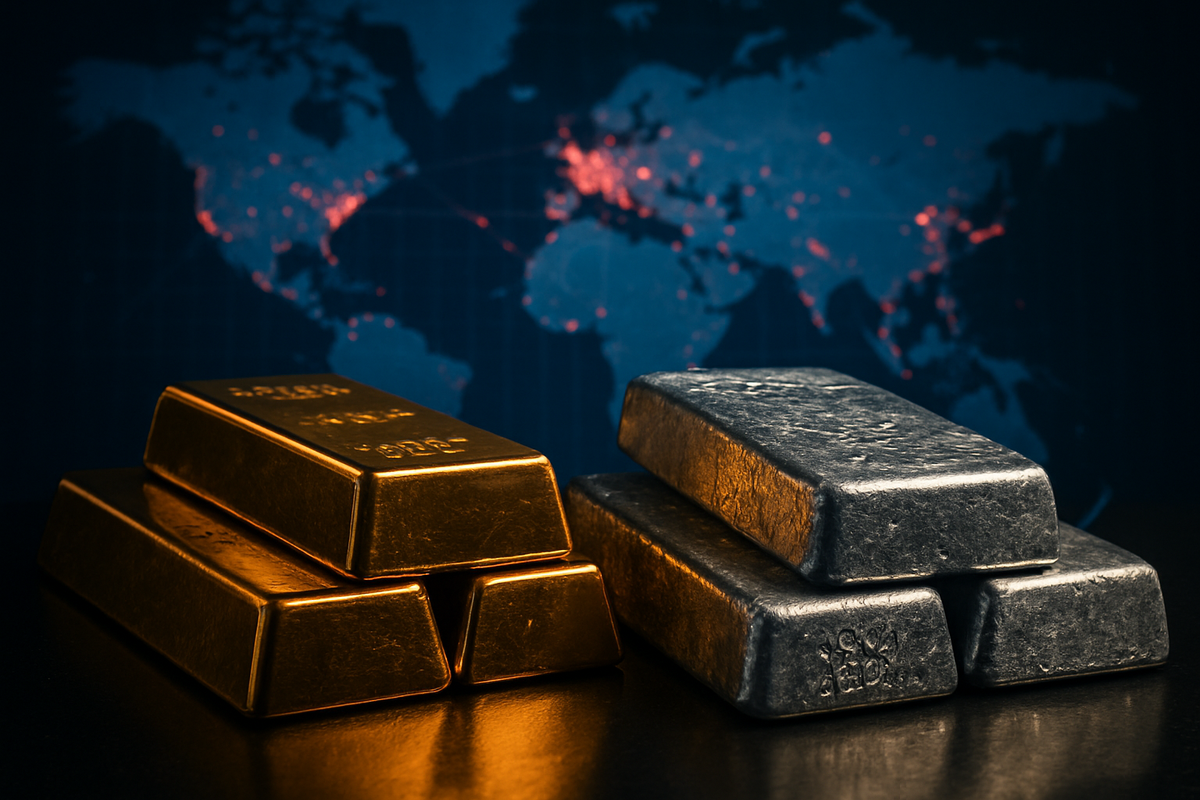
March 9, 2026 — The global financial landscape has been fundamentally reshaped in the opening months of 2026, as a historic surge in precious metals prices sends shockwaves through international markets. Driven by a catastrophic escalation of geopolitical conflict in the Middle East, gold and silver have transcended their traditional roles as mere hedges, becoming the primary sanctuary for investors fleeing a volatile mix of regional warfare and systemic inflationary threats. As of today, gold continues to consolidate near its staggering new baseline of $5,000 per ounce, while silver remains the center of intense speculative interest following a period of unprecedented price discovery.
The immediate implications of this rally are profound: a massive decoupling of precious metals from traditional correlations, such as U.S. Treasury yields, and a frantic repositioning by institutional portfolios. With energy markets reeling from threats to the Strait of Hormuz and global supply chains once again under duress, the "safe-haven" trade has evolved from a tactical defensive move into a dominant market regime. For the public, this surge signals a transition into an era of high-cost commodities and a potential fundamental shift in how the world values hard assets against fiat currency during times of extreme geopolitical duress.
A Perfect Storm: Geopolitical Chaos and the 2026 Metal Mania
The current rally traces its roots to a series of high-stakes military maneuvers that began in late 2025 and reached a boiling point in early January 2026. The primary catalyst was a massive Israeli military operation targeting strategic sites in Tehran, which resulted in the confirmed death of the Iranian Supreme Leader. This event triggered immediate and large-scale retaliatory strikes by Iran against both Israeli and U.S. assets in the region, effectively plunging the Middle East into a direct, high-intensity conflict. As the threat of a full-scale blockade of the Strait of Hormuz became a reality, Brent crude prices spiked toward $100 per barrel, further fueling the demand for gold as a hedge against energy-driven inflation.
By the first week of March 2026, gold is trading between $5,090 and $5,395 per ounce, having peaked at an intraday high of $5,595 in late January. This represents a more than 100% increase from its position in early 2025. Market reactions have been characterized by a "risk-off" stampede, where even high-interest environments—traditionally the enemy of non-yielding assets like gold—have failed to slow the ascent. The 10-year Treasury yield has risen to 4.10%, yet gold continues to climb, a rare phenomenon suggesting that investors are prioritizing "counterparty-free" assets over government debt in an environment where geopolitical stability is no longer guaranteed.
Silver has provided even more dramatic theater for market watchers. Entering 2026 at approximately $70 per ounce after a strong 2025, the "devil's metal" went parabolic in January, reaching a peak of $121 per ounce. However, the path has been anything but linear. On January 30, dubbed "Black Friday" by commodities traders, silver prices plunged 31% in a single session as speculative leverage was wiped out. Since then, the metal has stabilized in the $82 to $95 range. Investors are currently watching the $80 support level with bated breath, as the gold-to-silver ratio remains compressed at 64:1—down from over 100:1 just a year ago—indicating that silver is finally catching up to its more prestigious sibling.
The Mining Sector: Record Profits Meet Operational Hurdles
The meteoric rise in metal prices has created a bifurcated reality for the world’s largest mining operations. Newmont Corporation (NYSE: NEM) reported a staggering $7.3 billion in free cash flow for the 2025 fiscal year, yet its outlook for 2026 remains complex. Despite the windfall, Newmont has flagged a "production trough" for this year, with output expected to dip to 5.3 million ounces due to planned mine sequencing at its Peñasquito and Ahafo South sites. To appease shareholders, the company has pivoted toward a massive $6 billion share repurchase program, leveraging high margins to offset the lower output volume.
Barrick Gold Corporation (NYSE: GOLD) has emerged as a top pick for income-seeking investors, benefiting from expanding margins and a stable dividend base. The company is currently navigating the highly anticipated IPO of its Nevada Gold Mines assets, a move intended to unlock shareholder value during this peak in gold prices. While the corporate restructuring has created some management distraction, the sheer profitability of its operations at $5,000 gold has made it a darling of the resource sector.
Conversely, companies with a focus on silver, such as Fresnillo (LSE: FRES), have faced extreme volatility. As the world's largest silver producer, Fresnillo saw its stock price skyrocket in 2025, but analysts have recently begun taking profits. The high intraday swings in silver prices, combined with rising "country risks" in Mexico and other Latin American jurisdictions, have led some institutional holders to rotate their capital toward streaming companies like Wheaton Precious Metals (NYSE: WPM). As a streaming firm, Wheaton maintains fixed costs (averaging roughly $450/oz for gold) regardless of market spot prices, allowing it to capture nearly the entire upside of the rally without the operational risks of direct mining.
Macro Significance: A Departure from Historical Norms
The current precious metals rally is more than a simple reaction to war; it represents a significant shift in global macro trends. Historically, gold and silver rallies were often short-lived "fear spikes" that dissipated once diplomatic channels reopened. However, the 2026 surge is built on a foundation of structural supply deficits and a crumbling trust in the post-WWII international order. The fact that gold has surged while real interest rates remained elevated signals a "regime change" in the financial markets, where the traditional "60/40" portfolio is being discarded in favor of tangible assets.
Furthermore, the industrial demand for silver has provided a new, higher price floor that did not exist in previous cycles. The rapid expansion of AI infrastructure and the continued transition to green energy—specifically solar power and electric vehicles—have created a consistent industrial bid for silver. This dual-purpose role—as both a monetary safe-haven and a critical industrial metal—has led to a permanent re-rating of silver's value. We are seeing a ripple effect across the sector where junior explorers are suddenly receiving funding that had dried up for a decade, potentially leading to a new wave of resource discovery.
Regulatory and policy implications are also mounting. Central banks, particularly in the BRICS+ nations, have accelerated their gold accumulation to record levels, seeking to insulate their reserves from U.S. dollar-denominated sanctions. This "de-dollarization" trend, which was a fringe theory a few years ago, has become a central pillar of the 2026 gold market. For Western policymakers, the challenge is now managing the inflationary impact of high commodity prices without stifling the domestic economy through excessive interest rate hikes.
Outlook: The Path Forward in an Uncertain World
Looking ahead to the remainder of 2026, the market is entering a "wait and see" phase. Short-term, the focus will remain on the Middle East; any further expansion of the conflict into a regional war involving more actors would likely propel gold toward the $6,000 mark. Conversely, a sudden de-escalation or a successful ceasefire could lead to a sharp, painful correction for latecomers to the trade. Strategic pivots will be required from investors who have relied on traditional correlations, as the "old rules" of the gold market appear to be suspended.
In the long term, the primary challenge for the industry will be sustainability. Mining companies must find ways to increase production to meet demand, yet years of underinvestment in exploration mean that new supply is years away. This suggests that high prices may be a feature, not a bug, of the late 2020s. Scenarios currently being modeled by major banks suggest a "plateau" rather than a "peak," where gold settles into a high-price range sustained by ongoing geopolitical friction and a fractured global trade system.
Summary and Final Thoughts for Investors
The rally of early 2026 has definitively proven that gold and silver remain the ultimate arbiters of value during times of global crisis. The key takeaways from the current event are the unprecedented decoupling of metals from the bond market and the structural supply-demand imbalances that are magnifying price movements. While the geopolitical situation in the Middle East was the spark, the underlying dry tinder was a decade of fiscal expansion and global polarization.
Moving forward, the market will likely remain highly volatile, especially in the silver space. Investors should watch for technical support levels and remain cautious of extreme speculative leverage that can lead to "Black Friday" style crashes. The lasting impact of this rally will be a fundamental re-evaluation of the role of precious metals in the modern portfolio. In the coming months, keep a close eye on central bank reserve data and the ongoing conflict in the Levant, as these will be the ultimate barometers for the next leg of this historic bull market.
This content is intended for informational purposes only and is not financial advice.