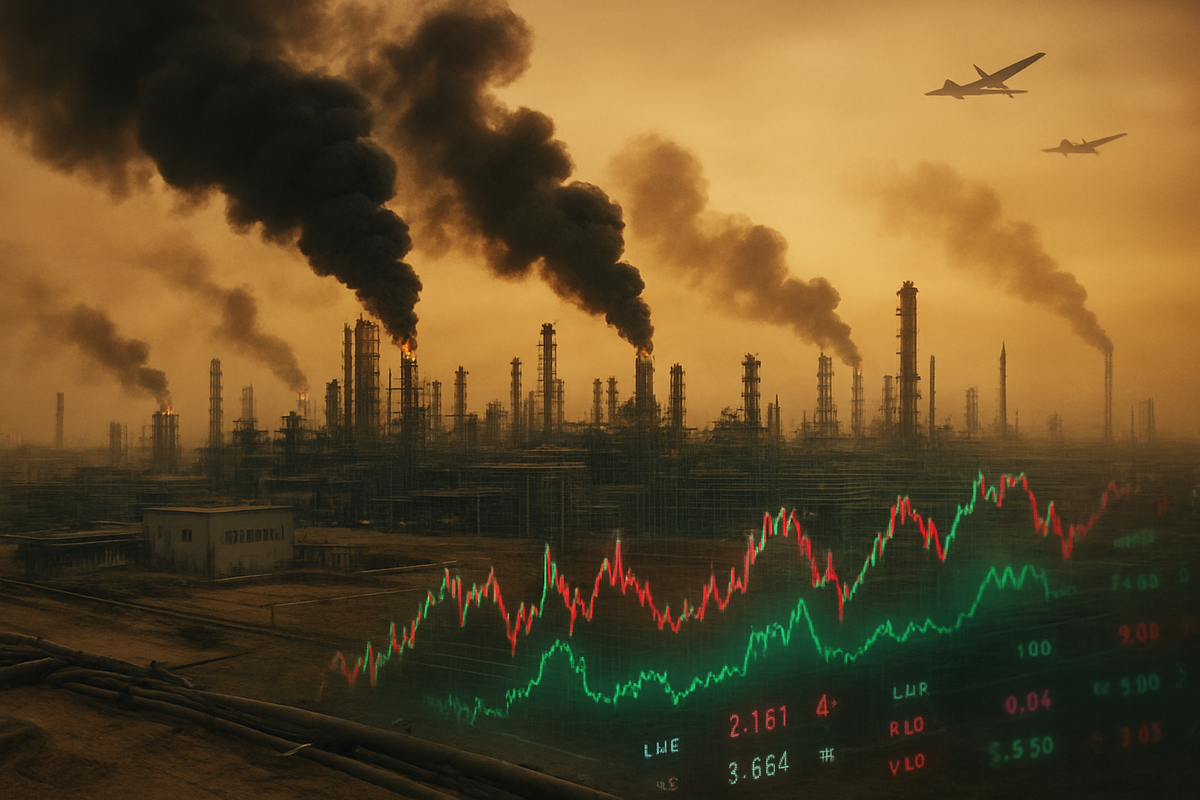
As of April 14, 2026, the global energy landscape remains in a state of high-velocity shock following a devastating Iranian drone campaign against Kuwait’s critical oil infrastructure. The strikes, which occurred just as OPEC+ ministers were preparing for a high-stakes supply meeting, have paralyzed Kuwait’s production and sent Brent crude prices on a volatile roller coaster, swinging between record highs and steep, sentiment-driven drops.
The attacks, launched on April 5, targeted the very heart of Kuwait’s energy administration and physical supply chain, including the Kuwait Petroleum Corporation (KPC) headquarters and the sprawling Mina al-Ahmadi refinery. With the Strait of Hormuz effectively shuttered and over 18 million barrels per day (bpd) of global supply currently offline, the immediate implications are clear: the world is facing its most significant energy security crisis since the 1970s, forcing a radical rethink of regional stability and the reliability of Middle Eastern export corridors.
The Strike on Shuwaikh: A Timeline of Escalation
The assault, dubbed "Operation Epic Fury" by regional intelligence, began in the early hours of April 5, 2026. A swarm of sophisticated Iranian drones and cruise missiles successfully bypassed local defense systems to strike the Shuwaikh oil sector complex, which houses the Ministry of Oil and the Kuwait Petroleum Corporation (KPC) headquarters. The precision of the strikes targeted not only administrative buildings but also vital power generation and water desalination units, effectively crippling the logistical backbone of Kuwait's energy sector. In a coordinated wave, the Mina al-Ahmadi refinery was also hit, leading to massive fires that were only contained days later.
Before the strikes, Kuwait was a steady pillar of the global market, producing approximately 3 million bpd. By the morning of April 6, that figure had plummeted to just 500,000 bpd. The timing was surgically precise, occurring less than 48 hours before a scheduled OPEC+ virtual session intended to discuss production quotas for the second half of the year. The Islamic Revolutionary Guard Corps (IRGC) claimed the strikes were "defensive measures" against nations hosting U.S. military assets, a move that immediately shifted the geopolitical calculus from diplomatic posturing to active industrial warfare.
The market reaction was instantaneous and violent. Brent Crude, which had been trading near $105 per barrel on April 4, surged to a peak of $116 in the hours following the attack. However, the price trajectory has since been defined by extreme volatility. On April 8, following a temporary two-week ceasefire brokered by Pakistan, prices saw a historic 16% single-day plunge to approximately $94.75 per barrel. Yet, as of April 14, 2026, prices have recovered toward the $99 mark as the U.S. government announced a full naval blockade of the Strait of Hormuz to intercept Iranian exports, an action Tehran has characterized as an "act of war."
Winners and Losers: Corporate Fallout in the Energy Sector
The crisis has created a stark divide among the "Big Oil" giants and the service firms that support them. ExxonMobil (NYSE: XOM) saw its shares fall 5.5% in early April trading as the company revealed that regional disruptions in the UAE and Qatar—where it has significant stakes—could hit up to 20% of its worldwide oil-equivalent production. Similarly, Shell (NYSE: SHEL) and BP (NYSE: BP) have suffered from the "Hormuz Blockade." Shell was forced to declare force majeure on several LNG shipments from Qatar, causing its stock to surrender a 24% gain built up during the pre-war buildup. Chevron (NYSE: CVX) also saw its "war premium" evaporate as investors began to fear physical damage to its joint-venture assets in the Neutral Zone between Kuwait and Saudi Arabia.
Conversely, the oilfield service (OFS) sector is bracing for a massive, albeit delayed, windfall from reconstruction efforts. SLB (NYSE: SLB) warned of a 6–9 cent per share earnings hit for Q1 2026 due to staff demobilization, yet the company remains a critical partner for future recovery. Halliburton (NYSE: HAL) has already begun using its "DecisionSpace 365" digital twin technology to remotely assess fire damage at the Shuwaikh site, positioning itself as a leader in the digital restoration of KPC’s assets. Baker Hughes (NASDAQ: BKR), which operates a major workshop in Kuwait, is currently the primary contractor tasked with repairing damaged electrical submersible pumps and turbomachinery that were fried during the power surges following the drone strikes.
The defense sector has emerged as the clear financial beneficiary of the escalating conflict. Shares of Lockheed Martin (NYSE: LMT) hit record highs of $676.70 as its F-35 fighters became central to Gulf patrol operations. RTX Corporation (NYSE: RTX) saw a 6.5% jump in early April following reports of massive munitions restocking, particularly Patriot missile defense systems and Tomahawk missiles. Northrop Grumman (NYSE: NOC) also tracked higher, gaining 6% as the U.S. Navy intensified its surveillance and aegis-class deployments in the Persian Gulf to secure what little shipping remains in the region.
A New Era of Supply Insecurity
The strikes on Kuwait represent more than just a temporary supply disruption; they signal a fundamental shift in the global energy security paradigm. Historically, markets have priced in "transit risks"—the possibility of a temporary closure of the Strait of Hormuz. However, the destruction of Kuwait’s power and desalination plants alongside its refineries introduces "structural risk." Analysts from the International Energy Agency (IEA) have noted that while a tanker can be rerouted, a destroyed desalination plant can take 2 to 5 years to rebuild. This "industrial catastrophe" model suggests that even if a permanent ceasefire is reached, Kuwait’s contribution to global supply will remain impaired for the foreseeable future.
Furthermore, this event has exposed the fragility of the Saudi East-West pipeline, which was also targeted on April 8. The failure of alternative routes to bypass the Strait of Hormuz has left the global market with a deficit of nearly 18 million bpd, a volume that dwarfs the 1973 and 1979 oil shocks combined. In a policy sense, this is likely to accelerate the Western "energy sovereignty" movement. Governments in Europe and North America are already discussing emergency subsidies for non-OPEC production and an accelerated rollout of nuclear and renewable baseload power to decouple their economies from Middle Eastern volatility.
Scenarios for the Second Quarter: What Lies Ahead
In the short term, the market remains pinned to the progress of negotiations in Pakistan. If the April 8 ceasefire holds and evolves into a formal de-escalation, oil prices could retreat into the $80-$85 range as the "fear premium" dissipates. However, the current U.S. naval blockade, initiated on April 13, suggests that a strategic pivot is more likely than a peaceful resolution. Should the U.S. and Iran engage in direct naval combat, Brent crude could easily surpass $150 per barrel, leading to global stagflation and a severe recession in energy-importing economies like China and India.
For Kuwait, the focus is now on the "Ahmadi Innovation Valley," where Baker Hughes and Halliburton are working to restore modular gas turbines. KPC officials have indicated that restoring the country’s 2.7 million bpd export capacity will take at least 3 to 4 months under ideal conditions. Investors should expect a "K-shaped" recovery for energy stocks: service companies with repair contracts will likely outperform, while integrated majors with heavy Gulf exposure may face prolonged headwinds until maritime safety is guaranteed.
Conclusion: The Market in the Shadow of War
The Iranian strikes on Kuwait’s oil infrastructure have fundamentally rewritten the rules of the energy market. The April 5 attacks moved the needle from a price-per-barrel discussion to a physical-availability crisis. As we stand on April 14, 2026, the OPEC+ alliance has been rendered largely irrelevant by the physical blockade of the Strait of Hormuz, proving that production quotas mean little if the oil cannot reach the water.
Investors must now watch for two critical indicators: the stability of the current naval blockade and the timeline for infrastructure repair in Kuwait. The "war premium" is currently being replaced by an "infrastructure deficit premium," which could keep oil prices structurally higher even if the fighting subsides. In the coming months, the resilience of the global economy will be tested as it grapples with the fallout of the most significant energy disruption in history. For now, the focus remains on the Gulf, where the smoke from the Shuwaikh complex serves as a stark reminder of the world’s enduring and dangerous dependence on a single, volatile region.
This content is intended for informational purposes only and is not financial advice