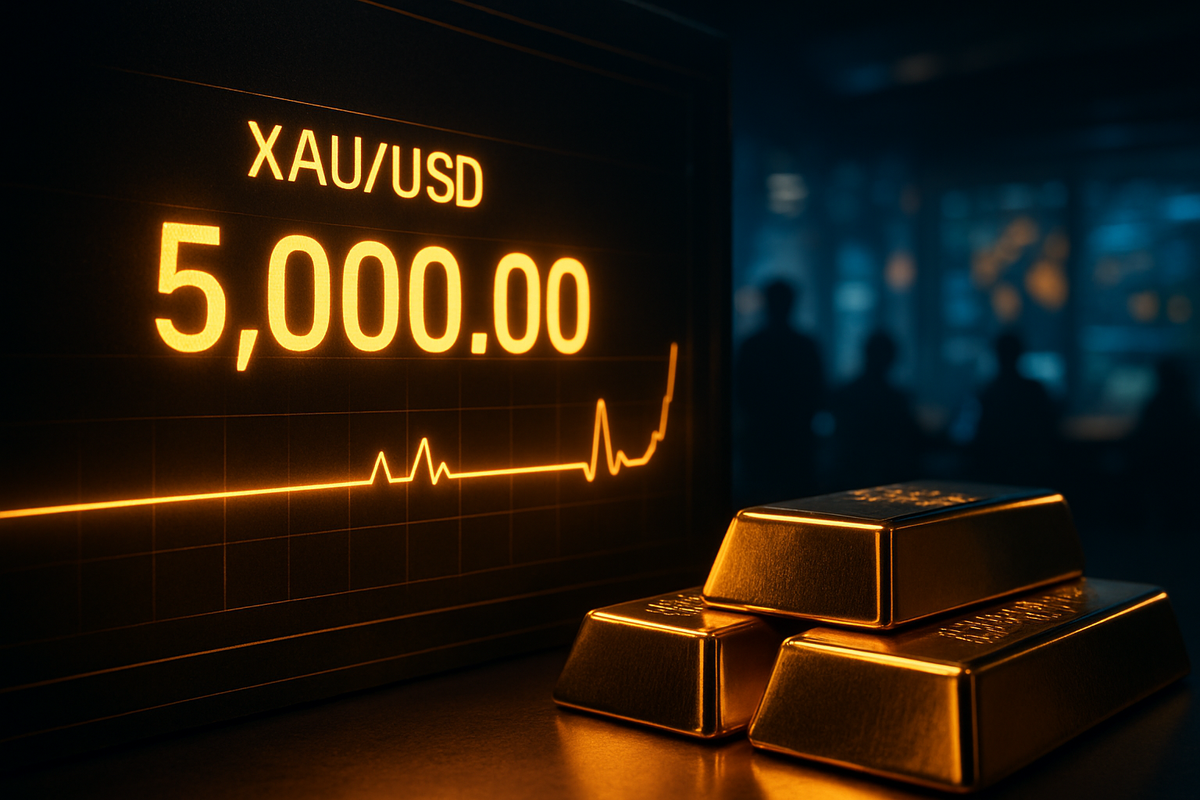
NEW YORK — On April 14, 2026, the global financial landscape is witnessing a historic confrontation between traditional monetary policy and a fundamental shift in the world’s reserve architecture. Gold (XAU/USD) is currently hovering at the critical $5,000 per ounce psychological level, testing it as a newfound support floor after a multi-month rally that has redefined the asset class. This pivotal moment comes as investors weigh a hawkish Federal Open Market Committee (FOMC) against a backdrop of intensifying geopolitical shocks and structural de-dollarization.
The immediate implications of gold testing $5,000 are profound for both institutional portfolios and global central bank reserves. As the "ultimate neutral asset" stabilizes at this unprecedented price point, the market is grappling with a "Geopolitical Paradox": interest rates remain elevated to combat "sticky" inflation, yet gold—a non-yielding asset—refuses to retreat. This decoupling from real yields suggests that the $5,000 level is no longer just a target, but a battleground for the future of the global monetary order.
The Ascent to $5,000: A Timeline of Volatility
The journey to $5,000 gold was catalyzed by a "perfect storm" that began in late 2024 and accelerated throughout 2025. A series of supply chain disruptions, combined with a sustained "oil shock" triggered by a blockade in the Strait of Hormuz, pushed crude oil prices toward $150 per barrel. This inflationary pressure led to a stagflationary environment in early 2026, characterized by a U.S. headline CPI of 3.3% and stagnant GDP growth of 0.5%. In response, central banks—led by the BRICS+ bloc—accelerated their diversification away from U.S. Treasuries, shifting record amounts of reserves into physical bullion.
The FOMC meeting this week has added fuel to the fire. Markets are currently pricing in a high probability of another 25-basis point rate hike, which would bring the Federal Funds Rate into the 3.75%–4.00% range. While higher rates traditionally dampen gold’s appeal, the current "policy mismatch" has had the opposite effect. Investors increasingly view the Fed as "trapped"—unable to cut rates to support a cooling economy without risking hyperinflation, yet unable to hike high enough to truly break the inflationary cycle. This lack of a clear exit strategy has solidified gold’s status as the premier hedge against fiscal sustainability risks.
The initial market reaction to the $5,000 test has been one of extreme volatility. Intraday swings of $100 have become the norm as algorithmic trading and institutional profit-taking clash with aggressive buying from sovereign wealth funds. Key players, including major bullion banks and the World Gold Council, have noted that the "price floor" for gold has reset significantly higher over the last 18 months, making a return to sub-$3,000 levels increasingly unlikely in the current geopolitical climate.
Corporate Impact: Super-Margins and the Gilded Squeeze
The primary beneficiaries of $5,000 gold are the global mining giants, though the gains are not without operational hurdles. Newmont Corporation (NYSE: NEM), the world’s largest gold miner, is reporting record net income, projected to hit $7.2 billion for the current fiscal year. However, the company is also facing a "Gilded Squeeze." Despite the high spot price, Newmont’s All-In Sustaining Costs (AISC) have climbed to approximately $1,680 per ounce due to rising labor costs and energy prices. While their margins are at historic highs, production remains in a "trough year," forcing the company to focus on high-grade assets to maintain profitability.
Similarly, Barrick Gold Corporation (NYSE: GOLD) has positioned itself as a dual-commodity powerhouse, leveraging its copper production to attract ESG-focused capital while reaping the rewards of $5,000 gold. Barrick’s AISC for 2026 is projected between $1,760 and $1,950 per ounce. While this allows for a massive 60-70% gross margin, the company continues to navigate legal disputes and jurisdictional risks that have caused its stock price to occasionally lag behind the spot price of the metal. Investors seeking direct exposure without the operational risks of mining have increasingly flocked to the SPDR Gold Shares (NYSE Arca: GLD), which has seen record inflows as a "liquidity king" in the ETF space.
On the losing side of this equation are industrial consumers and the luxury jewelry sector. High-end jewelers like Signet Jewelers Limited (NYSE: SIG) are struggling with a massive drop in unit volume as the "psychological barrier" of $5,000 gold pushes wedding bands and engagement rings out of reach for middle-class consumers. Furthermore, technology manufacturers who rely on gold for high-end circuitry are seeing their input costs balloon, potentially leading to price hikes for consumer electronics in the second half of 2026.
Broader Significance: The End of the Dollar-Centric Era?
The testing of $5,000 gold is a watershed moment that fits into the broader trend of "Cold War 2.0" and global de-globalization. Historically, gold has acted as a "burst and breathe" asset. For example, during the 2008 financial crisis, gold initially fell as investors liquidated assets for cash, only to rally 166% by 2011. Similarly, the $2,000 level in 2020 served as a multi-year resistance point before becoming a permanent floor. The $5,000 level represents the definitive end of the post-WWII dollar-centric monetary order, as gold reclaims its role as the primary reserve asset of the 21st century.
Ripple effects are being felt across the competitive landscape of finance. Digital assets, which once vied for the "digital gold" title, are seeing mixed results. While Bitcoin has benefited from the general flight from fiat, its volatility has caused some institutional players to revert to the relative stability of physical bullion. Furthermore, regulatory bodies are now scrambling to adapt. There is increasing talk in Washington and Brussels about new reporting requirements for gold-backed assets and potential taxes on "windfall profits" from mining companies, as governments look for ways to shore up their own balance sheets in a high-inflation environment.
The policy implications are particularly stark for the U.S. Treasury. As gold prices rise, the interest expense on the $34 trillion national debt becomes more burdensome, and the U.S. Dollar Index (DXY) has shown unprecedented vulnerability, trading near 98.40 despite high domestic interest rates. This suggests that the global market is no longer pricing the dollar based solely on interest rate differentials, but on the long-term fiscal health of the United States—a metric where gold currently reigns supreme.
The Path Forward: Scenarios for the Second Half of 2026
In the short term, the sustainability of the $5,000 level depends heavily on the next two FOMC meetings. If the Fed successfully orchestrates a "soft landing" and manages to bring inflation back toward 2%, gold could see a significant correction toward the $4,500 support level. However, if geopolitical tensions in the Middle East or Eastern Europe escalate, $5,000 may soon be viewed as a "cheap" entry point. Many analysts, including those at J.P. Morgan, are already looking toward a year-end target of $6,300 if Western ETF inflows continue at their current pace.
Strategic pivots are already underway among major market participants. Mining companies are likely to accelerate their M&A activity to replace aging reserves, while central banks in emerging markets are expected to continue their "gold-for-oil" trade arrangements. The primary challenge for the market moving forward will be liquidity. If the price remains at or above $5,000, the sheer cost of physical delivery and storage will require new innovations in the gold-backed financial product space, potentially leading to the rise of more sophisticated blockchain-based gold tokens.
Conclusion: A New Paradigm for Investors
The testing of $5,000 gold marks more than just a numerical milestone; it represents a fundamental shift in how the world perceives value in an era of high debt and geopolitical instability. The key takeaway for investors is that the "rules" of the previous decade—where high rates automatically meant lower gold—have been rewritten. The decoupling of gold from traditional correlations suggests that we have entered a "structural bull market" driven by a search for safety and fiscal sovereignty.
As we move through 2026, the market will likely remain in a state of heightened sensitivity. Investors should keep a close eye on central bank purchase data and the All-In Sustaining Costs of major miners like Agnico Eagle Mines Limited (NYSE: AEM) and Newmont, as these will be the ultimate indicators of the sector's health. While $5,000 may provide psychological resistance in the near term, the underlying drivers of this rally—inflation, debt, and de-dollarization—show no signs of abating.
This content is intended for informational purposes only and is not financial advice.