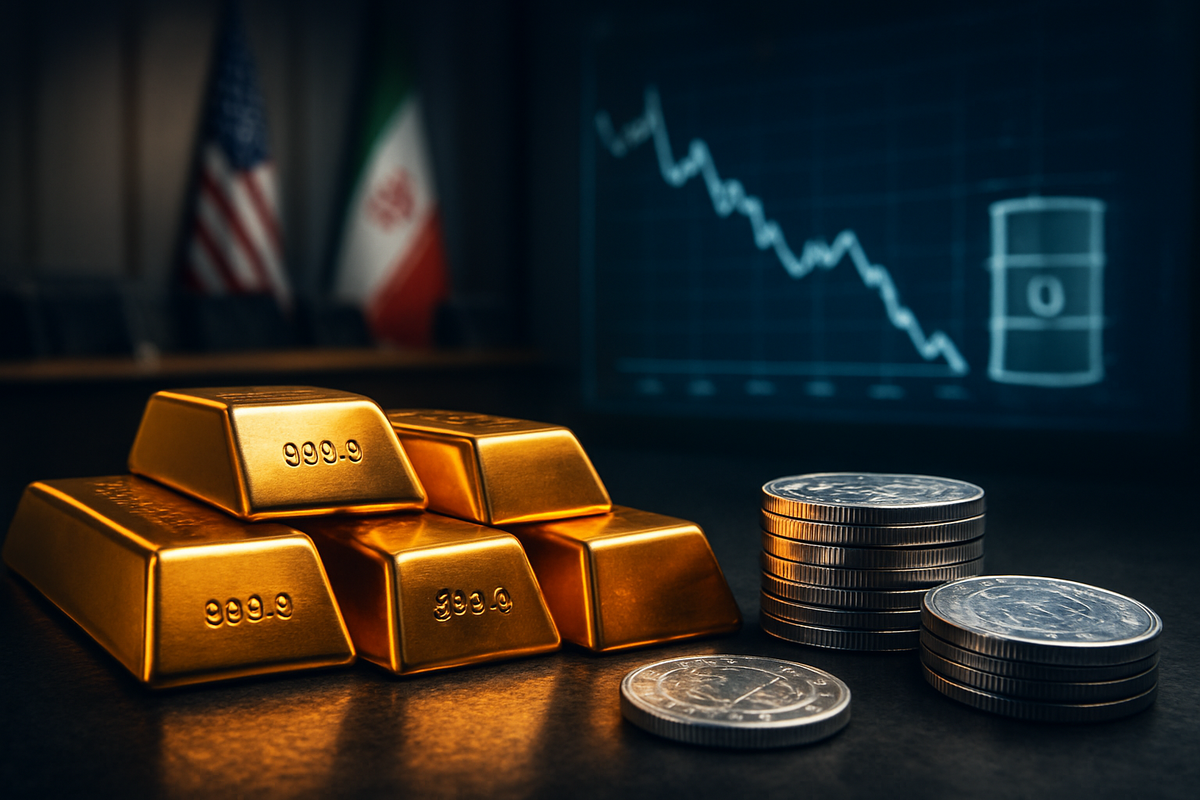
The global financial landscape witnessed a historic recalibration on April 14, 2026, as precious metals soared to unprecedented levels. Spot gold hit a milestone of $4,775.20 per ounce, while silver outperformed on a percentage basis, climbing to $77.73 per ounce. This dramatic rally was fueled by a convergence of high-stakes diplomacy in Pakistan and a sudden cooling of energy markets, which collectively upended months of stagnant trading patterns.
The immediate implications of this surge are profound, reflecting a market that is simultaneously hedging against geopolitical uncertainty and betting on a shift in central bank policy. As the "Islamabad Peace Talks" between the United States and Iran dominated headlines, the resulting drop in oil prices below the $100-per-barrel threshold fundamentally altered inflation expectations, weakening the U.S. dollar and providing the perfect springboard for the metals complex.
The surge in metal prices was the direct result of a volatile sequence of events beginning in mid-April. The "Islamabad Peace Talks," held at the Serena Hotel in Pakistan from April 11 to April 14, saw a high-level U.S. delegation led by Vice President JD Vance and special envoys including Jared Kushner meet with Iranian parliamentary speaker Mohammad Bagher Ghalibaf. While the talks ended without a formal treaty due to disagreements over the Strait of Hormuz, the mere existence of a diplomatic channel triggered a massive relief rally in the energy sector.
As rumors of a sustained ceasefire circulated, Brent crude oil prices plummeted nearly 15%, dropping from their wartime peaks to approximately $92.61 per barrel. This sharp decline below the psychological $100 barrier acted as a catalyst for the broader market. The drop in energy costs immediately lowered "sticky" inflation expectations, leading currency traders to dump the U.S. dollar in favor of hard assets. By the afternoon of April 14, the greenback had hit its lowest level in over a month, making dollar-denominated gold and silver significantly more attractive to international investors.
Investors reacted by pouring capital into liquid instruments to capture the move. The SPDR Gold Shares (NYSE Arca: GLD) rose to $435.36, reflecting the 0.8% daily gain in gold bullion, while the iShares Silver Trust (NYSE Arca: SLV) jumped to $70.38, tracking silver’s nearly 3% breakout. This movement was characterized by technical analysts as a "regime shift," where silver finally began to close the performance gap with gold, which had dominated safe-haven flows throughout the early months of the year.
The primary beneficiaries of this price action were the exchange-traded funds specifically designed to track these metals. The SPDR Gold Shares (NYSE Arca: GLD) and the iShares Silver Trust (NYSE Arca: SLV) saw record-breaking inflows on April 14 as institutional "fast money" rotated out of energy futures and into precious metals. For silver investors, the rally was particularly sweet, as the metal broke through a long-standing resistance level at $75.50, suggesting that the industrial and monetary demand for silver is entering a new, more aggressive phase.
Major mining corporations also saw significant gains. Newmont Corporation (NYSE: NEM) and Barrick Gold Corporation (NYSE: GOLD) both saw their stock prices jump as their projected profit margins expanded alongside the spot price of gold. With energy costs—a major expense for mining operations—dropping due to the oil price collapse, these companies are experiencing a rare "double win" of rising revenue and falling input costs. Conversely, major oil producers like Exxon Mobil (NYSE: XOM) faced selling pressure as the "war premium" that had propped up crude prices began to evaporate.
On the losing side of this shift are traditional "dollar bulls" and holders of short-term Treasury bills. As the probability of a Federal Reserve interest rate cut jumped from 13% to 31% following the cooling inflation data, the opportunity cost of holding non-yielding assets like gold and silver fell. Investors who had remained overweight in the U.S. dollar found themselves on the wrong side of a rapidly devaluing currency, while those exposed to high-inflation hedges in the energy sector saw their positions erode as the Islamabad talks progressed.
The events of April 14, 2026, represent a significant pivot in the broader narrative of the 2020s. For years, the market has been gripped by the fear of "stagflation"—high inflation coupled with stagnant growth. The drop in oil prices below $100, combined with the gold rally, suggests that the market is finally seeing a path toward a "disinflationary safe-haven" environment. This shift fits into a larger industry trend where precious metals are regaining their status as the ultimate hedge against both geopolitical instability and currency debasement.
The ripple effects of the Islamabad talks extend far beyond the commodities desk. If the U.S. and Iran can reach a durable agreement, it could lead to a permanent restructuring of global trade routes, specifically through the Strait of Hormuz. This would reduce the "risk premium" currently baked into everything from maritime insurance to consumer electronics. Regulatory bodies and central banks are also watching closely; a sustained drop in inflation could give the Federal Reserve the political cover it needs to pivot toward more accommodative monetary policies, further fueling the bull run in equities and metals.
Historically, this event draws comparisons to the diplomatic breakthroughs of the late 20th century, where a cooling of Middle Eastern tensions often led to a multi-year bull market in industrial and precious metals. However, the 2026 iteration is unique due to the speed of digital trade and the massive scale of the silver supply deficit. The fact that silver reached $77.73 reflects not just geopolitical fear, but a fundamental recognition of the metal's scarcity in an increasingly electrified global economy.
Looking ahead, the market's trajectory will depend heavily on the "second round" of the Islamabad talks. While the door remains open for diplomacy, the U.S. naval blockade of Iran remains in place as of April 14. Should negotiations fail to produce a definitive treaty, oil prices could just as easily spike back above $120, potentially stalling the silver rally while further driving gold's safe-haven appeal. Investors must be prepared for a period of extreme "headline risk," where a single statement from Islamabad or Washington can swing prices by 5% in minutes.
In the short term, technical analysts are watching the $4,800 level for gold and the $80.00 level for silver. Breaking these psychological barriers would likely trigger another wave of algorithmic buying. Strategically, mining companies may take this opportunity to lock in lower energy prices through hedging, while also accelerating production at previously marginal mine sites that are now highly profitable at $4,700 gold. The central challenge for the market will be navigating the transition from a "fear-based" rally to one driven by fundamental dollar weakness.
The events of April 14, 2026, mark a watershed moment for the financial markets. The record highs in gold and silver, catalyzed by the Islamabad peace talks and a collapse in oil prices, have redefined the investment landscape for the mid-2020s. The shift in inflation expectations and the subsequent weakening of the U.S. dollar have created a powerful tailwind for precious metals that could persist for the remainder of the year.
As we move forward, investors should keep a close watch on the U.S. Dollar Index (DXY) and the outcome of further diplomatic efforts. The resilience of the $4,775 gold price level will be a key indicator of whether this rally has "real legs" or is merely a temporary reaction to geopolitical noise. For now, the "gold-and-silver-standard" of safe-haven investing has returned with a vengeance, leaving the market to ponder just how high these metals can climb in a world of shifting alliances and cooling energy costs.
This content is intended for informational purposes only and is not financial advice.