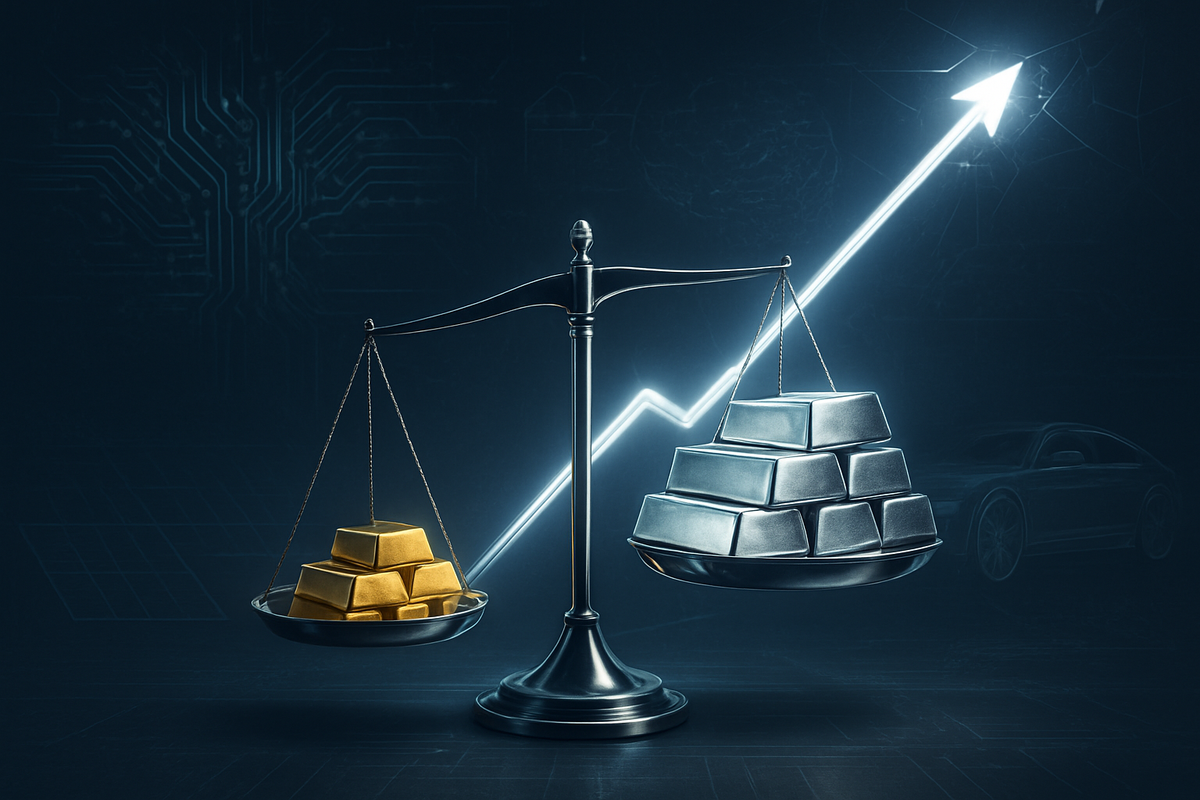
As of April 14, 2026, the global financial landscape is witnessing a historic realignment in the precious metals sector. Silver, long dismissed as the volatile "poor man’s gold," has officially decoupled from its yellow counterpart, posting explosive gains of over 140% since the start of 2024. In early morning trading today, silver prices hovered near $72.00 per ounce, while the closely watched gold-silver ratio has plummeted to approximately 64:1, down from the staggering 90:1 levels seen just two years ago.
This monumental surge is not merely a speculative bubble but the result of a structural "perfect storm." A relentless supply deficit, now entering its sixth consecutive year, has finally collided with a voracious appetite for silver in the high-tech industrial sector. From the massive power grids required for Artificial Intelligence (AI) to the rapid rollout of renewable energy infrastructure, silver has transitioned from a decorative asset to a critical strategic mineral for the 21st-century economy.
The 24-Month Ascent: From Breakout to Bull Market
The timeline of silver's current dominance traces back to the second half of 2024, when the metal broke out of a multi-year consolidation range of $22 to $26. By mid-2025, silver had surpassed the $50 mark, fueled by a realization among institutional investors that the "Green Revolution" was physically impossible without massive amounts of silver. This momentum accelerated through the first quarter of 2026, as the iShares Silver Trust (NYSE Arca: SLV) saw record-breaking inflows, signaling a shift from retail speculation to massive institutional accumulation.
The key stakeholders in this shift have been industrial end-users. Large-scale tech firms and automotive manufacturers have moved to secure direct supply contracts with miners, bypassing traditional spot markets to ensure their production lines remain operational. This "physical scramble" has drained inventories at major exchanges, including the COMEX and the London Bullion Market Association (LBMA), to their lowest levels in a decade.
The Mining Giants: First Majestic and the Pure-Play Advantage
Among the primary beneficiaries of this price explosion is First Majestic Silver (NYSE: AG). The company, which successfully integrated its landmark acquisition of Gatos Silver in late 2024, has transformed into a production powerhouse. By the first quarter of 2026, First Majestic has managed to optimize its high-grade Cerro Los Gatos assets, contributing to an annual production guidance of over 14 million ounces of pure silver. With silver prices trading at double their 2024 levels, First Majestic’s margins have expanded exponentially, making it a favorite among growth-oriented commodity investors.
The success of First Majestic Silver (NYSE: AG) highlights a broader trend: the market is rewarding "pure-play" miners who offer direct exposure to the silver price. Other diversified miners, like Pan American Silver (NYSE: PAAS), have also seen significant gains, but the focused production model of companies like First Majestic has allowed them to capture a greater share of the price delta. Meanwhile, the iShares Silver Trust (NYSE Arca: SLV) has become a primary liquidity vehicle for hedge funds looking to play the silver-gold ratio compression without taking physical delivery of the metal.
The Industrial Engine: AI, Solar, and EVs
The driving force behind silver's 140% rise is a fundamental shift in demand. The AI boom of 2025 has proved to be silver-intensive; the advanced chips and high-performance servers used in AI data centers require 2 to 3 times more silver than traditional hardware due to the metal's unmatched electrical and thermal conductivity. As companies like NVIDIA (NASDAQ: NVDA) and Microsoft (NASDAQ: MSFT) continue to build out global AI infrastructure, the demand for silver components has become a "non-negotiable" input cost.
Simultaneously, the solar energy sector continues to consume nearly 200 million ounces of silver annually. Despite efforts to "thrift" or reduce the amount of silver used in photovoltaic cells, the sheer volume of global solar installations in 2026 has offset any technological savings. Coupled with the Electric Vehicle (EV) market—where a single car can use up to 50 grams of silver for its complex sensor and battery management systems—the industrial floor for silver prices has risen permanently. This shift mirrors the "Super-Cycle" of copper and lithium seen earlier in the decade, where supply-side constraints met an immovable wall of green demand.
Looking Ahead: The Path to $100?
As we move into the second half of 2026, the question for many is how high this rally can go. Short-term volatility is expected as some early investors take profits, but the structural deficit remains unresolved. New mining projects can take a decade to bring online, and because 70% of silver is produced as a byproduct of lead, zinc, and copper mining, the industry cannot simply "turn on the taps" to meet higher prices.
Market analysts are now debating whether silver will reach the triple-digit milestone of $100 per ounce before 2027. Strategic pivots are already occurring; some electronics manufacturers are experimenting with high-copper alloys to mitigate costs, but for high-end AI applications, silver’s conductivity remains irreplaceable. The most likely scenario involves continued price discovery as industrial buyers compete with financial investors for a shrinking pool of physical bullion.
The New Era of the White Metal
In summary, silver’s performance in 2026 represents a fundamental revaluation of the metal. No longer tethered exclusively to the movements of gold, silver has earned its place as a critical technology metal. The compression of the gold-silver ratio to 64:1 is a clear signal that the market is finally pricing in the scarcity of silver relative to its vast industrial utility.
For investors, the coming months will require close monitoring of inventory levels at global vaults and quarterly production reports from leaders like First Majestic Silver (NYSE: AG). While the 140% gains of the past two years have been extraordinary, the underlying supply-demand imbalance suggests that the era of "cheap silver" is firmly in the rearview mirror. Watch for any signs of government intervention or the designation of silver as a "Strategic Mineral" in major economies, as these could provide the next catalyst for the market.
This content is intended for informational purposes only and is not financial advice.