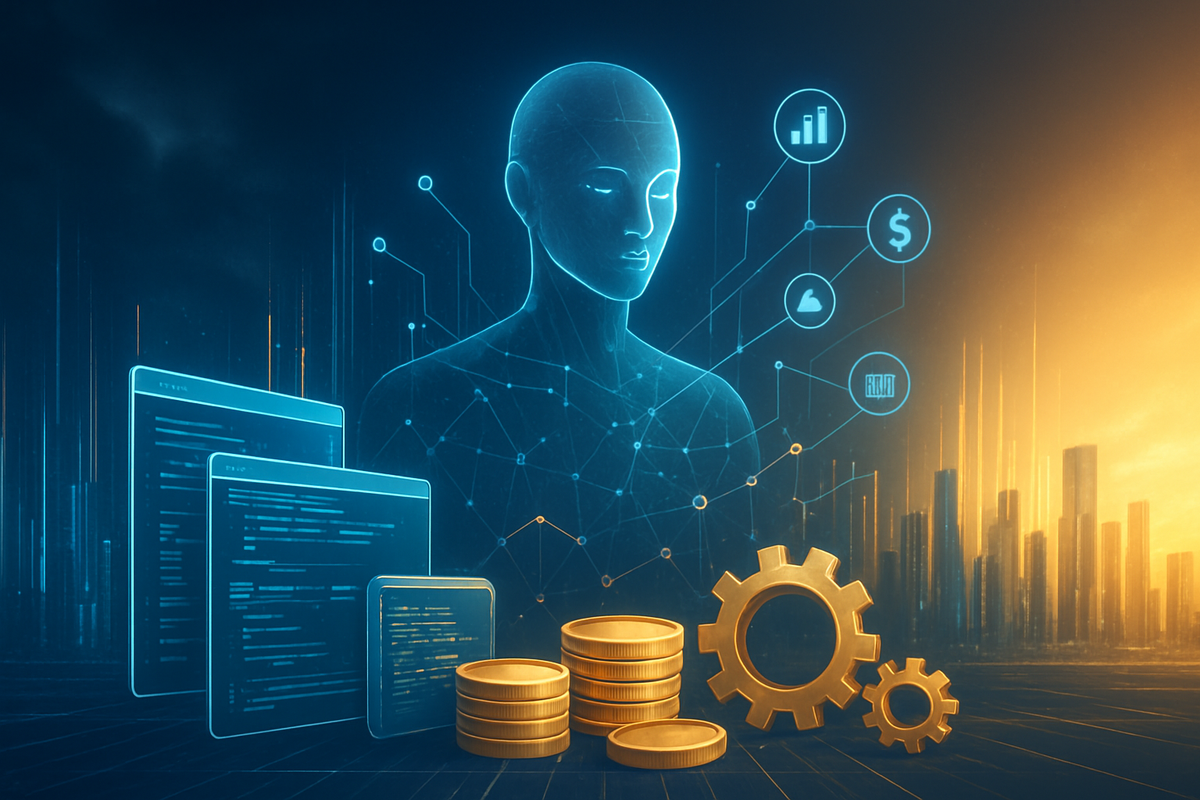
As of April 3, 2026, the global financial markets are witnessing a definitive shift in the technology landscape. After a turbulent 2025—a year many traders dubbed the "SaaSpocalypse"—the enterprise software sector is undergoing a massive resurgence. Institutional capital is flowing back into the space at rates not seen in nearly a decade, driven by a pivot from existential dread regarding AI’s disruptive power to a celebration of its tangible monetization.
The primary catalysts for this rally are the proven revenue streams from "agentic" AI models. For the first time, large-cap software giants are demonstrating that they can not only survive the transition to an AI-first world but can actually thrive by expanding their unit economics. The fear that AI would replace human workers and shrink the "seat-based" revenue model has been replaced by a reality where companies charge for the actual work completed by digital agents.
The Journey from "SaaSpocalypse" to the 2026 Spring Rebound
The path to this recovery began in late 2024 and throughout 2025, a period characterized by deep investor skepticism. As Large Language Models (LLMs) became more capable, a prevailing narrative emerged: if AI can do the work of five junior developers or ten customer service reps, companies would need far fewer software licenses. This "seat-count" fear led to a massive valuation compression across the sector. However, the tide began to turn in late 2025 as the industry’s heavyweights initiated a strategic pivot toward usage-based and "agentic" pricing.
The timeline of this recovery reached a boiling point in March 2026. Following a series of blockbuster Q4 earnings reports, it became clear that the software industry had successfully decoupled its revenue from human headcount. Salesforce (NYSE: CRM) was a primary mover in this space, introducing "Agentic Work Units" (AWUs) as a primary billing metric. By the time the calendar turned to April, a coordinated rally across the SaaS (Software as a Service) sector signaled that the market had finally priced in the "AI-as-a-service" premium.
Key stakeholders, including major hedge funds and institutional allocators, have played a pivotal role in this turnaround. A February 2026 Goldman Sachs survey revealed that 49% of institutional allocators planned to increase exposure to software, the highest net figure since 2017. This return of the "smart money" has provided a stable floor for valuations, supported further by massive buyback programs, such as the $50 billion authorization from Salesforce and an additional $5 billion from ServiceNow (NYSE: NOW).
Winners and Losers: The Triumphant Return of the Titans
Salesforce (NYSE: CRM) has emerged as a clear leader in this new era. Their "Agentforce" platform, which utilizes autonomous AI agents to manage customer interactions and sales pipelines, reached an Annual Recurring Revenue (ARR) run rate of $800 million by the end of fiscal 2026. Investors were particularly impressed by the report that 2.4 billion tasks were completed by autonomous agents in the fourth quarter alone, validating the company's shift toward charging for the value of work rather than just the number of users logged in.
Adobe (NASDAQ: ADBE) has also seen a dramatic sentiment recovery. Once the "poster child" for AI disruption fears due to concerns over generative media, Adobe’s Q1 2026 results reported revenue of $6.4 billion. The company’s success stems from the mass adoption of Adobe Firefly and its AI Acrobat Assistant, which have collectively tripled their ARR contribution year-over-year. Even with the recent retirement announcement of long-time CEO Shantanu Narayen, the stock has remained resilient as investors focus on the 50% year-over-year growth in "Creative Freemium" users converting to paid AI-tiers.
ServiceNow (NYSE: NOW) is frequently cited as the "definitive winner" of this cycle. By positioning itself as the "AI Control Tower" or the orchestration layer for the enterprise, it has successfully avoided the commoditization of AI. Its "Now Assist" engine surpassed $600 million in Annual Contract Value (ACV) early this year. Meanwhile, Microsoft (NASDAQ: MSFT) continues to leverage its massive infrastructure moat, reporting that over 90% of the Fortune 500 are now utilizing Microsoft 365 Copilot, effectively turning every office seat into an AI-augmented workstation.
The "losers" in this environment are primarily niche SaaS providers who failed to integrate deep data layers. Smaller companies that relied on "thin" software layers without the proprietary data necessary to train or ground AI agents have seen their churn rates spike. These legacy players are increasingly becoming acquisition targets for the larger "platforms" that have the scale to implement complex AI billing models.
A Fundamental Shift in the Industrial Trend
The broader significance of this recovery lies in the evolution of software economics. For twenty years, the SaaS industry lived and died by the "per-user" license. The 2026 rebound marks the historical moment when software became a "labor replacement" rather than just a "tool." This transition is being compared to the early 2000s shift from on-premise software to the cloud; it is a fundamental re-architecting of how value is captured in the digital economy.
This shift has significant ripple effects on competitors and partners alike. Companies like HubSpot (NYSE: HUBT) and Workday (NASDAQ: WDAY) are following the leaders into usage-based models, creating a more volatile but potentially more lucrative revenue stream. Regulators are also taking note, as the shift toward "agentic work" raises new questions about digital labor and the tax implications of software that replaces human-filled roles.
Historically, this event mirrors the "Cloud Recovery" of 2011-2012, where initial fears of lower margins in the cloud were eventually proven wrong by the sheer scale and stickiness of the model. In 2026, the market has realized that while an AI agent might replace three human seats, the software provider can charge more for that agent because it provides 24/7 productivity without benefits or overhead, effectively capturing a portion of the "saved" salary.
The Road Ahead: Towards the Autonomous Enterprise
In the short term, the market will likely focus on the sustainability of these new pricing models. Investors will be watching for "pilot-to-production" conversion rates—ensuring that the billions of tasks handled by agents actually result in long-term contract renewals. There is also the potential for a strategic pivot toward "Sovereign AI" software, as large enterprises seek to host these autonomous agents on-premise or in private clouds for security reasons.
Long-term, we are entering the era of the "Autonomous Enterprise." This represents a scenario where the software layer doesn't just assist employees but proactively manages the business. The challenge for companies like Adobe and Salesforce will be maintaining their competitive moats as open-source models become more efficient. However, their current advantage lies in their "Data Moat"—the decades of customer interactions that allow their agents to be more accurate than generic competitors.
Market opportunities will likely emerge in the "AI Orchestration" space, where software helps different agents from different vendors talk to each other. We may see a new wave of M&A activity as the cash-rich software giants look to snap up specialized AI startups that can further enhance their agentic capabilities.
Wrap-Up and Investor Outlook
The recovery of large-cap software in early 2026 represents a landmark victory for the SaaS model. The sector has successfully navigated the "trough of disillusionment" regarding AI disruption and is now firmly in the "slope of enlightenment." Key takeaways include the successful implementation of consumption-based billing and the realization that enterprise data remains the ultimate currency in an AI-driven world.
Moving forward, the market looks bullish, but disciplined. The era of "growth at any cost" has been replaced by "growth through monetization." Investors should watch for the continued expansion of Annual Recurring Revenue from AI assistants and the stabilization of seat-based churn. As the "Spring Awakening" continues, the software titans have proven they are not the victims of the AI revolution—they are its primary beneficiaries.
This content is intended for informational purposes only and is not financial advice.