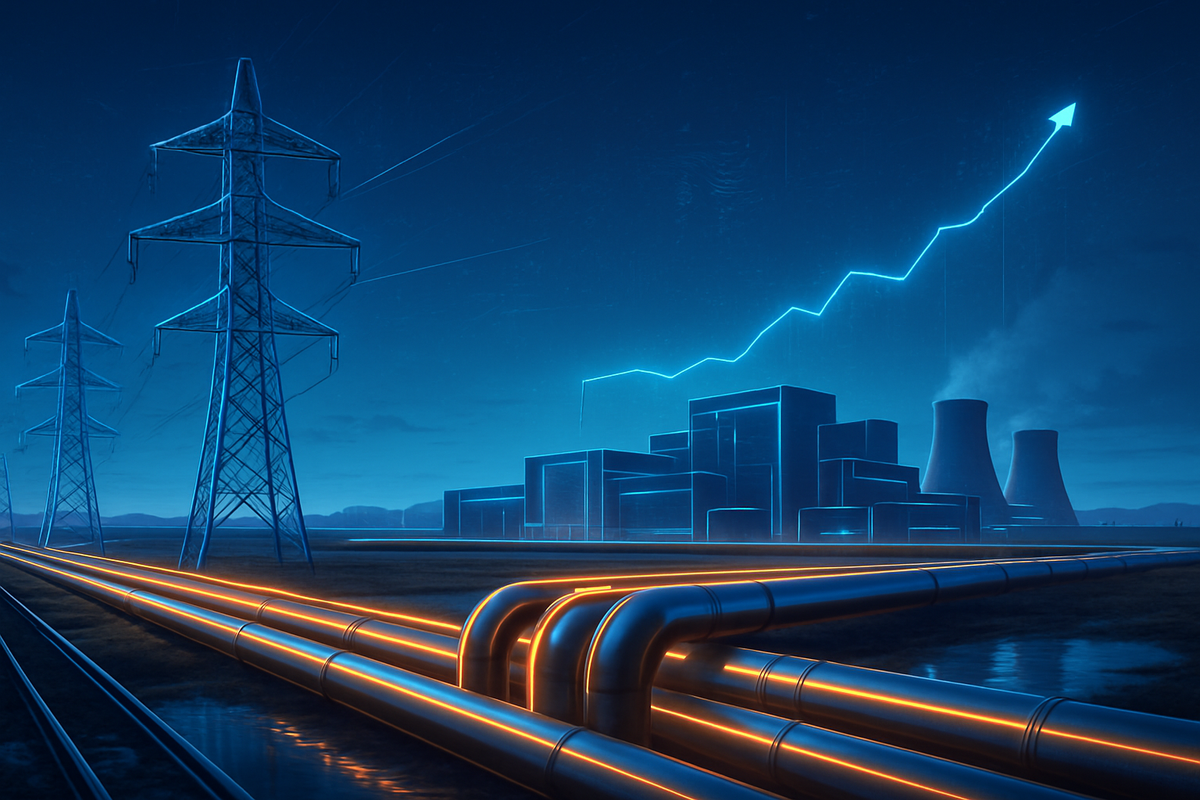
As of April 6, 2026, the global financial landscape is witnessing a historic transformation of its most traditionally "boring" sectors. New consensus forecasts released this week project a staggering 15.9% earnings growth for global infrastructure companies in 2026, a figure that dwarfs the sector’s historical low-single-digit averages. This surge is being fueled by an unprecedented "AI power supercycle," where the physical demands of the digital economy have forced a fundamental re-valuation of utilities, midstream pipelines, and grid operators.
What was once a defensive haven for dividend-seeking investors has morphed into the "picks and shovels" play of the artificial intelligence era. As hyperscalers race to build out massive data center clusters, the bottleneck has shifted from chips to kilowatts. This shift has triggered a massive capital deployment phase, with the infrastructure sector now expected to see its most profitable year in decades as the large-scale monetization of the digital grid begins to reflect in quarterly earnings.
The 2026 Reliability Shock: From Digital Pilots to Physical Power
The road to this 15.9% growth forecast began in late 2024, but it reached a fever pitch in early 2026 following what analysts have dubbed the "Reliability Shock." By February 2026, it became clear that the existing global power grid was insufficient to support the 1,000+ Terawatt-hours (TWh) of annual energy required by generative AI. This realization sparked a historic rally in the U.S. Utilities sector, which saw a 10.3% breakout in a single month as investors realized that tech giants like Meta, Google, and Amazon were willing to pay a "reliability premium" for guaranteed power.
Key players have spent the last 18 months pivoting their entire business models to meet this demand. The timeline of this acceleration is marked by the transition from AI experimentation to the physical reality of GPU clusters. In early 2026, regional grid operators like PJM and ERCOT reported that data centers now account for over 70% of new large-load interconnection requests. This has forced utilities to dramatically increase their capital expenditure plans, with the total investment needs for the global "infrastructure supercycle" now estimated to exceed $100 trillion by 2040.
The Power Winners: Utilities and Pipelines Take Center Stage
The clear leaders in this earnings explosion are the diversified utilities and midstream energy companies that can provide "firm" 24/7 power. NextEra Energy (NYSE: NEE) has emerged as a premier beneficiary, recently securing a landmark 2.5 GW capacity contract with Meta. Management at NextEra has reaffirmed a 2026 adjusted earnings-per-share (EPS) guidance of $3.92 to $4.02, explicitly targeting the high end of that range as their solar-plus-storage projects become the preferred choice for tech firms with net-zero mandates.
In the pipeline sector, the narrative has shifted toward the "AI Bridge"—the use of natural gas as the essential baseload fuel for data centers. Enbridge (NYSE: ENB) has capitalized on this trend, advancing over 50 potential data center opportunities that could require up to 10 billion cubic feet per day (Bcf/d) of natural gas. Enbridge’s 2026 adjusted EBITDA guidance of C$20.2 billion to C$20.8 billion reflects this aggressive pivot. Similarly, Southern Company (NYSE: SO) has been re-rated as a growth stock after announcing a massive $81 billion five-year capital expenditure plan. With its Vogtle nuclear units fully operational, Southern Company is one of the few players capable of providing the massive, carbon-free baseload power that hyperscalers desperately need.
A Convergence of Decarbonization and Digitization
The significance of this growth forecast lies in the convergence of two of the 21st century's most powerful trends: decarbonization and digitization. This isn't just about building more power plants; it's about a structural shift in how energy is managed. Regulatory bodies have responded to the "Reliability Shock" by moving toward "Energy Mandates," which prioritize grid stability over almost all other considerations. This has created a policy environment that favors an "all-of-the-above" strategy, combining renewables with nuclear and natural gas.
Historically, the utility sector has traded on interest rate expectations, but in 2026, it has decoupled from the bond market. The "Speed-to-Power" premium is now the primary driver of valuation. Companies like Williams Companies (NYSE: WMB) are seeing their margins expand as they leverage existing "right-of-way" assets to fast-track direct-connect gas lines for on-site power generation. This mirrors historical precedents like the railroad boom of the 19th century or the fiber-optic buildout of the late 1990s, where the underlying infrastructure ultimately captured a massive share of the economic value created by the new technology.
Short-Term Surges and Long-Term Constraints
Looking ahead to the remainder of 2026 and into 2027, the primary challenge for the infrastructure sector will be supply chain bottlenecks. While the earnings growth is currently high, the lead times for high-voltage transformers and grid-scale batteries remain a concern. Market opportunities will likely emerge for secondary infrastructure players like Eaton Corporation (NYSE: ETN) and Vertiv (NYSE: VRT), which provide the electrical components and cooling systems required for these massive builds.
In the long term, we may see a strategic pivot toward "behind-the-meter" generation, where data centers bypass the public grid entirely by building their own small modular reactors (SMRs) or natural gas plants. This would create a two-tiered energy market: one for the digital elite and one for the public. Infrastructure companies that can manage these private microgrids will likely be the next frontier for investors seeking to sustain the current 15.9% growth trajectory.
The New Reality for Infrastructure Investors
The 15.9% earnings growth forecast for 2026 marks the end of the "slow and steady" era for global infrastructure. The sector has successfully rebranded itself as the vital backbone of the AI economy, and the market is responding with higher valuations and aggressive capital allocation. The key takeaway for investors is that the "AI trade" is no longer confined to Silicon Valley; it has moved to the power lines of Georgia, the gas fields of Pennsylvania, and the wind farms of the Midwest.
Moving forward, the market will be watching for any signs of regulatory pushback or grid-connection delays that could dampen this growth. However, as long as the demand for compute continues to rise, the demand for the power to fuel it will remain insatiable. Investors should keep a close eye on quarterly updates from the "Big Three"—NextEra, Southern, and Enbridge—as they provide the roadmap for this new era of high-growth infrastructure.
This content is intended for informational purposes only and is not financial advice