The U.S. manufacturing sector continues its resilient march forward, but the cost of progress is reaching a breaking point. According to the March 2026 Institute for Supply Management (ISM) report released this morning, the headline Purchasing Managers’ Index (PMI) landed at a robust 52.7. This marks the third consecutive month of expansion for the nation's industrial heartland, fueled largely by a domestic "reshoring" boom and aggressive tax incentives.
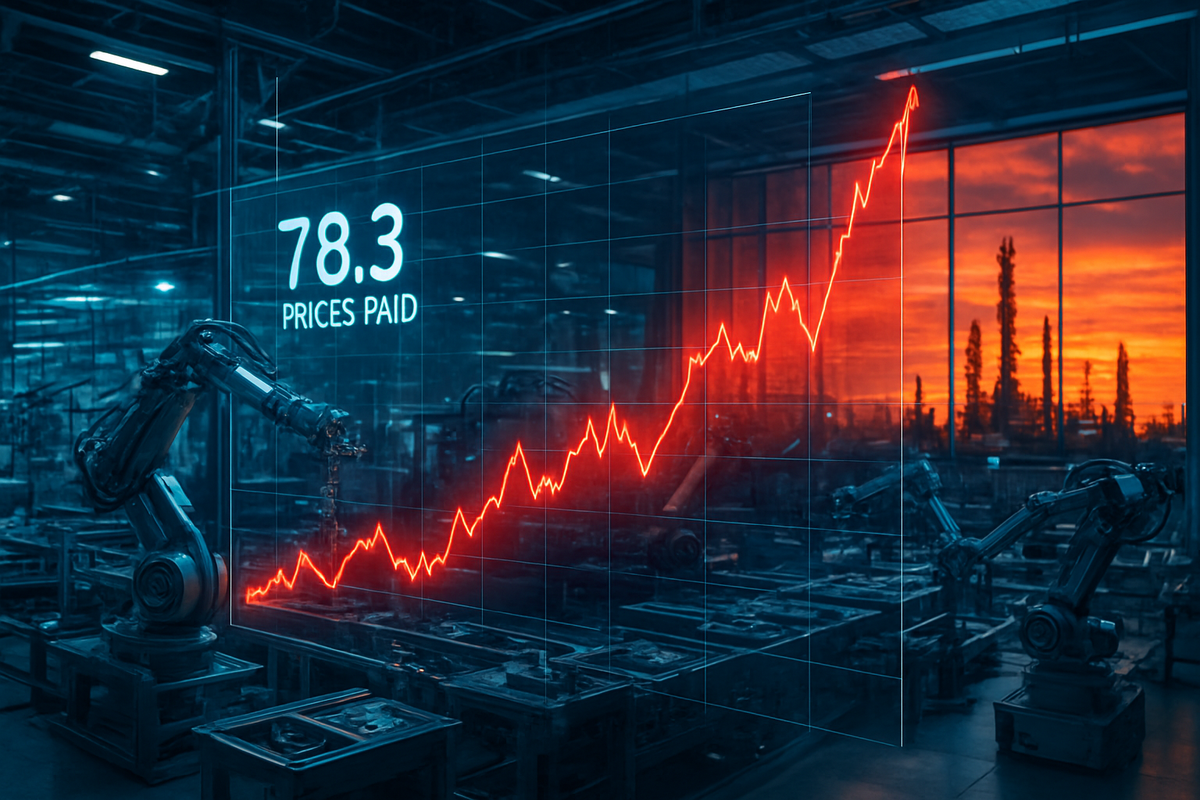
However, the celebration among economists is being cut short by a staggering spike in the Prices Paid Index, which skyrocketed to 78.3. This surge—the highest reading since the post-pandemic volatility of mid-2022—signals that the ghost of inflation has returned with a vengeance. As energy prices climb and supply chains buckle under new geopolitical weights, the manufacturing sector finds itself in a precarious state: growing in volume but bleeding in margins.
Expansion Under Fire: Breaking Down the March Data
The March PMI of 52.7 reflects a sector that is fundamentally strong yet increasingly stressed. This expansionary reading was bolstered by the "One Big Beautiful Bill Act" (OBBBA) of 2025, which restored critical tax provisions like 100% bonus depreciation. Companies like Caterpillar Inc. (NYSE: CAT) and Deere & Co (NYSE: DE) have reported steady demand as domestic infrastructure projects and modernized mining operations continue to scale up. Despite this, the underlying data suggests a cooling trend, as New Orders began to soften in the final two weeks of the month.
The timeline leading to this moment is dominated by the sudden geopolitical eruption in the Middle East. Following the outbreak of the U.S.-Israel-Iran conflict on February 28, 2026, the effective closure of the Strait of Hormuz has sent shockwaves through global trade. By mid-March, Brent crude had surged toward $120 per barrel, directly translating into the 78.3 Prices Paid reading. This 19.3-percentage point jump in costs over a two-month period is one of the most rapid price escalations in ISM history.
Initial market reactions have been predictably volatile. Bond yields spiked as traders scrapped hopes for a Federal Reserve rate cut in the first half of the year. While industrial stocks initially held steady on the headline growth, the afternoon session saw a sell-off in energy-intensive sectors. Analysts are now grappling with the realization that the "soft landing" projected for 2026 may be replaced by a period of "high-inflation expansion," where growth is maintained only by government stimulus and emergency stockpiling.
Winners and Losers in the High-Cost Normal
The divergence between growth and cost is creating a landscape of clear winners and losers. In the "win" column are the domestic energy titans and raw material providers. ExxonMobil (NYSE: XOM) and Chevron (NYSE: CVX) have seen renewed interest as the disruption in the Middle East places a premium on American-sourced hydrocarbons. Similarly, companies specializing in industrial automation, such as Rockwell Automation (NYSE: ROK), are benefiting as manufacturers desperately seek to lower labor and energy costs through technological efficiency to preserve their shrinking margins.
Conversely, the chemical and automotive sectors are bearing the brunt of the 78.3 price index. Dow Inc. (NYSE: DOW) and LyondellBasell (NYSE: LYB) are facing a "double squeeze" as the price of petroleum-based feedstocks rises while their own energy utility bills soar. In the automotive space, Ford Motor Company (NYSE: F) and General Motors (NYSE: GM) are struggling to maintain the momentum of their "Great EV Reset." With the expiration of 2025 federal tax credits and a sudden $60 billion increase in logistics costs across the industry, consumer affordability is becoming a major headwind for the remainder of the year.
Logistics giants are also caught in the crossfire. United Parcel Service (NYSE: UPS) and FedEx (NYSE: FDX) must now navigate a world where fuel surcharges are back at record levels while "Supplier Deliveries" (at 58.9) signal significant delays. Companies that have successfully transitioned to "Safety Stock" models are faring better than those still tethered to "Just-in-Time" inventory, as the latter are forced to pay exorbitant spot prices to keep assembly lines moving.
The Ghost of 2022: Broader Economic and Policy Significance
This current spike in Prices Paid draws haunting parallels to the inflation crisis of 2021-2022, but with a critical difference: the Federal Reserve's hands are now tied by a higher baseline interest rate. In early 2026, markets had been pricing in a shift toward a 2.5% neutral rate. However, the 78.3 reading has forced a hawkish pivot from Fed officials. The consensus now suggests that the federal funds rate will remain anchored at 3.5%–3.75% for the foreseeable future to prevent headline inflation from spiraling back toward 5%.
The event also highlights the long-term impact of the OBBBA legislation. While the bill was intended to spur a manufacturing renaissance, it has arguably created an "overheated" floor for the industry. By incentivizing massive capital expenditures, the government has ensured that production remains high, which in turn keeps demand for raw materials—and their prices—elevated. This "Industrial Re-Localization" is a structural shift that makes the U.S. economy more resilient to foreign trade wars but more sensitive to domestic commodity shocks.
Furthermore, the "Strait of Hormuz factor" underscores the fragility of globalized supply chains even in an era of reshoring. Despite the push for domestic production, the U.S. manufacturing base still relies on a global web of intermediate goods. The jump in the Supplier Deliveries index to 58.9 suggests that "decoupling" is far from complete, and any disruption in maritime chokepoints still carries the power to derail the American economic engine.
Looking Ahead: The Struggle for Margin Preservation
In the short term, the manufacturing sector must prepare for a "margin winter." With the Prices Paid index at 78.3, the primary strategic pivot for the next two quarters will be price pass-throughs. Consumers should expect to see higher price tags on everything from heavy appliances to consumer electronics as manufacturers attempt to offload their increased input costs. If the New Orders index continues to soften, we may see a transition from "expansion" to "stagflation" by the third quarter of 2026.
Long-term, this data will likely accelerate the adoption of "As-a-Service" models in heavy industry. To avoid massive upfront debt in a high-interest, high-cost environment, companies may increasingly rent equipment from the likes of United Rentals (NYSE: URI) rather than purchasing it outright. This shift could provide a cushion for the industry, allowing for technological upgrades without the traditional capital expenditure risks that have historically led to industrial recessions.
The potential for a strategic de-escalation in the Middle East remains the biggest "wild card." If diplomatic efforts reopen the Strait of Hormuz by summer, the Prices Paid index could collapse as quickly as it rose. However, if the conflict enters a protracted phase, the U.S. manufacturing sector will have to adapt to a "High-Cost Normal," where survival depends on extreme efficiency and government-backed resilience rather than cheap energy and global trade.
Summary and Investor Outlook
The March 2026 ISM Manufacturing report is a classic good-news, bad-news story. The 52.7 PMI headline proves that the American industrial base is robust, supported by strong legislative tailwinds and a structural commitment to reshoring. Yet, the 78.3 Prices Paid index is a loud warning siren that the battle against inflation is far from over. The convergence of geopolitical conflict and domestic stimulus has created a high-pressure environment that will test the mettle of even the most seasoned corporate leaders.
Moving forward, the market is likely to reward companies with strong "pricing power"—those capable of passing on costs without losing volume. Conversely, capital-intensive firms with high debt loads will face increased scrutiny as the prospect of Fed rate cuts vanishes into the autumn. The resilience shown in production is encouraging, but investors must remain vigilant; a manufacturing sector that grows but cannot profit is a sector built on a foundation of sand.
In the coming months, the most critical data points to watch will be the New Orders index and the monthly Consumer Price Index (CPI) releases. If demand remains resilient in the face of these price hikes, the expansion may continue. But if consumers finally balk at the "High-Cost Normal," the 2026 manufacturing boom could find itself heading for a cold, inflationary shower.
This content is intended for informational purposes only and is not financial advice