
The end of an earnings season can be a great time to discover new stocks and assess how companies are handling the current business environment. Let’s take a look at how Purple (NASDAQ: PRPL) and the rest of the consumer discretionary - home furnishings stocks fared in Q4.
The Consumer Discretionary sector, by definition, is made up of companies selling non-essential goods and services. When economic conditions deteriorate or tastes shift, consumers can easily cut back or eliminate these purchases. For long-term investors with five-year holding periods, this creates a structural challenge: the sector is inherently hit-driven, with low switching costs and fickle customers. As a result, only a handful of companies can reliably grow demand and compound earnings over long periods, which is why our bar is high and High Quality ratings are rare. Home furnishings companies design, manufacture, and sell furniture, décor, bedding, and related household products for residential and commercial spaces. Tailwinds include e-commerce expansion enabling broader distribution, continued remote-work trends sustaining home improvement interest, and premiumization as consumers invest in living spaces. However, headwinds are considerable: demand is closely tied to housing market activity, and rising mortgage rates have slowed home sales—a key purchase trigger. Bulky products carry high shipping costs and complex logistics. Intense competition from low-cost imports and mass-market retailers compresses margins, while consumer spending on furnishings is among the first categories deferred during economic downturns.
The 6 consumer discretionary - home furnishings stocks we track reported a slower Q4. As a group, revenues along with next quarter’s revenue guidance were in line with analysts’ consensus estimates.
While some consumer discretionary - home furnishings stocks have fared somewhat better than others, they have collectively declined. On average, share prices are down 3.6% since the latest earnings results.
Purple (NASDAQ: PRPL)
Founded by two brothers, Purple (NASDAQ: PRPL) creates sleep and home comfort products such as mattresses, pillows, and bedding accessories.
Purple reported revenues of $140.7 million, up 9.1% year on year. This print exceeded analysts’ expectations by 0.6%. Despite the top-line beat, it was still a slower quarter for the company with full-year revenue guidance missing analysts’ expectations and revenue guidance for next quarter missing analysts’ expectations significantly.
"2025 marked an important inflection point for Purple," said Rob DeMartini, CEO of Purple Innovation.
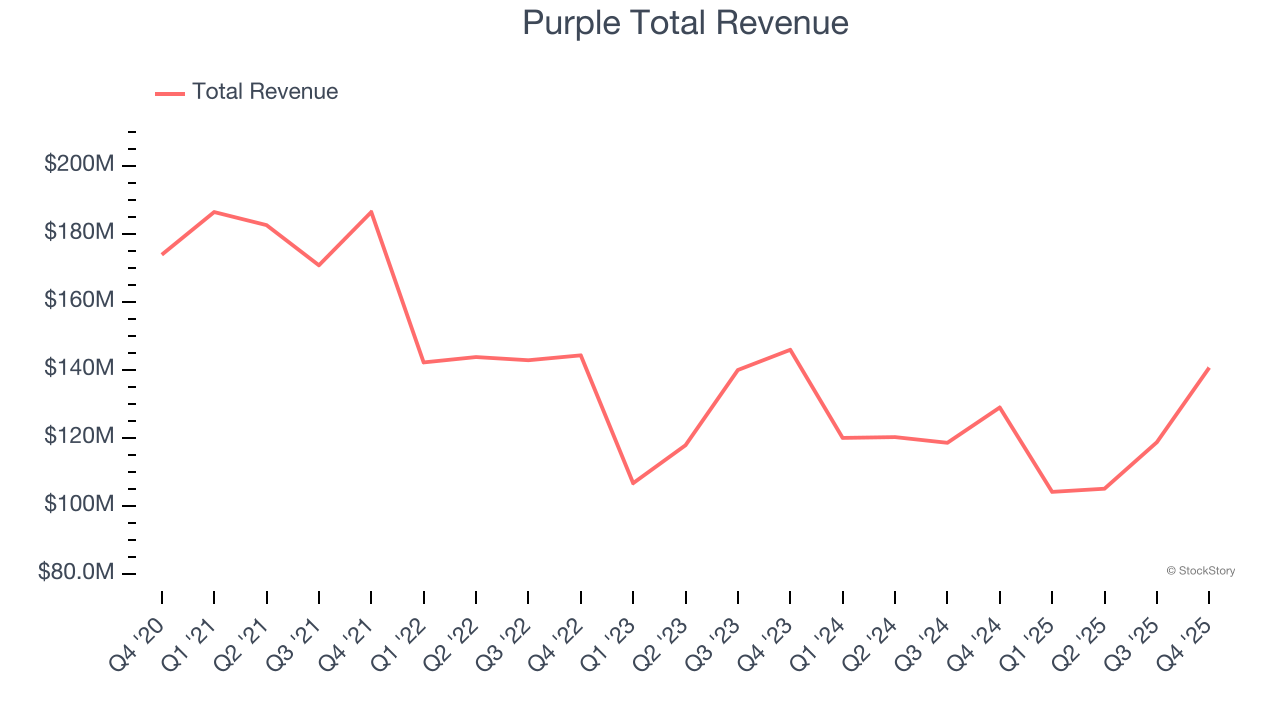
Purple scored the highest full-year guidance raise of the whole group. Still, the market seems discontent with the results. The stock is down 11.3% since reporting and currently trades at $0.62.
Read our full report on Purple here, it’s free.
Best Q4: La-Z-Boy (NYSE: LZB)
The prized possession of every mancave, La-Z-Boy (NYSE: LZB) is a furniture company specializing in recliners, sofas, and seats.
La-Z-Boy reported revenues of $541.6 million, up 3.8% year on year, outperforming analysts’ expectations by 1.1%. The business performed better than its peers, but it was unfortunately a mixed quarter with a decent beat of analysts’ adjusted operating income estimates but revenue guidance for next quarter missing analysts’ expectations.
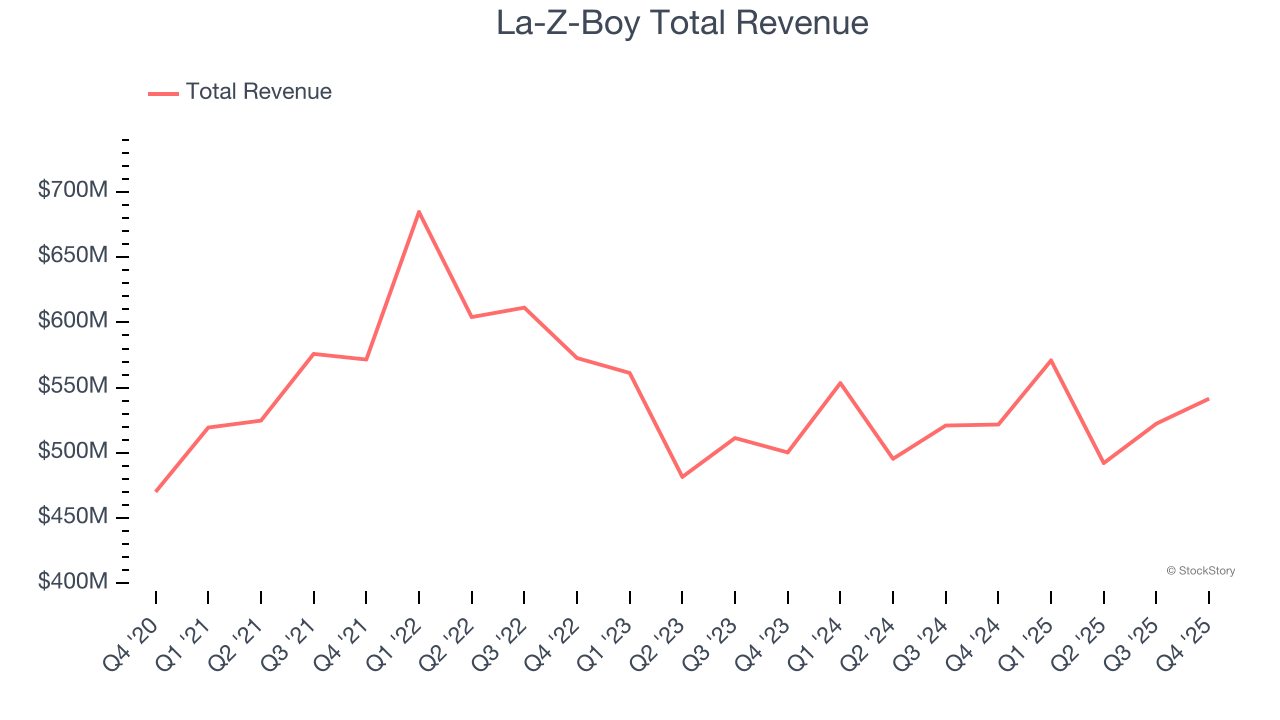
Although it had a fine quarter compared its peers, the market seems unhappy with the results as the stock is down 11.3% since reporting. It currently trades at $33.63.
Is now the time to buy La-Z-Boy? Access our full analysis of the earnings results here, it’s free.
Weakest Q4: Somnigroup (NYSE: SGI)
Established through the merger of Tempur-Pedic and Sealy in 2012, Somnigroup (NYSE: SGI) is a bedding manufacturer known for its innovative memory foam mattresses and sleep products
Somnigroup reported revenues of $1.87 billion, up 54.7% year on year, falling short of analysts’ expectations by 3.2%. It was a slower quarter as it posted a miss of analysts’ revenue estimates and full-year EPS guidance missing analysts’ expectations.
Somnigroup delivered the fastest revenue growth but had the weakest performance against analyst estimates in the group. As expected, the stock is down 15.6% since the results and currently trades at $81.07.
Read our full analysis of Somnigroup’s results here.
Mohawk Industries (NYSE: MHK)
Established in 1878, Mohawk Industries (NYSE: MHK) is a leading producer of floor-covering products for both residential and commercial applications.
Mohawk Industries reported revenues of $2.7 billion, up 2.4% year on year. This result beat analysts’ expectations by 0.9%. Taking a step back, it was a mixed quarter as it also logged a narrow beat of analysts’ revenue estimates but EPS guidance for next quarter missing analysts’ expectations.
The stock is down 21.5% since reporting and currently trades at $104.84.
Read our full, actionable report on Mohawk Industries here, it’s free.
Leggett & Platt (NYSE: LEG)
Founded in 1883, Leggett & Platt (NYSE: LEG) is a diversified manufacturer of products and components for various industries.
Leggett & Platt reported revenues of $938.6 million, down 11.2% year on year. This print was in line with analysts’ expectations. Zooming out, it was a slower quarter as it recorded a miss of analysts’ adjusted operating income estimates and a miss of analysts’ EBITDA estimates.
Leggett & Platt had the slowest revenue growth among its peers. The stock is down 9.5% since reporting and currently trades at $11.22.
Read our full, actionable report on Leggett & Platt here, it’s free.
Market Update
Late in 2025 into early 2026, there was hand wringing around artificial intelligence. For software companies, the fear was that AI would erode pricing power and compress margins as new tools made it easier to replicate what once required expensive enterprise platforms. Crypto investors had their own version of the same anxiety: if AI agents could trade, allocate capital, and manage wallets autonomously, what exactly was the long-term value of today’s crypto infrastructure?
These concerns triggered a noticeable rotation away from these sectors and into safer havens. But markets rarely dwell on one narrative for long. Spring 2026 came, and the focus shifted abruptly from technological disruption to geopolitical risk. The US’ conflict with Iran became the dominant driver of market psychology, and when geopolitics takes center stage, the script changes quickly. Investors stop debating growth rates and start worrying about oil supply, inflation, and global stability.
Want to invest in winners with rock-solid fundamentals? Check out our Strong Momentum Stocks and add them to your watchlist. These companies are poised for growth regardless of the political or macroeconomic climate.
StockStory’s analyst team — all seasoned professional investors — uses quantitative analysis and automation to deliver market-beating insights faster and with higher quality.