Integrated energy company Chevron (NYSE: CVX) met Wall Street’s revenue expectations in Q1 CY2026, but sales were flat year on year at $47.56 billion. Its non-GAAP profit of $1.41 per share was 45.6% above analysts’ consensus estimates.
Is now the time to buy Chevron? Find out by accessing our full research report, it’s free.
Chevron (CVX) Q1 CY2026 Highlights:
- Revenue: $47.56 billion vs analyst estimates of $47.54 billion (flat year on year, in line)
- Adjusted EPS: $1.41 vs analyst estimates of $0.97 (45.6% beat)
- Adjusted EBITDA: $9.18 billion vs analyst estimates of $10.2 billion (19.3% margin, 10% miss)
- Operating Margin: 4.6%, down from 12.2% in the same quarter last year
- Free Cash Flow was -$1.55 billion, down from $1.26 billion in the same quarter last year
- Oil production: up 23.7% year on year
- Market Capitalization: $385.1 billion
“Despite heightened geopolitical volatility and related supply disruptions, Chevron delivered solid first quarter performance, underscoring the resilience of our portfolio and the value of disciplined execution,” said Mike Wirth, Chevron’s Chairman and Chief Executive Officer.
Company Overview
Operating everything from deepwater drilling rigs to corner gas stations, Chevron (NYSE: CVX) explores for, produces, and transports crude oil and natural gas, then refines that crude oil into gasoline, diesel, and other petroleum products.
Revenue Growth
Cyclical industries such as Energy can make mediocre companies look great for a time, but a long-term view reveals which businesses can actually withstand and adapt to changing conditions. Thankfully, Chevron’s 14.7% annualized revenue growth over the last five years was solid. Its growth beat the average energy upstream and integrated energy company and shows its offerings resonate with customers, a helpful starting point for our analysis.
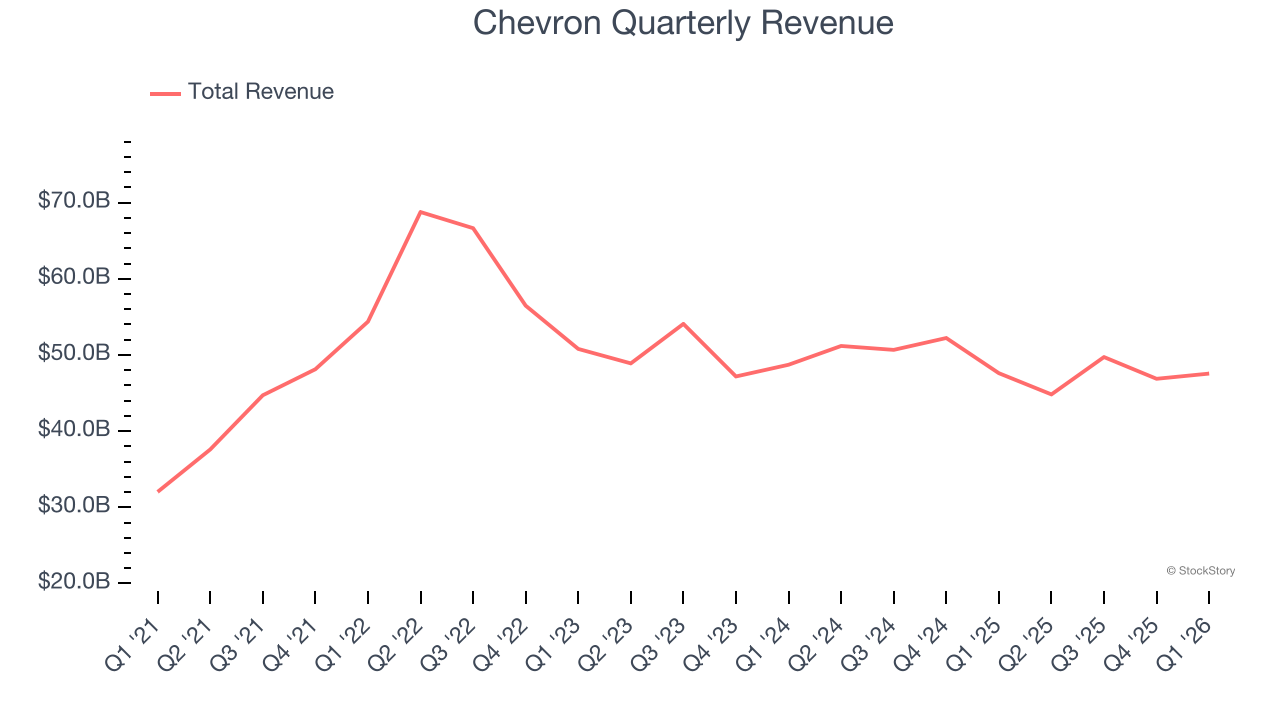
Even a long stretch in Energy can be shaped by a single commodity cycle, so extending the view to ten years adds another perspective and reveals which companies are built to grow regardless of the pricing regime. Chevron’s annualized revenue growth of 4% over the last ten years is below its five-year trend, but we still think the results suggest decent demand.
While looking at revenue is important, it can also introduce noise around commodity prices and M&A. Analyzing drivers of revenue, on the other hand, highlights what is happening inside the asset base and whether the economic footprint of a company is expanding. Over the last two years, Chevron’s oil production averaged 16.7% year-on-year growth while its natural gas production averaged 18.6% year-on-year growth. 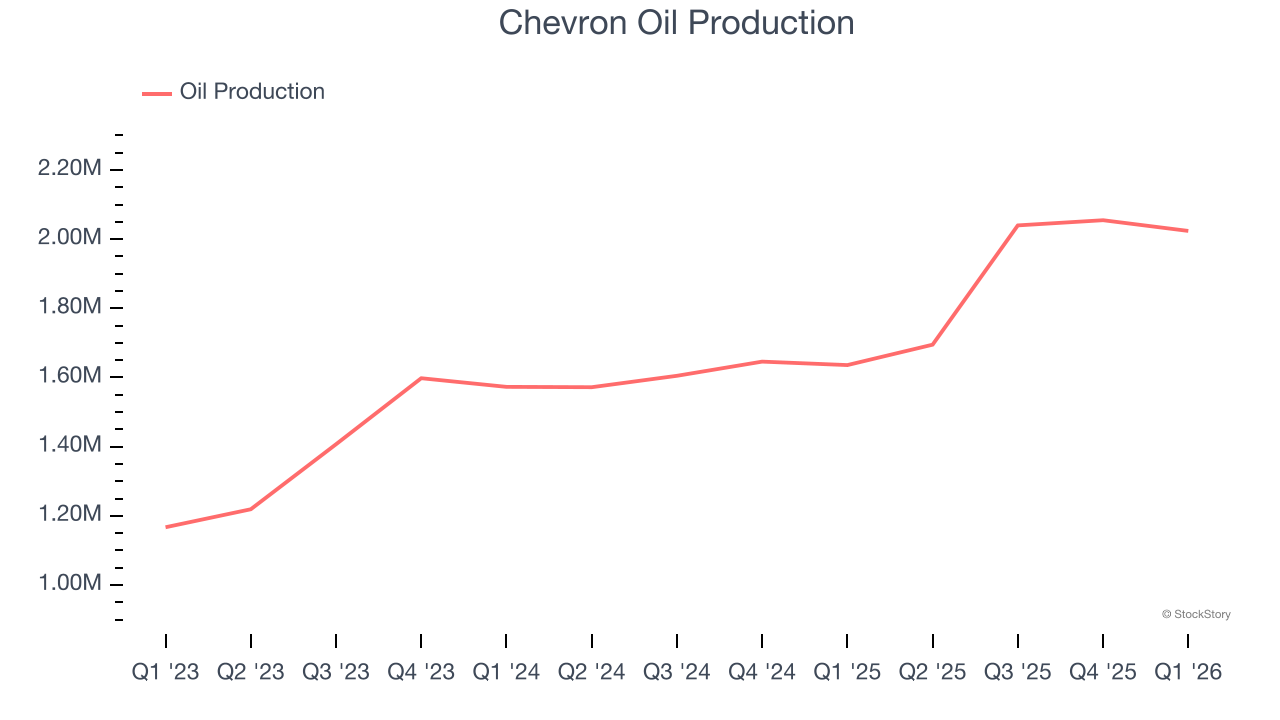
This quarter, Chevron’s $47.56 billion of revenue was flat year on year and in line with Wall Street’s estimates. This quarter, Chevron reported robust year-on-year Oil production growth of 23.7%.
WHILE YOU’RE HERE: The Next Palantir? One satellite company captures images of every point on Earth. Every single day. The Pentagon wants it. Hedge funds are using it to beat earnings. You’ve probably never heard of it.
This is what the early days of Palantir looked like before it became a $437 billion giant. Same playbook. Different technology. If you missed Palantir, you need to see this. Claim The Stock Ticker for Free HERE.
Adjusted EBITDA Margin
Chevron was profitable over the last five years but held back by its large cost base. Its average EBITDA margin of 24.5% was weak for an upstream and integrated energy business.
Looking at the trend in its profitability, Chevron’s EBITDA margin decreased by 3.4 percentage points over the last year. This raises questions about the company’s expense base because its revenue growth should have given it leverage on its fixed costs, resulting in better economies of scale and profitability. Chevron’s performance was poor no matter how you look at it - it shows that costs were rising and it couldn’t pass them onto its customers.
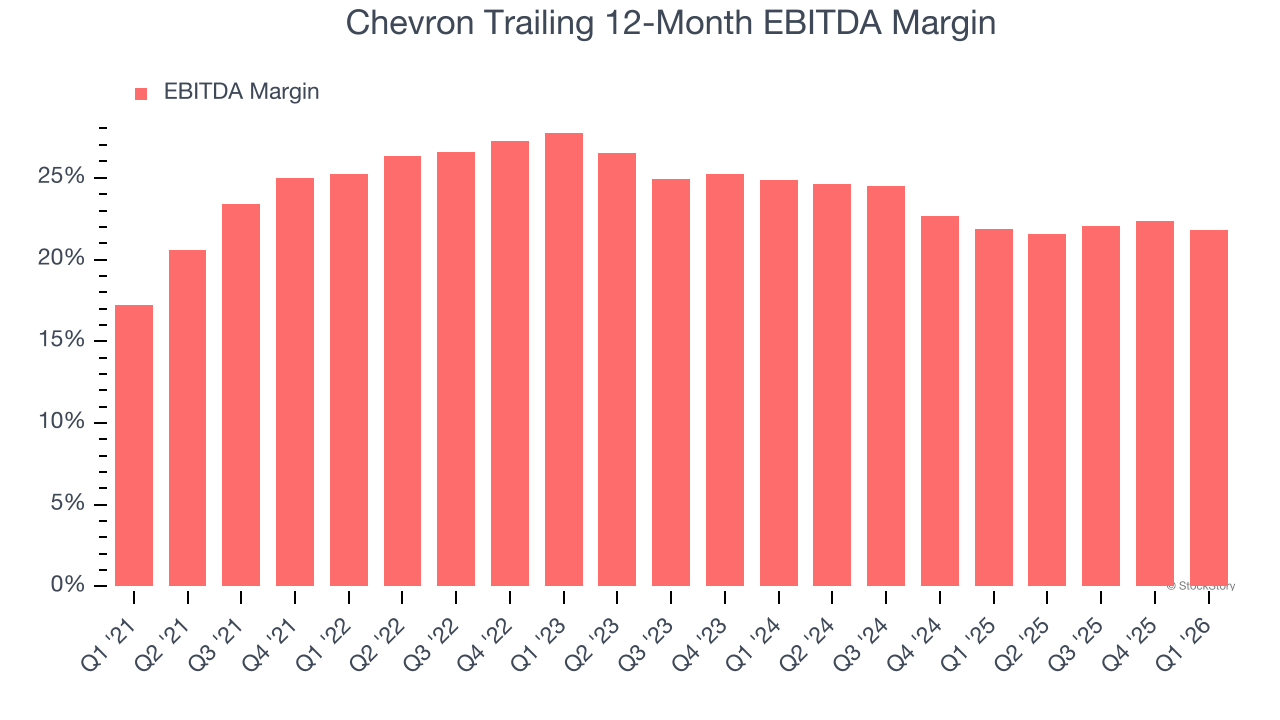
In Q1, Chevron generated an EBITDA margin profit margin of 19.3%, down 2.2 percentage points year on year. This contraction shows it was less efficient because its expenses increased relative to its revenue. This adjusted EBITDA fell short of Wall Street’s estimates.
Cash Is King
Adjusted EBITDA shows how profitable a company’s existing “rock” is before financing and reinvestment, while free cash flow shows how much value remains after paying to replace those wells. Because production declines over time, strong EBITDA can coexist with weak FCF if drilling is expensive or declines are steep. FCF therefore captures both operating efficiency and the cost of sustaining production.
Chevron has shown impressive cash profitability, giving it the option to reinvest or return capital to investors. The company’s free cash flow margin averaged 10.4% over the last five years, better than the broader energy upstream and integrated energy sector.
Absolute FCF margin levels matter but so does stability of free cash flow. All else equal, we’d prefer a 25.0% average free cash flow margin that is quite steady no matter how commodity prices behave rather than extremely high margins when times are good and negative ones when they’re tough.
Chevron’s ratio of quarterly free cash flow volatility to WTI crude price volatility over the past five years was 4 (lower is better), indicating excellent insulation from commodity swings. This stability supports superior capital access in downturns and positions Chevron to act as a consolidator when weaker peers are forced to retrench.
You may be asking why we wait until the free cash flow line to perform this stability analysis versus commodity prices. Why not compare revenue or EBITDA to WTI in the case of Chevron? Because what ultimately matters is not how much revenue or profit you earn when prices are high but how much cash you can generate when prices are low. Free cash flow is the superior metric because it includes everything from hedging prowess to growth and maintenance capex to management behavior during good times and bad.
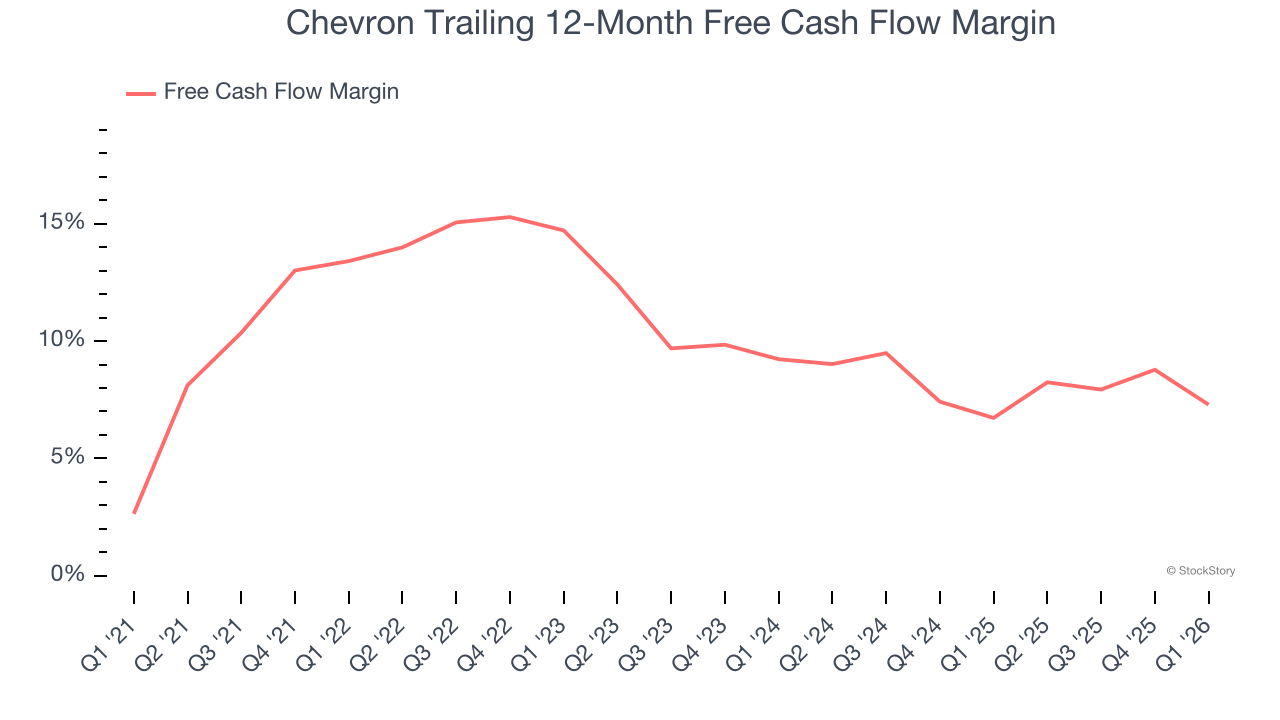
Chevron burned through $1.55 billion of cash in Q1, equivalent to a negative 3.3% margin. The company’s cash flow turned negative after being positive in the same quarter last year, which isn’t ideal considering its longer-term trend.
Key Takeaways from Chevron’s Q1 Results
Although revenue was in line, it was good to see Chevron beat analysts’ EPS expectations this quarter. Overall, this quarter was fine but not the windfall that could have been with higher oil prices as a result of the war in Iran. The stock traded up 1.3% to $195.84 immediately after reporting.
Should you buy the stock or not? The latest quarter does matter, but not nearly as much as longer-term fundamentals and valuation, when deciding if the stock is a buy. We cover that in our actionable full research report which you can read here (it’s free).