Let’s dig into the relative performance of Parsons (NYSE: PSN) and its peers as we unravel the now-completed Q1 defense contractors earnings season.
Defense contractors typically require technical expertise and government clearance. Companies in this sector can also enjoy long-term contracts with government bodies, leading to more predictable revenues. Combined, these factors create high barriers to entry and can lead to limited competition. Lately, geopolitical tensions–whether it be Russia’s invasion of Ukraine or China’s aggression towards Taiwan–highlight the need for defense spending. On the other hand, demand for these products can ebb and flow with defense budgets and even who is president, as different administrations can have vastly different ideas of how to allocate federal funds.
The 13 defense contractors stocks we track reported a very strong Q1. As a group, revenues beat analysts’ consensus estimates by 3.4% while next quarter’s revenue guidance was 1.9% below.
Amidst this news, share prices of the companies have had a rough stretch. On average, they are down 7% since the latest earnings results.
Parsons (NYSE: PSN)
Delivering aerospace technology during the Cold War-era, Parsons (NYSE: PSN) offers engineering, construction, and cybersecurity solutions for the infrastructure and defense sectors.
Parsons reported revenues of $1.49 billion, down 4.1% year on year. This print fell short of analysts’ expectations by 0.5%, but it was still a strong quarter for the company with an impressive beat of analysts’ adjusted operating income estimates.
“Our first quarter results highlighted the resilience of our business and our team's high level of execution, as we delivered our highest adjusted EBITDA margin ever, reached record levels for both total and funded backlog, achieved a robust book-to-bill ratio of 1.4x in both segments, and generated record first quarter cash flow. Revenue performance was in line with our expectations, and we continued to complement our organic growth with strategic, accretive acquisitions that enhance our differentiation and drive long-term shareholder value," said Carey Smith, chair, president, and chief executive officer.
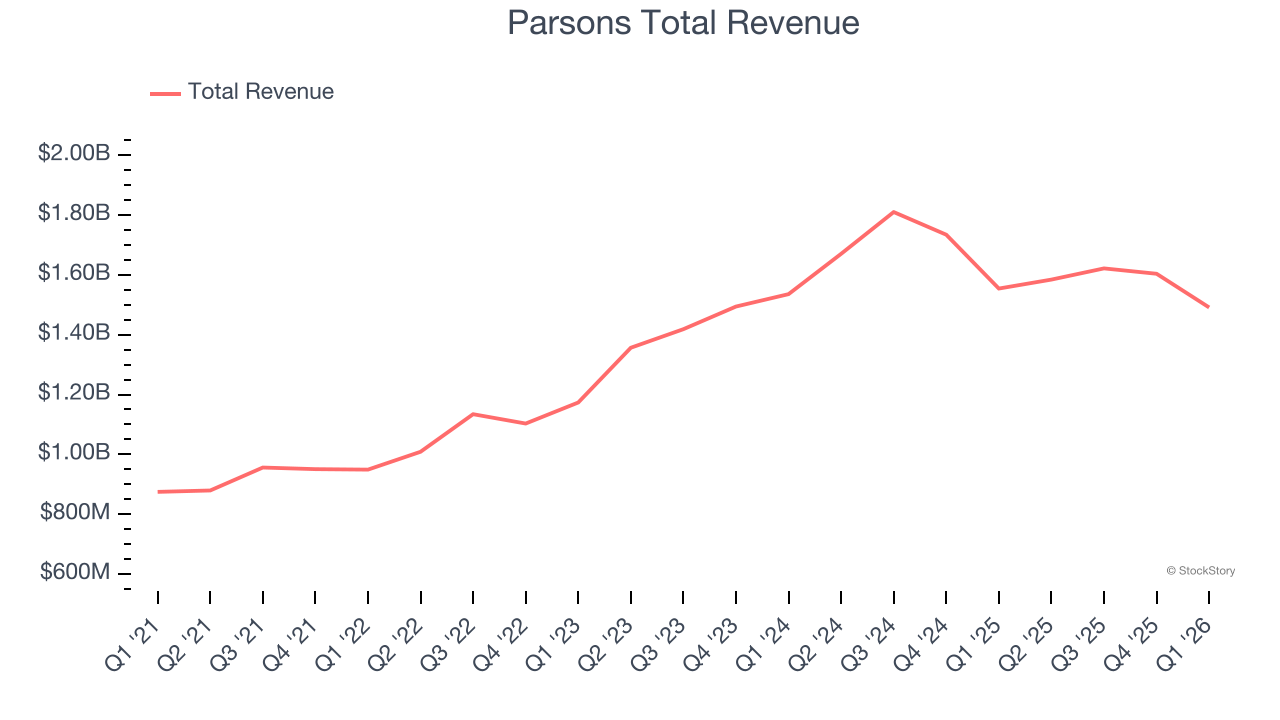
The stock is down 2.2% since reporting and currently trades at $50.69.
Is now the time to buy Parsons? Access our full analysis of the earnings results here, it’s free.
Best Q1: Mercury Systems (NASDAQ: MRCY)
Founded in 1981, Mercury Systems (NASDAQ: MRCY) specializes in providing processing subsystems and components for primarily defense applications.
Mercury Systems reported revenues of $235.8 million, up 11.5% year on year, outperforming analysts’ expectations by 14.2%. The business had an incredible quarter with a beat of analysts’ EPS and EBITDA estimates.
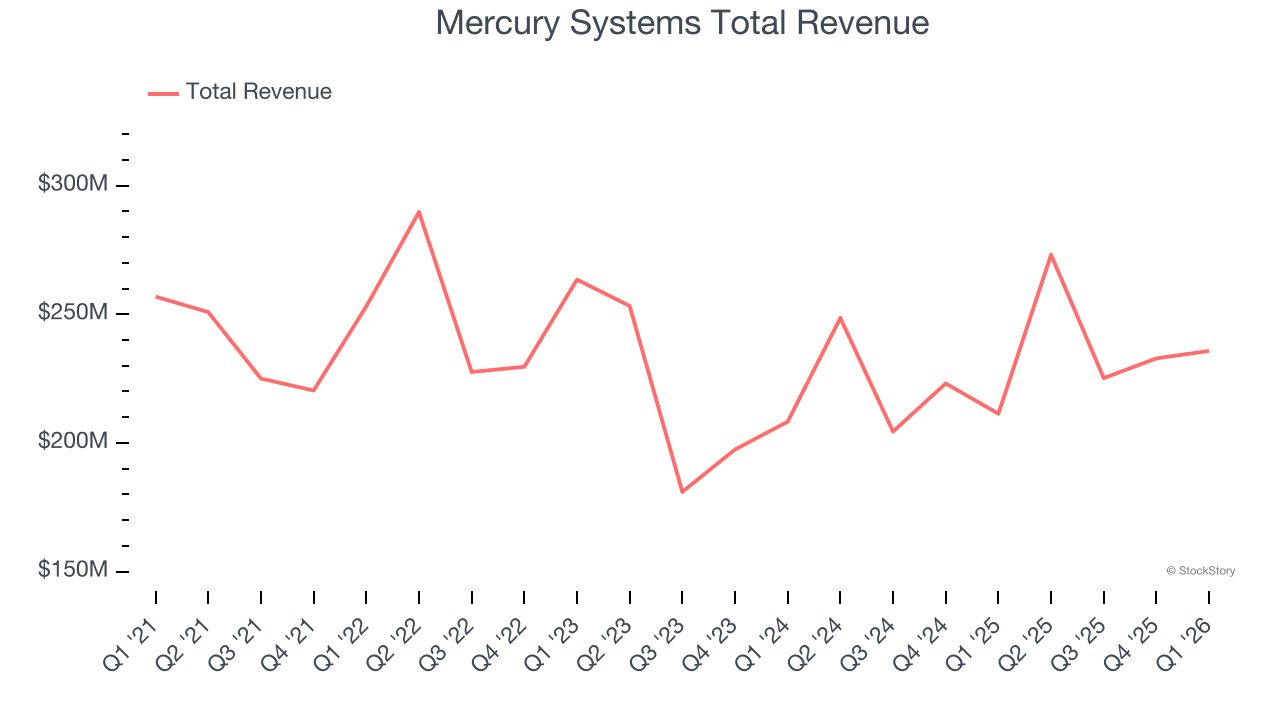
Mercury Systems delivered the biggest analyst estimates beat among its peers. The market seems happy with the results as the stock is up 11% since reporting. It currently trades at $92.06.
Is now the time to buy Mercury Systems? Access our full analysis of the earnings results here, it’s free.
Weakest Q1: Lockheed Martin (NYSE: LMT)
Headquartered in Maryland, Famous for the F-35 aircraft, Lockheed Martin (NYSE: LMT) specializes in defense, space, homeland security, and information technology products.
Lockheed Martin reported revenues of $18.02 billion, flat year on year, falling short of analysts’ expectations by 0.9%. It was a softer quarter as it posted a significant miss of analysts’ adjusted operating income estimates.
Lockheed Martin delivered the weakest performance against analyst estimates in the group. As expected, the stock is down 6.9% since the results and currently trades at $516.87.
Read our full analysis of Lockheed Martin’s results here.
KBR (NYSE: KBR)
Known for projects like the construction of Guantanamo Bay, KBR provides professional services and technologies, specializing in engineering, construction, and government services sectors.
KBR reported revenues of $1.92 billion, down 4.7% year on year. This number surpassed analysts’ expectations by 2.8%. It was an exceptional quarter as it also put up a solid beat of analysts’ EBITDA estimates.
KBR scored the highest full-year guidance raise but had the slowest revenue growth among its peers. The stock is down 22.2% since reporting and currently trades at $30.09.
Read our full, actionable report on KBR here, it’s free.
General Dynamics (NYSE: GD)
Creator of the famous M1 Abrahms tank, General Dynamics (NYSE: GD) develops aerospace, marine systems, combat systems, and information technology products.
General Dynamics reported revenues of $13.48 billion, up 10.3% year on year. This print beat analysts’ expectations by 5.9%. Overall, it was a stunning quarter as it also recorded an impressive beat of analysts’ EBITDA estimates.
The stock is up 7% since reporting and currently trades at $335.66.
Read our full, actionable report on General Dynamics here, it’s free.
Market Update
Late in 2025 into early 2026, there was hand wringing around artificial intelligence. For software companies, the fear was that AI would erode pricing power and compress margins as new tools made it easier to replicate what once required expensive enterprise platforms. Crypto investors had their own version of the same anxiety: if AI agents could trade, allocate capital, and manage wallets autonomously, what exactly was the long-term value of today’s crypto infrastructure?
These concerns triggered a noticeable rotation away from these sectors and into safer havens. But markets rarely dwell on one narrative for long. Spring 2026 came, and the focus shifted abruptly from technological disruption to geopolitical risk. The US’ conflict with Iran became the dominant driver of market psychology, and when geopolitics takes center stage, the script changes quickly. Investors stop debating growth rates and start worrying about oil supply, inflation, and global stability.
Want to invest in winners with rock-solid fundamentals? Check out our Top 6 Stocks and add them to your watchlist. These companies are poised for growth regardless of the political or macroeconomic climate.
StockStory’s analyst team — all seasoned professional investors — uses quantitative analysis and automation to deliver market-beating insights faster and with higher quality.