Clothing and accessories retailer Urban Outfitters (NASDAQ: URBN) announced better-than-expected revenue in Q1 CY2026, with sales up 11.4% year on year to $1.48 billion. Its GAAP profit of $1.30 per share was 16.4% above analysts’ consensus estimates.
Is now the time to buy Urban Outfitters? Find out by accessing our full research report, it’s free.
Urban Outfitters (URBN) Q1 CY2026 Highlights:
- Revenue: $1.48 billion vs analyst estimates of $1.46 billion (11.4% year-on-year growth, 1.4% beat)
- EPS (GAAP): $1.30 vs analyst estimates of $1.12 (16.4% beat)
- Adjusted EBITDA: $183.9 million vs analyst estimates of $162.1 million (12.4% margin, 13.4% beat)
- Operating Margin: 9.4%, in line with the same quarter last year
- Free Cash Flow was -$177.8 million compared to -$13.13 million in the same quarter last year
- Same-Store Sales rose 5.6% year on year, in line with the same quarter last year
- Market Capitalization: $5.90 billion
“We are pleased to report record first quarter sales and earnings driven by positive retail segment ‘comps’ at all brands and impressive double-digit growth in both our Wholesale and Subscription segments,” said Richard A. Hayne, Chief Executive Officer.
Company Overview
Founded as a purveyor of vintage items, Urban Outfitters (NASDAQ: URBN) now largely sells new apparel and accessories to teens and young adults seeking on-trend fashion.
Revenue Growth
Examining a company’s long-term performance can provide clues about its quality. Any business can have short-term success, but a top-tier one grows for years.
With $6.32 billion in revenue over the past 12 months, Urban Outfitters is a mid-sized retailer, which sometimes brings disadvantages compared to larger competitors benefiting from better economies of scale.
As you can see below, Urban Outfitters’s 9.2% annualized revenue growth over the last three years was mediocre, but to its credit, it opened new stores and increased sales at existing, established locations.
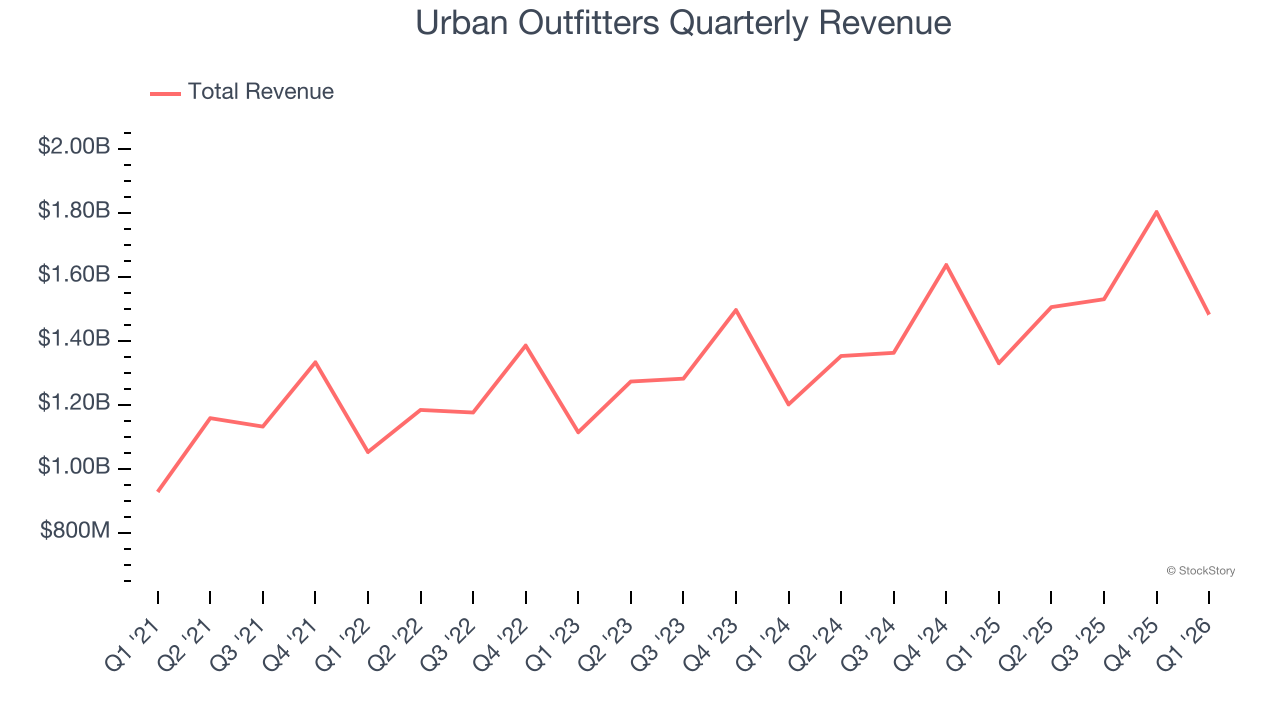
This quarter, Urban Outfitters reported year-on-year revenue growth of 11.4%, and its $1.48 billion of revenue exceeded Wall Street’s estimates by 1.4%.
Looking ahead, sell-side analysts expect revenue to grow 7.5% over the next 12 months, a slight deceleration versus the last three years. Still, this projection is healthy and indicates the market is baking in success for its products.
WHILE YOU’RE HERE: The Next Palantir? One satellite company captures images of every point on Earth. Every single day. The Pentagon wants it. Hedge funds are using it to beat earnings. You’ve probably never heard of it.
This is what the early days of Palantir looked like before it became a $437 billion giant. Same playbook. Different technology. If you missed Palantir, you need to see this. Claim The Stock Ticker for Free HERE.
Store Performance
Number of Stores
The number of stores a retailer operates is a critical driver of how quickly company-level sales can grow.
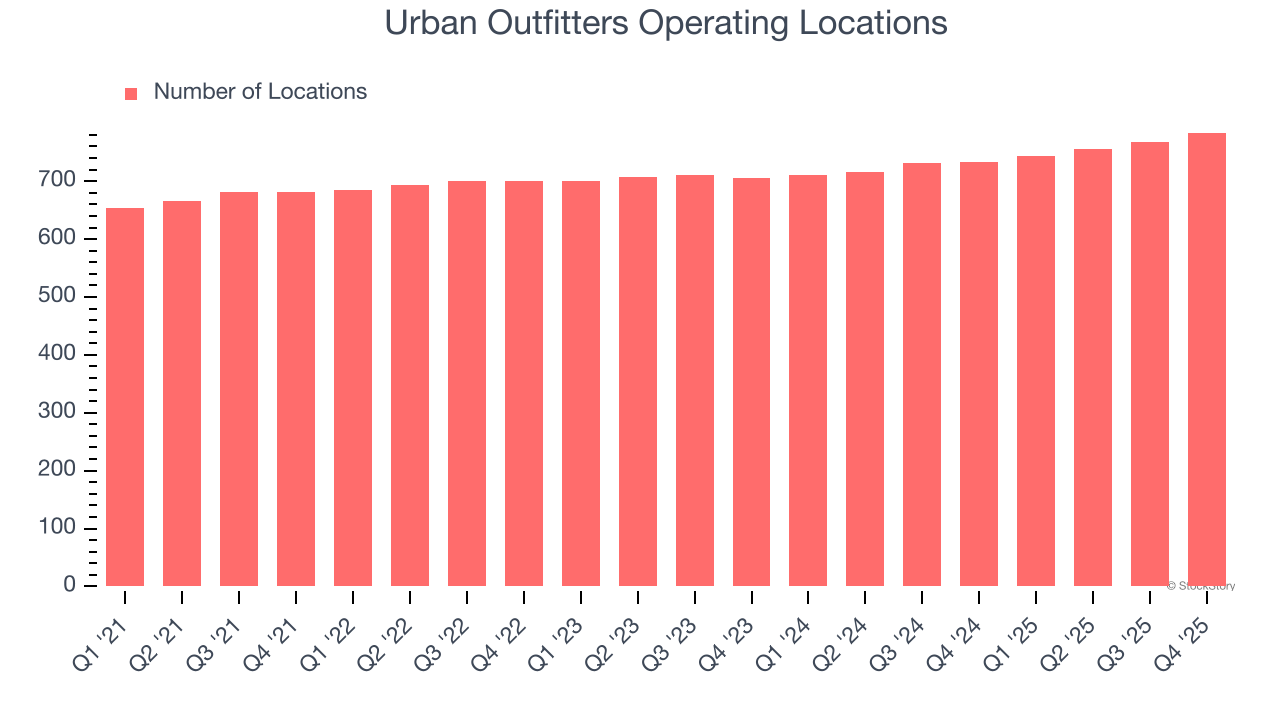
Urban Outfitters opened new stores at a rapid clip over the last two years, averaging 4.3% annual growth, much faster than the broader consumer retail sector. This gives it a chance to become a large, scaled business over time.
When a retailer opens new stores, it usually means it’s investing for growth because demand is greater than supply, especially in areas where consumers may not have a store within reasonable driving distance.
Note that Urban Outfitters reports its store count intermittently, so some data points are missing in the chart below.
Same-Store Sales
A company's store base only paints one part of the picture. When demand is high, it makes sense to open more. But when demand is low, it’s prudent to close some locations and use the money in other ways. Same-store sales gives us insight into this topic because it measures organic growth for a retailer's e-commerce platform and brick-and-mortar shops that have existed for at least a year.
Urban Outfitters has been one of the most successful retailers over the last two years thanks to skyrocketing demand within its existing locations. On average, the company has posted exceptional year-on-year same-store sales growth of 4.8%. This performance suggests its rollout of new stores is beneficial for shareholders. We like this backdrop because it gives Urban Outfitters multiple ways to win: revenue growth can come from new stores, e-commerce, or increased foot traffic and higher sales per customer at existing locations.
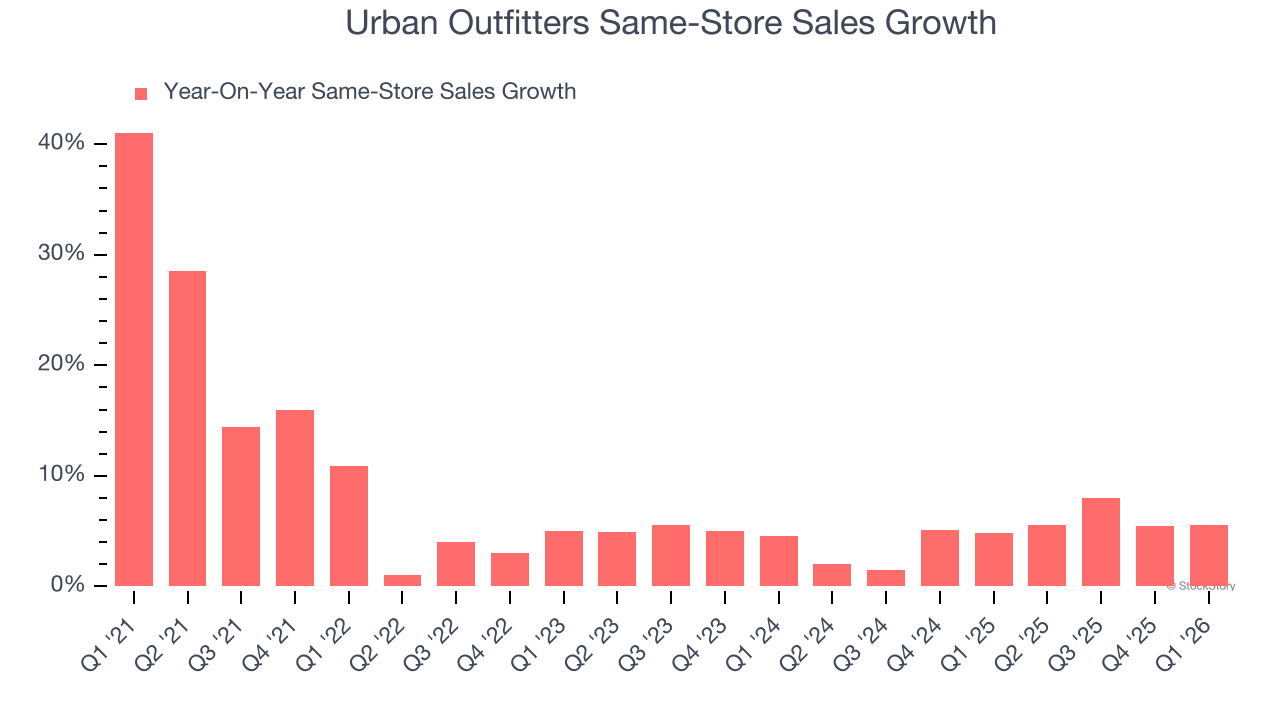
In the latest quarter, Urban Outfitters’s same-store sales rose 5.6% year on year. This performance was more or less in line with its historical levels.
Key Takeaways from Urban Outfitters’s Q1 Results
We were impressed by how significantly Urban Outfitters blew past analysts’ EBITDA expectations this quarter. We were also glad its EPS outperformed Wall Street’s estimates. Zooming out, we think this quarter featured some important positives. The stock traded up 3.2% to $73.95 immediately following the results.
Urban Outfitters had an encouraging quarter, but one earnings result doesn’t necessarily make the stock a buy. Let’s see if this is a good investment. The latest quarter does matter, but not nearly as much as longer-term fundamentals and valuation, when deciding if the stock is a buy. We cover that in our actionable full research report which you can read here (it’s free).