The end of an earnings season can be a great time to discover new stocks and assess how companies are handling the current business environment. Let’s take a look at how Matthews (NASDAQ: MATW) and the rest of the consumer discretionary - specialized consumer services stocks fared in Q1.
The Consumer Discretionary sector, by definition, is made up of companies selling non-essential goods and services. When economic conditions deteriorate or tastes shift, consumers can easily cut back or eliminate these purchases. For long-term investors with five-year holding periods, this creates a structural challenge: the sector is inherently hit-driven, with low switching costs and fickle customers. As a result, only a handful of companies can reliably grow demand and compound earnings over long periods, which is why our bar is high and High Quality ratings are rare. Some consumer discretionary companies don’t fall neatly into a category because their products or services are unique. Although their offerings may be niche, these companies have often found more efficient or technology-enabled ways of doing or selling something that has existed for a while. Technology can be a double-edged sword, though, as it may lower the barriers to entry for new competitors and allow them to serve customers better.
The 10 consumer discretionary - specialized consumer services stocks we track reported a mixed Q1. As a group, revenues beat analysts’ consensus estimates by 1.5% while next quarter’s revenue guidance was 0.5% above.
In light of this news, share prices of the companies have held steady as they are up 2% on average since the latest earnings results.
Best Q1: Matthews (NASDAQ: MATW)
Originally a death care company, Matthews International (NASDAQ: MATW) is a diversified company offering ceremonial services, brand solutions and industrial technologies.
Matthews reported revenues of $258.6 million, down 39.5% year on year. This print exceeded analysts’ expectations by 2%. Overall, it was a strong quarter for the company with a beat of analysts’ EPS and EBITDA estimates.
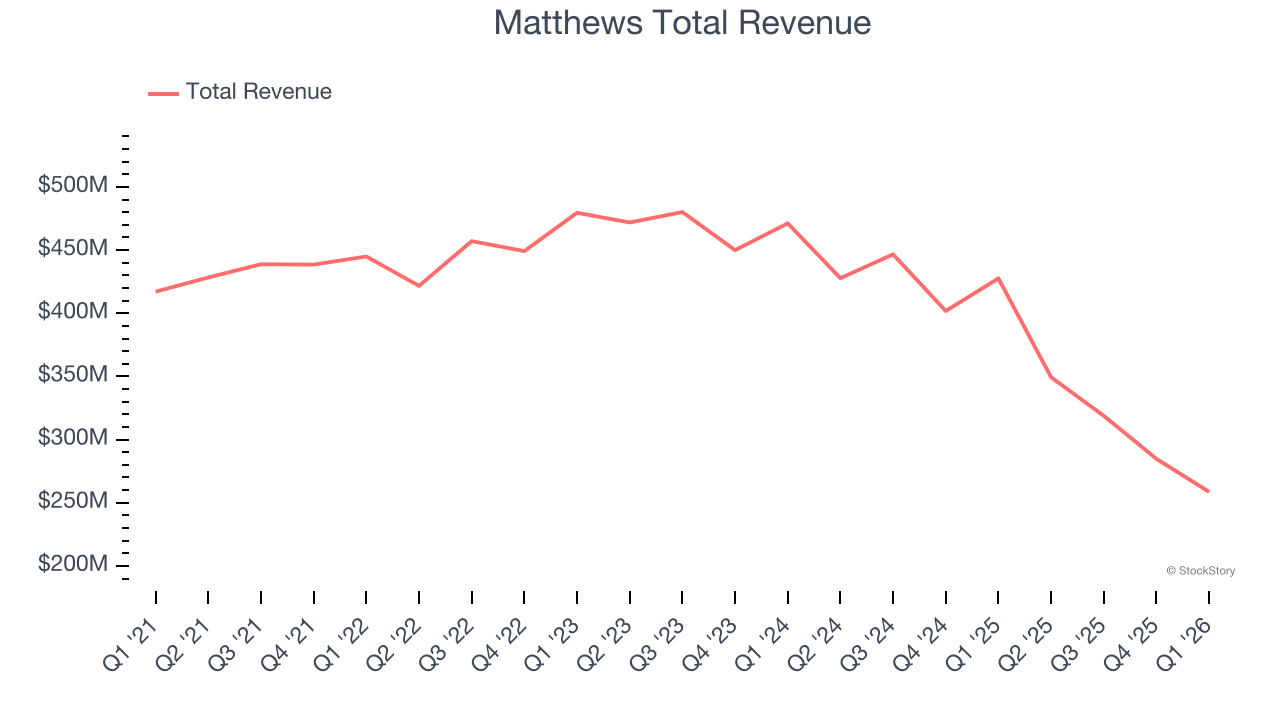
Matthews delivered the slowest revenue growth among its peers. Investor expectations, however, were likely higher than Wall Street’s published projections, leaving some wishing for even better results (analysts’ consensus estimates are those published by big banks and advisory firms, not the investors who make buy and sell decisions). The stock is down 8.9% since reporting and currently trades at $25.99.
Is now the time to buy Matthews? Access our full analysis of the earnings results here, it’s free.
H&R Block (NYSE: HRB)
Founded in 1955 by brothers Henry W. Bloch and Richard A. Bloch, H&R Block (NYSE: HRB) is a tax preparation company offering professional tax assistance and financial solutions to individuals and small businesses.
H&R Block reported revenues of $2.40 billion, up 5.3% year on year, outperforming analysts’ expectations by 2.5%. The business had a strong quarter with full-year EPS and revenue guidance slightly topping analysts’ expectations.
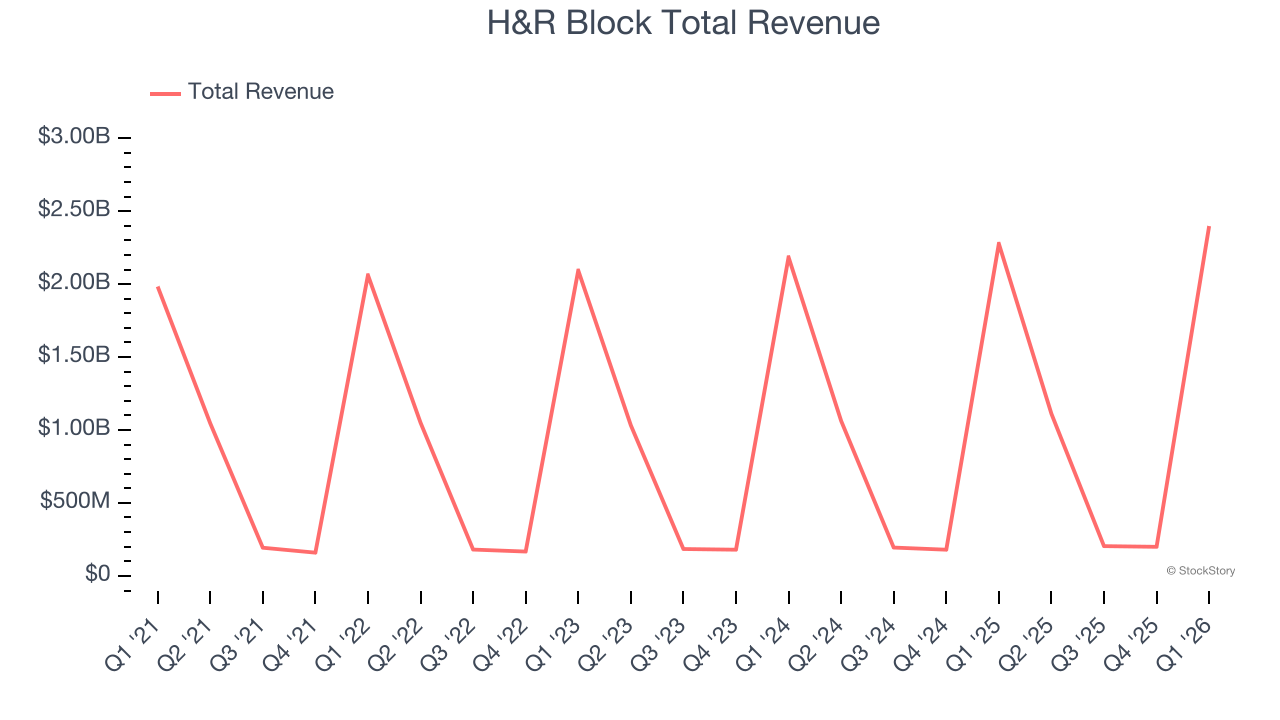
H&R Block achieved the highest full-year guidance raise in the group. The market seems happy with the results as the stock is up 39.5% since reporting. It currently trades at $40.90.
Is now the time to buy H&R Block? Access our full analysis of the earnings results here, it’s free.
Weakest Q1: WeightWatchers (NASDAQ: WW)
Known by many for its old cable television commercials, WeightWatchers (NASDAQ: WW) is a wellness company offering a range of products and services promoting weight loss and healthy habits.
WeightWatchers reported revenues of $168.3 million, down 9.8% year on year, exceeding analysts’ expectations by 6.1%. Still, it was a slower quarter as it posted a significant miss of analysts’ EBITDA and EPS estimates.
WeightWatchers delivered the biggest analyst estimate beat but had the weakest full-year guidance update in the group. Interestingly, the stock is up 24% since the results and currently trades at $14.64.
Read our full analysis of WeightWatchers’s results here.
Carriage Services (NYSE: CSV)
Established in 1991, Carriage Services (NYSE: CSV) is a provider of funeral and cemetery services in the United States.
Carriage Services reported revenues of $106.1 million, flat year on year. This print lagged analysts’ expectations by 4.7%. It was a slower quarter as it also produced a significant miss of analysts’ EPS and EBITDA estimates.
Carriage Services had the weakest performance against analyst estimates of the whole group. The stock is down 15.5% since reporting and currently trades at $39.37.
Read our full, actionable report on Carriage Services here, it’s free.
1-800-FLOWERS (NASDAQ: FLWS)
Founded in 1976, 1-800-FLOWERS (NASDAQ: FLWS) is an online retailer of flowers, gifts, and gourmet foods, serving customers globally.
1-800-FLOWERS reported revenues of $293 million, down 11.6% year on year. This result met analysts’ expectations. Taking a step back, it was a slower quarter as it produced a significant miss of analysts’ EPS estimates.
The stock is down 2.5% since reporting and currently trades at $3.83.
Read our full, actionable report on 1-800-FLOWERS here, it’s free.
Market Update
Over the past year, investors have been forced to repeatedly answer the same question: what is the market’s biggest risk? The answer has changed several times, and each shift has reshaped market leadership.
Late in 2025 and early 2026, artificial intelligence became the market’s primary uncertainty. Investors questioned whether AI would erode software pricing power and weaken competitive moats as AI made it easier to replicate once-differentiated products.
By the spring, technology took a back seat to geopolitics. The U.S. conflict with Iran briefly became the market’s dominant narrative, raising concerns about oil prices, inflation, and global growth. But as energy markets remained orderly and fears of a prolonged supply disruption faded, investors quickly turned their focus back to fundamentals.
Want to invest in winners with rock-solid fundamentals? Check out our Hidden Gem Stocks and add them to your watchlist. These companies are poised for growth regardless of the political or macroeconomic climate.