
Arcade company Dave & Buster’s (NASDAQ: PLAY) missed Wall Street’s revenue expectations in Q2 CY2026, with sales falling 2.4% year on year to $544.1 million. Its non-GAAP loss of $0.27 per share was significantly below analysts’ consensus estimates.
Is now the time to buy Dave & Buster's? Find out by accessing our full research report, it’s free.
Dave & Buster's (PLAY) Q2 CY2026 Highlights:
- Revenue: $544.1 million vs analyst estimates of $556.8 million (2.4% year-on-year decline, 2.3% miss)
- Adjusted EPS: -$0.27 vs analyst estimates of $0.19 (significant miss)
- Adjusted EBITDA: $98.9 million vs analyst estimates of $116.6 million (18.2% margin, 15.2% miss)
- Operating Margin: 3.6%, down from 9.5% in the same quarter last year
- Same-Store Sales rose 2.9% year on year (-3% in the same quarter last year)
- Market Capitalization: $283.2 million
“We are energized by the obvious, actionable, and enormous opportunities ahead for Dave & Buster’s and Main Event,” said Darin Harper, Chief Executive Officer. “Our Back-to-Basics strategy is gaining momentum with enhanced executional urgency. We are experiencing ongoing growth in food and beverage sales as well as in special events sales. The same store sales of our remodels continue to outperform the system. Further, we improved overall same store sales in July, and saw continued improvement in overall same store sales during the third quarter to date. We are laser focused on returning to same-store sales and EBITDA growth, sharpening our margin management with cost saving initiatives, generating significant free cash flow, and delivering meaningful shareholder value. I have tremendous confidence in the direction of our business and am excited about what we will accomplish together as we shape the future of our company.”
Company Overview
Founded by a former game parlor and bar operator, Dave & Buster’s (NASDAQ: PLAY) operates a chain of arcades providing immersive entertainment experiences.
Revenue Growth
Examining a company’s long-term performance can provide clues about its quality. Any business can experience short-term success, but top-performing ones enjoy sustained growth for years. Over the last five years, Dave & Buster's grew its sales at a 19.1% annual rate. Though this growth is acceptable on an absolute basis, we need to see more than just topline growth for the consumer discretionary sector, which can display significant earnings volatility. This means our bar for the sector is particularly high, reflecting the non-essential and hit-driven nature of the products and services offered. Additionally, five-year CAGR starts around Covid, when revenue was depressed then rebounded.
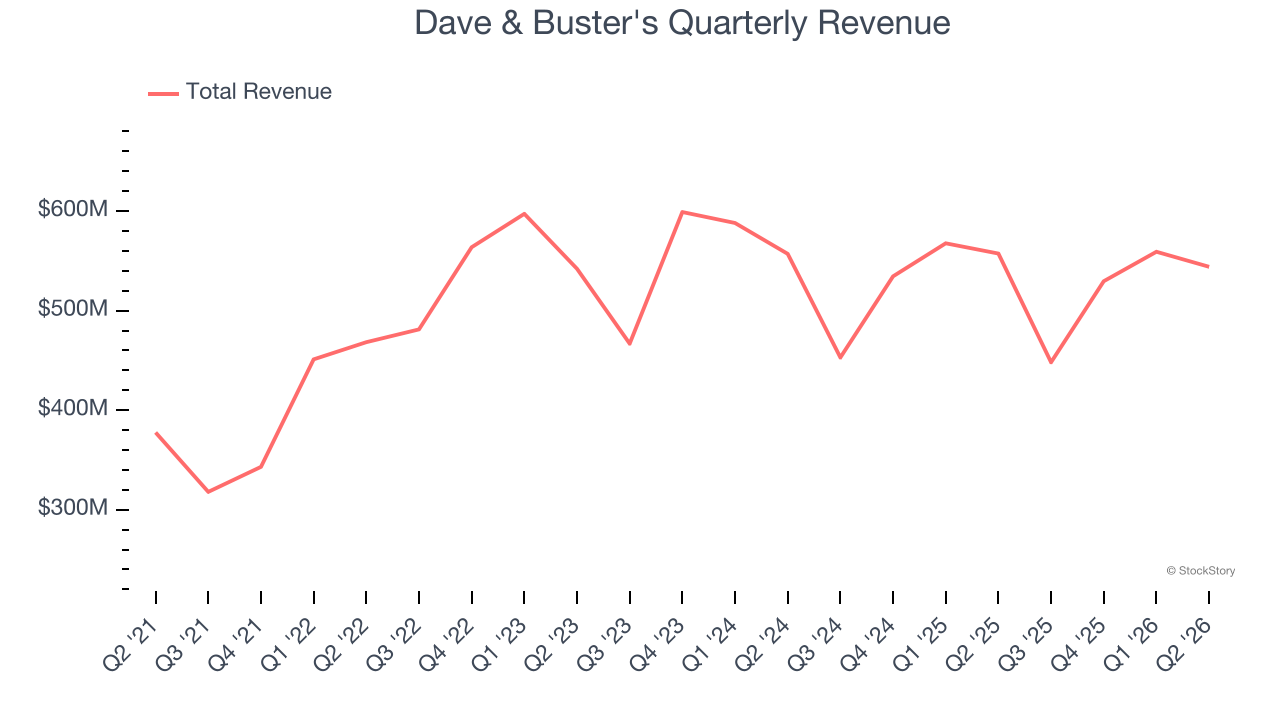
We at StockStory place the most emphasis on long-term growth, but within consumer discretionary, a stretched historical view may miss a company riding a successful new product or trend. Dave & Buster’s performance shows it grew in the past but relinquished its gains over the last two years, as its revenue fell by 3% annually. Note that COVID hurt Dave & Buster’s business in 2020 and part of 2021, and it bounced back in a big way thereafter. 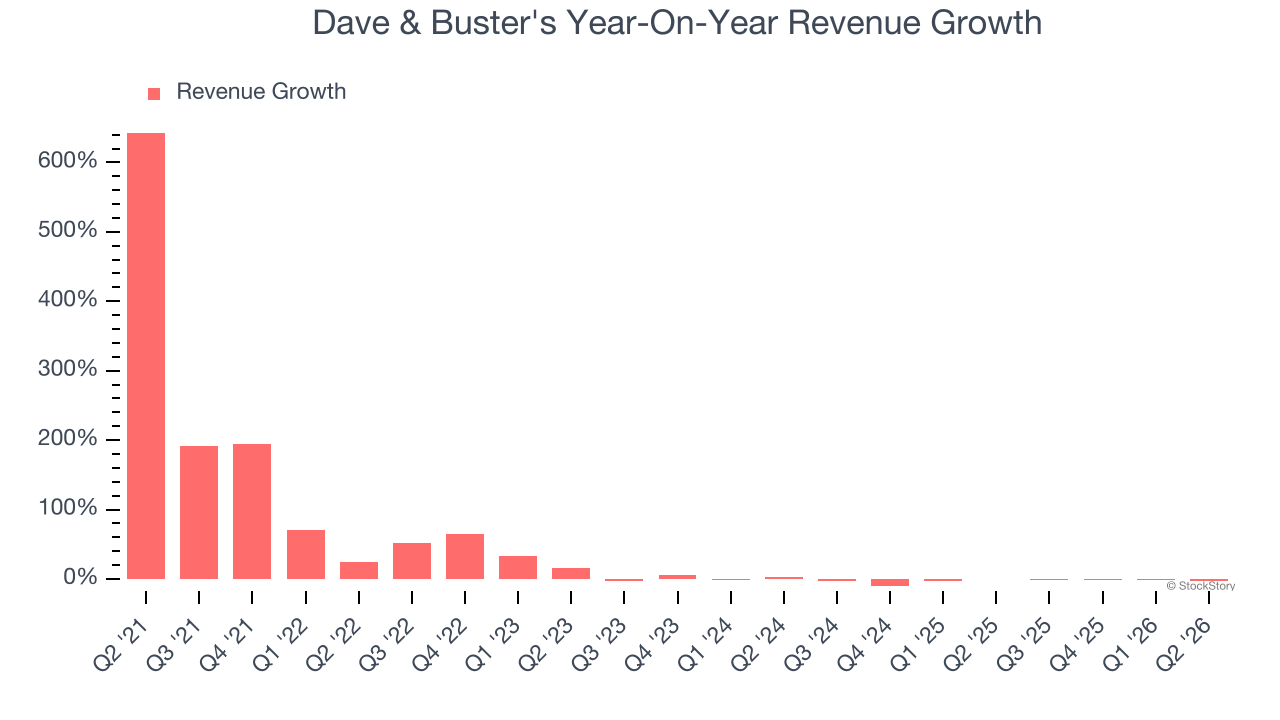
Dave & Buster's also reports same-store sales, which show how much revenue its established locations generate. Over the last two years, Dave & Buster’s same-store sales averaged 4.8% year-on-year declines. Because this number is lower than its revenue growth, we can see the opening of new locations is boosting the company’s top-line performance. 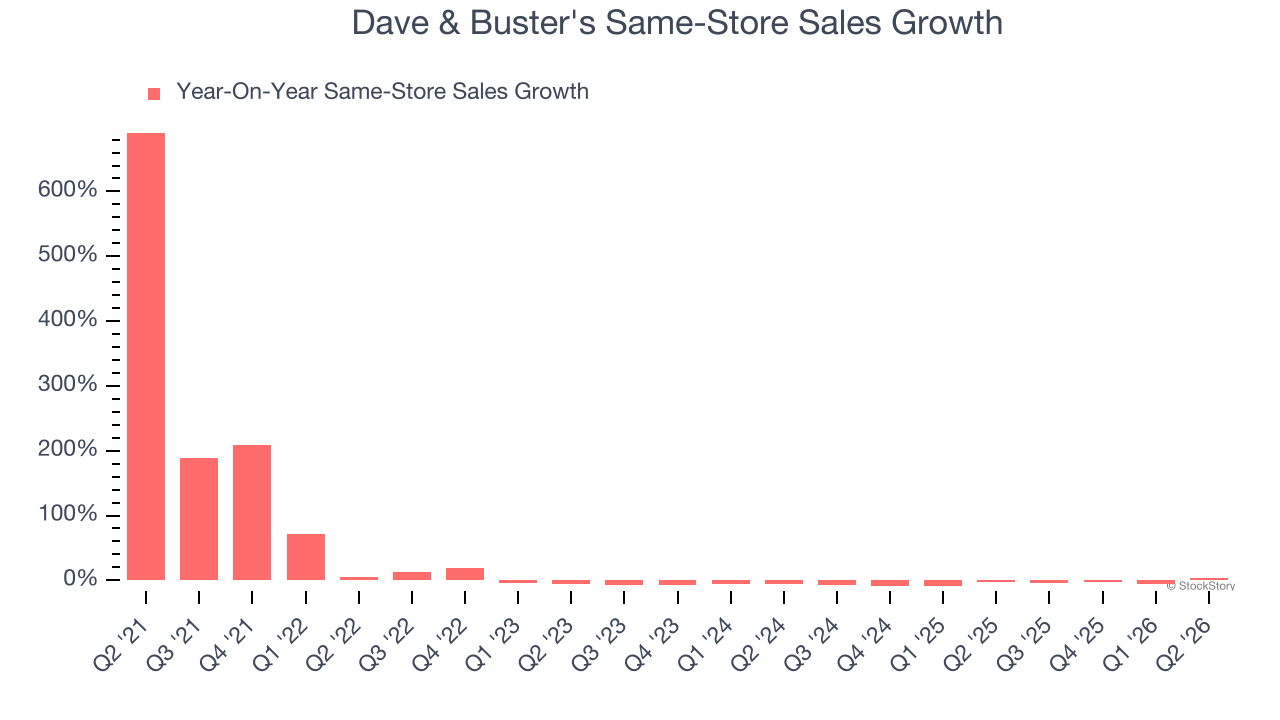
This quarter, Dave & Buster's missed Wall Street’s estimates and reported a rather uninspiring 2.4% year-on-year revenue decline, generating $544.1 million of revenue.
Looking ahead, sell-side analysts expect revenue to grow 4.4% over the next 12 months. While this projection implies its newer products and services will catalyze better top-line performance, it is still below the sector average.
ONE MORE THING: 3 Hidden Platforms Growing 3X Faster than Amazon, Google, and PayPal. Amazon, Google, and Meta all followed the same playbook: Dominate an ignored market. Build an unbeatable moat. Scale until you’re unstoppable.
These three platforms are running that exact playbook right now. The early investors in Amazon made fortunes. The early investors in these could do the same. Get All 3 Stocks Here for FREE.
Operating Margin
Operating margin is an important measure of profitability as it shows the portion of revenue left after accounting for all core expenses — everything from the cost of goods sold to advertising and wages. It’s also useful for comparing profitability across companies with different levels of debt and tax rates because it excludes interest and taxes.
Dave & Buster’s operating margin has been trending down over the last 12 months and averaged 4.8% over the last two years. The company’s profitability was mediocre for a consumer discretionary business and shows it couldn’t pass its higher operating expenses onto its customers.
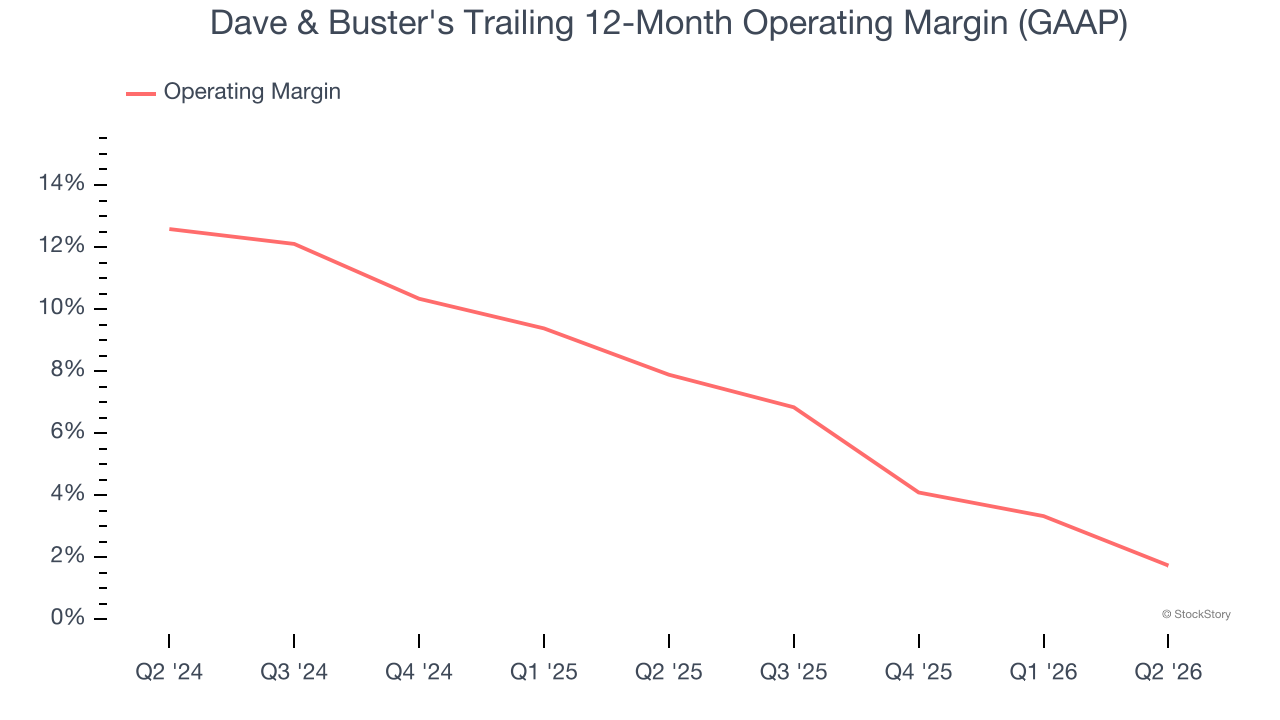
This quarter, Dave & Buster's generated an operating margin profit margin of 3.6%, down 5.9 percentage points year on year. This contraction shows it was less efficient because its expenses increased relative to its revenue.
Earnings Per Share
We track the long-term change in earnings per share (EPS) for the same reason as long-term revenue growth. Compared to revenue, however, EPS highlights whether a company’s growth is profitable.
Dave & Buster’s earnings losses deepened over the last five years as its EPS dropped 16.1% annually. We tend to steer our readers away from companies with falling EPS, where diminishing earnings could imply changing secular trends and preferences. Consumer Discretionary companies are particularly exposed to this, and if the tide turns unexpectedly, Dave & Buster’s low margin of safety could leave its stock price susceptible to large downswings.
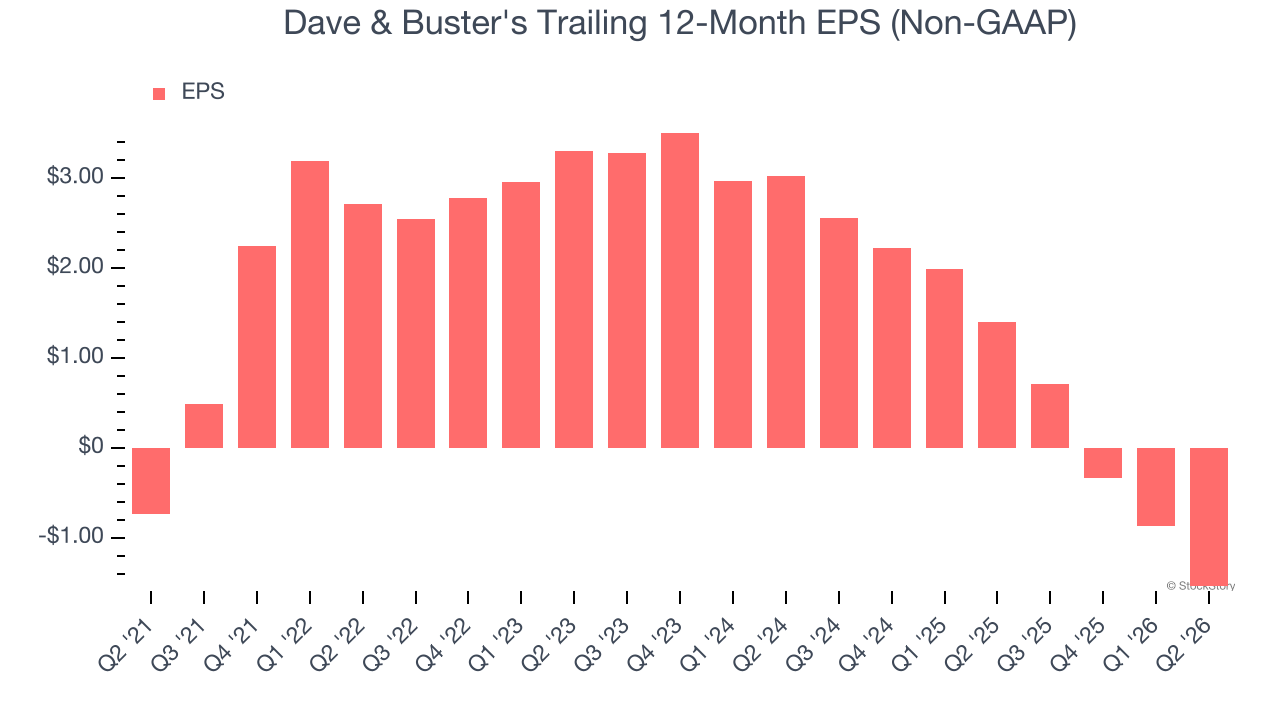
In Q2, Dave & Buster's reported adjusted EPS of negative $0.27, down from $0.40 in the same quarter last year. This print missed analysts’ estimates. Over the next 12 months, Wall Street expects Dave & Buster's to improve its earnings losses. Analysts forecast its full-year EPS will improve from negative $1.54 to negative $0.66.
Key Takeaways from Dave & Buster’s Q2 Results
We were impressed by how significantly Dave & Buster's blew past analysts’ same-store sales expectations this quarter. On the other hand, its EPS missed and its EBITDA fell short of Wall Street’s estimates. Overall, this quarter could have been better. The stock traded down 16% to $7.31 immediately following the results.
Dave & Buster’s latest earnings report disappointed. One quarter doesn’t define a company’s quality, so let’s explore whether the stock is a buy at the current price. If you’re making that decision, you should consider the bigger picture of valuation, business qualities, as well as the latest earnings. We cover that in our actionable full research report which you can read here (it’s free).