Restaurant company Cracker Barrel (NASDAQ: CBRL) reported Q2 CY2026 results beating Wall Street’s revenue expectations, but sales fell by 2.2% year on year to $849.3 million. On the other hand, the company’s full-year revenue guidance of $3.36 billion at the midpoint came in 0.8% below analysts’ estimates. Its non-GAAP profit of $0.99 per share was significantly above analysts’ consensus estimates.
Is now the time to buy Cracker Barrel? Find out by accessing our full research report, it’s free.
Cracker Barrel (CBRL) Q2 CY2026 Highlights:
- Revenue: $849.3 million vs analyst estimates of $836.8 million (2.2% year-on-year decline, 1.5% beat)
- Adjusted EPS: $0.99 vs analyst estimates of $0.17 (significant beat)
- Adjusted EBITDA: $62.05 million vs analyst estimates of $41.96 million (7.3% margin, 47.9% beat)
- EBITDA guidance for the upcoming financial year 2027 is $190 million at the midpoint, above analyst estimates of $177.7 million
- Operating Margin: 1.5%, up from 0.5% in the same quarter last year
- Free Cash Flow Margin: 10.2%, up from 6.5% in the same quarter last year
- Locations: 655 at quarter end, down from 725 in the same quarter last year
- Same-Store Sales rose 2.1% year on year (5.4% in the same quarter last year)
- Market Capitalization: $1.02 billion
Cracker Barrel President and Chief Executive Officer David Deno said, "I'm honored to lead such a differentiated and iconic brand. The Company is focused on the right areas and has a strong plan, as demonstrated by the continued improvements in the underlying traffic trend, key guest metrics, and EBITDA results. I am excited about the opportunity ahead and confident that our strategic priorities around food, experience, and people will sustain this momentum and drive long-term value creation."
Company Overview
Known for its country-themed food and merchandise, Cracker Barrel (NASDAQ: CBRL) is a beloved American restaurant and retail chain that celebrates the warmth and charm of Southern hospitality.
Revenue Growth
Examining a company’s long-term performance can provide clues about its quality. Any business can put up a good quarter or two, but many enduring ones grow for years.
With $3.32 billion in revenue over the past 12 months, Cracker Barrel is one of the larger restaurant chains in the industry and benefits from a well-known brand that influences consumer purchasing decisions. However, its scale is a double-edged sword because it’s harder to find incremental growth when your existing restaurant banners have penetrated most of the market. To accelerate system-wide sales, Cracker Barrel likely needs to optimize its pricing or lean into new chains and international expansion.
As you can see below, Cracker Barrel’s sales grew at a weak 1.1% compounded annual growth rate over the last seven years as it closed restaurants.
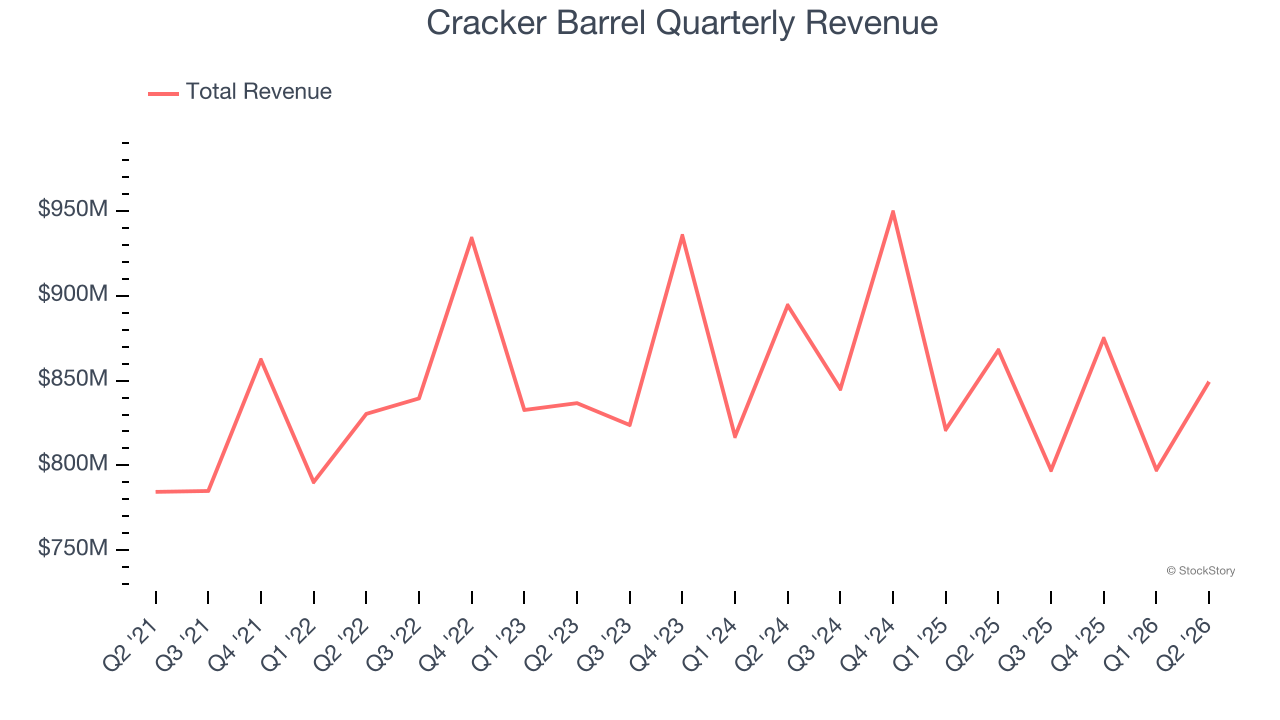
This quarter, Cracker Barrel’s revenue fell by 2.2% year on year to $849.3 million but beat Wall Street’s estimates by 1.5%.
Looking ahead, sell-side analysts expect revenue to grow 2% over the next 12 months, similar to its seven-year rate. This projection doesn’t excite us and indicates its newer menu offerings will not lead to better top-line performance yet.
WHILE YOU’RE HERE: The Next Palantir? One satellite company captures images of every point on Earth. Every single day. The Pentagon wants it. Hedge funds are using it to beat earnings. You’ve probably never heard of it.
This is what the early days of Palantir looked like before it became a giant. Same playbook. Different technology. If you missed Palantir, you need to see this. Claim The Stock Ticker for Free HERE.
Restaurant Performance
Number of Restaurants
A restaurant chain’s total number of dining locations influences how much it can sell and how quickly revenue can grow.
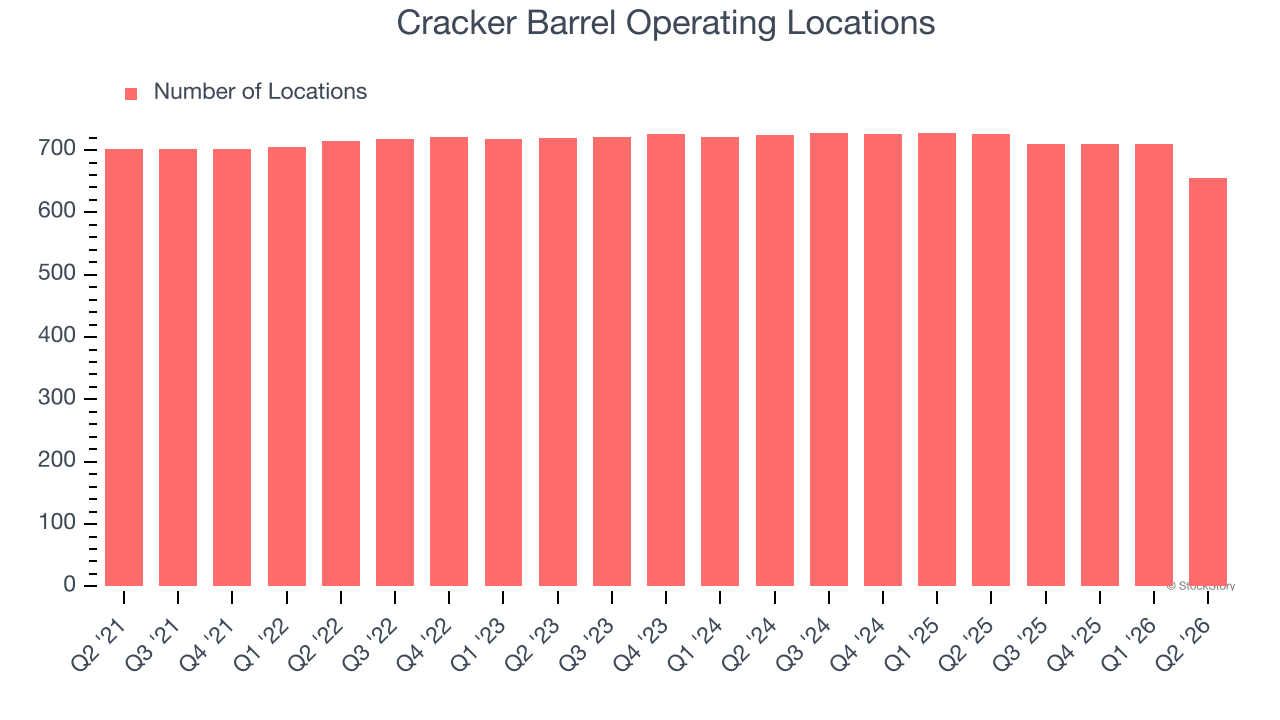
Cracker Barrel operated 655 locations in the latest quarter. Over the last two years, the company has generally closed its restaurants, averaging 1.8% annual declines.
When a chain shutters restaurants, it usually means demand for its meals is waning, and it is responding by closing underperforming locations to improve profitability.
Same-Store Sales
The change in a company’s restaurant base only tells one side of the story. The other is the performance of its existing locations, which informs management teams whether they should expand or downsize their physical footprints. Same-store sales gives us insight into this topic because it measures organic growth at restaurants open for at least a year.
Cracker Barrel’s demand within its existing dining locations has barely increased over the last two years as its same-store sales were flat. This performance isn’t ideal, and Cracker Barrel is attempting to boost same-store sales by closing restaurants (fewer locations sometimes lead to higher same-store sales).
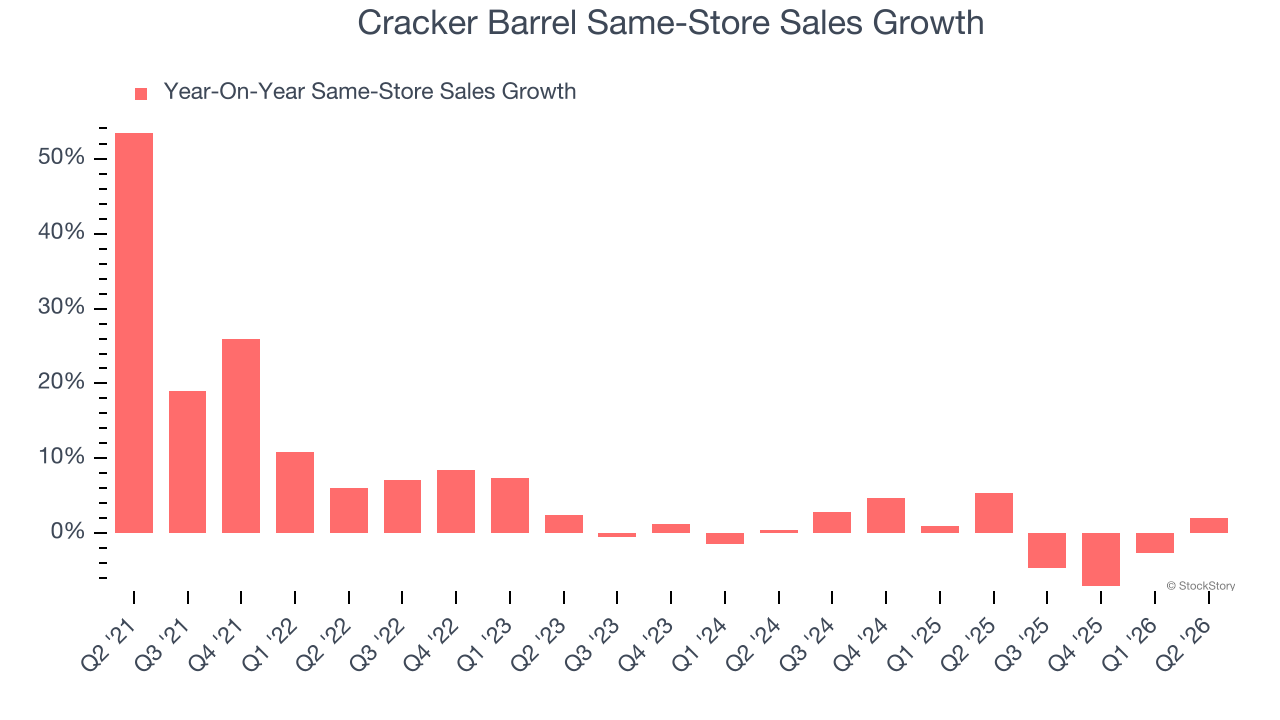
In the latest quarter, Cracker Barrel’s same-store sales rose 2.1% year on year. This growth was an acceleration from its historical levels, which is always an encouraging sign.
Key Takeaways from Cracker Barrel’s Q2 Results
It was good to see Cracker Barrel beat analysts’ EPS expectations this quarter. We were also excited its EBITDA outperformed Wall Street’s estimates by a wide margin. On the other hand, its full-year revenue guidance slightly missed. Zooming out, we think this was a good print with some key areas of upside. The stock traded up 7.7% to $49 immediately after reporting.
Cracker Barrel put up rock-solid earnings, but one quarter doesn’t necessarily make the stock a buy. Let’s see if this is a good investment. We think that the latest quarter is only one piece of the longer-term business quality puzzle. Quality, when combined with valuation, can help determine if the stock is a buy. We cover that in our actionable full research report which you can read here (it’s free).