
As the Q2 earnings season comes to a close, it’s time to take stock of this quarter’s best and worst performers in the consumer discretionary - wireless, cable and satellite industry, including Optimum Communications (NYSE: OPTU) and its peers.
The Consumer Discretionary sector, by definition, is made up of companies selling non-essential goods and services. When economic conditions deteriorate or tastes shift, consumers can easily cut back or eliminate these purchases. For long-term investors with five-year holding periods, this creates a structural challenge: the sector is inherently hit-driven, with low switching costs and fickle customers. As a result, only a handful of companies can reliably grow demand and compound earnings over long periods, which is why our bar is high and High Quality ratings are rare. Wireless, cable, and satellite companies provide pay-TV, broadband internet, and mobile connectivity through large fixed-infrastructure networks. Tailwinds include growing bandwidth consumption, bundling opportunities across video, internet, and wireless services, and rural broadband subsidies from government programs. However, headwinds are pronounced: cord-cutting continues to erode traditional video subscriber bases, capital expenditure requirements for network upgrades (such as fiber overbuilds and 5G rollouts) are substantial, and aggressive promotional pricing among competitors compresses margins. Regulatory oversight on pricing and net neutrality adds uncertainty, while streaming platforms increasingly bypass traditional distributors, reducing the value of the legacy pay-TV bundle.
The 7 consumer discretionary - wireless, cable and satellite stocks we track reported a mixed Q2. As a group, revenues were in line with analysts’ consensus estimates.
Amidst this news, share prices of the companies have had a rough stretch. On average, they are down 8.8% since the latest earnings results.
Optimum Communications (NYSE: OPTU)
Based in Long Island City, Optimum Communications (NYSE: OPTU) is a telecommunications company offering cable, internet, telephone, and television services across the United States.
Optimum Communications reported revenues of $2.02 billion, down 5.8% year on year. This print fell short of analysts’ expectations by 0.5%. Overall, it was a slower quarter for the company with a significant miss of analysts’ EPS estimates and EBITDA in line with analysts’ estimates.
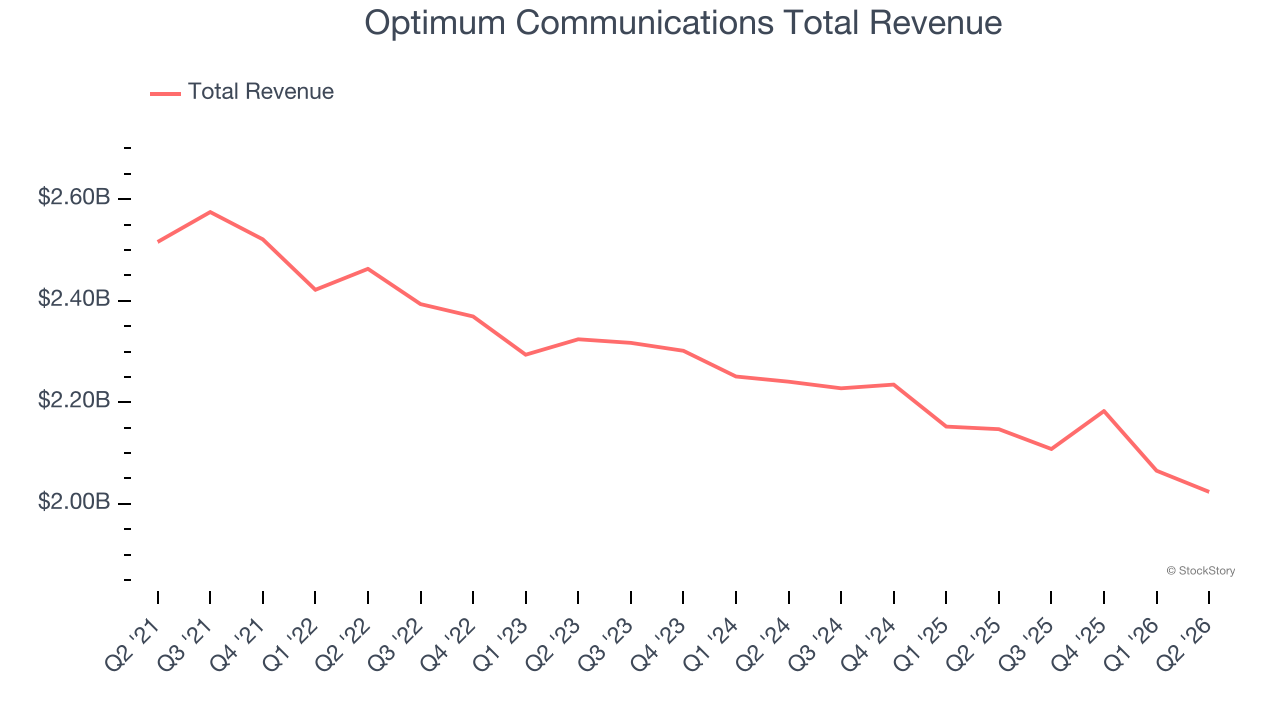
Interestingly, the stock is up 29.4% since reporting and currently trades at $1.02.
Read our full report on Optimum Communications here, it’s free.
Best Q2: Comcast (NASDAQ: CMCSA)
Formerly known as American Cable Systems, Comcast (NASDAQ: CMCSA) is a multinational telecommunications company offering a wide range of services.
Comcast reported revenues of $29.57 billion, up 4.7% year on year, outperforming analysts’ expectations by 1%. The business had a satisfactory quarter with a beat of analysts’ EPS estimates.
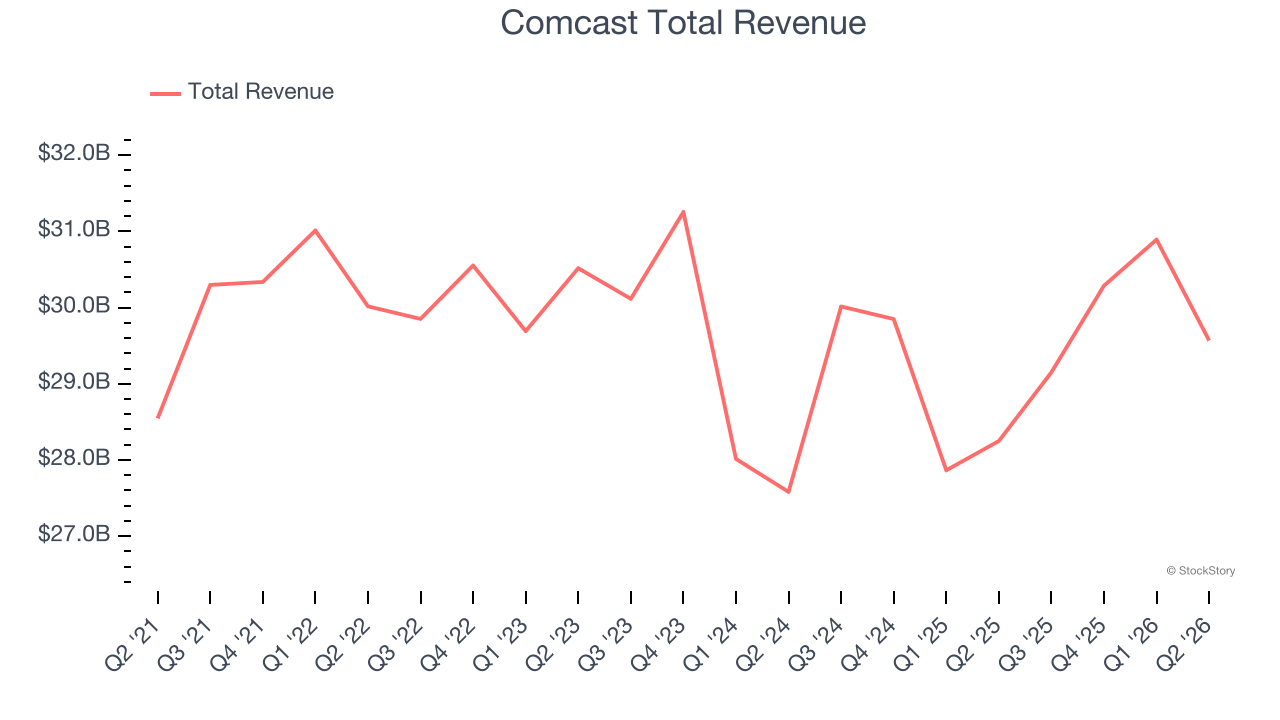
Comcast achieved the biggest analyst estimate beat and fastest revenue growth among its peers. Although it had a fine quarter compared to its peers, the market seems unhappy with the results as the stock is down 6.9% since reporting. It currently trades at $21.90.
Is now the time to buy Comcast? Access our full analysis of the earnings results here, it’s free.
Weakest Q2: Cable One (NYSE: CABO)
Founded in 1986, Cable One (NYSE: CABO) provides high-speed internet, cable television, and telephone services, primarily in smaller markets across the United States.
Cable One reported revenues of $348.9 million, down 8.4% year on year, in line with analysts’ expectations. It was a slower quarter as it posted a significant miss of analysts’ EPS estimates and a miss of analysts’ EBITDA estimates.
Cable One delivered the slowest revenue growth of the whole group. As expected, the stock is down 71.8% since the results and currently trades at $12.56.
Read our full analysis of Cable One’s results here.
Verizon (NYSE: VZ)
Formed in 1984 as Bell Atlantic after the breakup of Bell System into seven companies, Verizon (NYSE: VZ) is a telecom giant providing a range of communications and internet services.
Verizon reported revenues of $34.25 billion, flat year on year. This number lagged analysts’ expectations by 2.9%. All in all, it was a slower quarter for the company.
Verizon had the weakest performance against analyst estimates in the group. The stock is up 6.7% since reporting and currently trades at $46.78.
Read our full, actionable report on Verizon here, it’s free.
Charter (NASDAQ: CHTR)
Operating as Spectrum, Charter (NASDAQ: CHTR) is a leading telecommunications company offering cable television, high-speed internet, and voice services across the United States.
Charter reported revenues of $13.53 billion, down 1.7% year on year. This result met analysts’ expectations. Zooming out, it was a mixed quarter as it also recorded a beat of analysts’ EPS estimates but a miss of analysts’ EBITDA estimates.
The stock is down 10.9% since reporting and currently trades at $112.72.
Read our full, actionable report on Charter here, it’s free.
Market Update
Over the past year, investors have been forced to repeatedly answer the same question: what is the market’s biggest risk? The answer has changed several times, and each shift has reshaped market leadership.
Late in 2025 and early 2026, artificial intelligence became the market’s primary uncertainty. Investors questioned whether AI would erode software pricing power and weaken competitive moats as AI made it easier to replicate once-differentiated products.
By the spring, technology took a back seat to geopolitics. The U.S. conflict with Iran briefly became the market’s dominant narrative, raising concerns about oil prices, inflation, and global growth. But as energy markets remained orderly and fears of a prolonged supply disruption faded, investors quickly turned their focus back to fundamentals.
Want to invest in winners with rock-solid fundamentals? Check out our Top 6 Stocks and add them to your watchlist. These companies are poised for growth regardless of the political or macroeconomic climate.