The landscape of personal computing has undergone a seismic shift as CES 2025 draws to a close, marking the definitive arrival of the "AI PC." What was once a buzzword in 2024 has become the industry's new North Star, as the world’s leading silicon manufacturers have unified around a single goal: bringing massive Large Language Models (LLMs) off the cloud and directly onto the consumer’s desk. This transition represents the most significant architectural change to the personal computer since the introduction of the graphical user interface, signaling an era where privacy, speed, and intelligence are baked into the silicon itself.
The significance of this development cannot be overstated. By moving the "brain" of AI from remote data centers to local Neural Processing Units (NPUs), the tech industry is addressing the three primary hurdles of the AI era: latency, cost, and data sovereignty. As Intel Corporation (NASDAQ: INTC), Advanced Micro Devices, Inc. (NASDAQ: AMD), and Qualcomm Incorporated (NASDAQ: QCOM) unveil their latest high-performance chips, the era of the "Cloud-First" AI assistant is being challenged by a "Local-First" reality that promises to make artificial intelligence as ubiquitous and private as the files on your hard drive.
Silicon Powerhouse: The Rise of the NPU
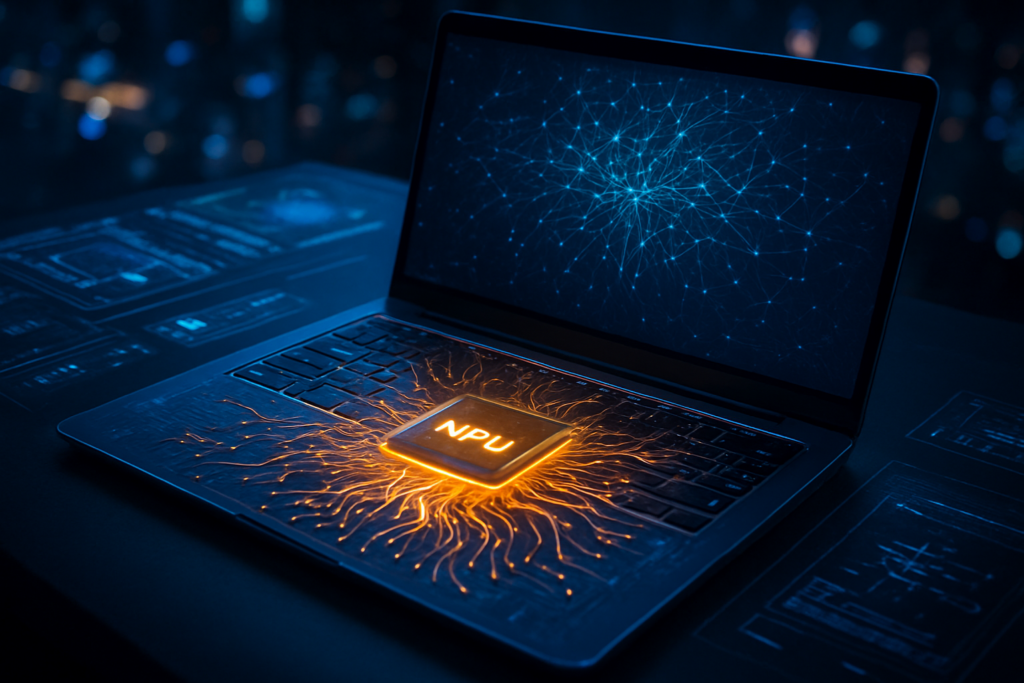
The technical heart of this revolution is the Neural Processing Unit (NPU), a specialized processor designed specifically to handle the mathematical heavy lifting of AI workloads. At CES 2025, the "TOPS War" (Trillions of Operations Per Second) reached a fever pitch. Intel Corporation (NASDAQ: INTC) expanded its Core Ultra 200V "Lunar Lake" series, featuring the NPU 4 architecture capable of 48 TOPS. Meanwhile, Advanced Micro Devices, Inc. (NASDAQ: AMD) stole headlines with its Ryzen AI Max "Strix Halo" chips, which boast a staggering 50 NPU TOPS and a massive 256GB/s memory bandwidth—specifications previously reserved for high-end workstations.
This new hardware is not just about theoretical numbers; it is delivering tangible performance for open-source models like Meta’s Llama 3. For the first time, laptops are running Llama 3.2 (3B) at speeds exceeding 100 tokens per second—far faster than the average human can read. This is made possible by a shift in how memory is handled. Intel has moved RAM directly onto the processor package in its Lunar Lake chips to eliminate data bottlenecks, while AMD’s "Block FP16" support allows for 16-bit floating-point accuracy at 8-bit speeds, ensuring that local models remain highly intelligent without the "hallucinations" often caused by over-compression.
This technical leap differs fundamentally from the AI PCs of 2024. Last year’s models featured NPUs that were largely treated as "accelerators" for background tasks like background blur in video calls. The 2025 generation, however, establishes a 40 TOPS baseline—the minimum requirement for Microsoft Corporation (NASDAQ: MSFT) and its "Copilot+" certification. This shift moves the NPU from a peripheral luxury to a core system component, as essential to the modern OS as the CPU or GPU.
Initial reactions from the AI research community have been overwhelmingly positive, particularly regarding the democratization of AI development. Researchers note that the ability to run 8B and 30B parameter models locally on a consumer laptop allows for rapid prototyping and fine-tuning without the prohibitive costs of cloud API credits. Industry experts suggest that the "Strix Halo" architecture from AMD, in particular, may bridge the gap between consumer laptops and professional AI development rigs.
Shifting the Competitive Landscape
The move toward on-device AI is fundamentally altering the strategic positioning of the world’s largest tech entities. Microsoft Corporation (NASDAQ: MSFT) is perhaps the most visible driver of this trend, using its Copilot+ platform to force a massive hardware refresh cycle. By tethering its most advanced Windows 11 features to NPU performance, Microsoft is creating a compelling reason for enterprise customers to abandon aging Windows 10 machines ahead of their 2025 end-of-life date. This "Agentic OS" strategy positions Windows not just as a platform for apps, but as a proactive assistant that can navigate a user’s local files and workflows autonomously.
Hardware manufacturers like HP Inc. (NYSE: HPQ), Dell Technologies Inc. (NYSE: DELL), and Lenovo Group Limited (HKG:0992) stand to benefit immensely from this "AI Supercycle." After years of stagnant PC sales, the AI PC offers a high-margin premium product that justifies a higher Average Selling Price (ASP). Conversely, cloud-centric companies may face a strategic pivot. As more inference moves to the edge, the reliance on cloud APIs for basic productivity tasks could diminish, potentially impacting the explosive growth of cloud infrastructure revenue for companies that don't adapt to "Hybrid AI" models.
Apple Inc. (NASDAQ: AAPL) continues to play its own game with "Apple Intelligence," leveraging its M4 and upcoming M5 chips to maintain a lead in vertical integration. By controlling the silicon, the OS, and the apps, Apple can offer a level of cross-app intelligence that is difficult for the fragmented Windows ecosystem to match. However, the surge in high-performance NPUs from Qualcomm and AMD is narrowing the performance gap, forcing Apple to innovate faster on the silicon front to maintain its "Pro" market share.
In the high-end segment, NVIDIA Corporation (NASDAQ: NVDA) remains the undisputed king of raw power. While NPUs are optimized for efficiency and battery life, NVIDIA’s RTX 50-series GPUs offer over 1,300 TOPS, targeting developers and "prosumers" who need to run massive models like DeepSeek or Llama 3 (70B). This creates a two-tier market: NPUs for everyday "always-on" AI agents and RTX GPUs for heavy-duty generative tasks.
Privacy, Latency, and the End of Cloud Dependency
The broader significance of the AI PC revolution lies in its solution to the "Sovereignty Gap." For years, enterprises and privacy-conscious individuals have been hesitant to feed sensitive data—financial records, legal documents, or proprietary code—into cloud-based LLMs. On-device AI eliminates this concern entirely. When a model like Llama 3 runs on a local NPU, the data never leaves the device's RAM. This "Data Sovereignty" is becoming a non-negotiable requirement for healthcare, finance, and government sectors, potentially unlocking billions in enterprise AI spending that was previously stalled by security concerns.
Latency is the second major breakthrough. Cloud-based AI assistants often suffer from a "round-trip" delay of several seconds, making them feel like a separate tool rather than an integrated part of the user experience. Local LLMs reduce this latency to near-zero, enabling real-time features like instantaneous live translation, AI-driven UI navigation, and "vibe coding"—where a user describes a software change and sees it implemented in real-time. This "Zero-Internet" functionality ensures that the PC remains intelligent even in air-gapped environments or during travel.
However, this shift is not without concerns. The "TOPS War" has led to a fragmented ecosystem where certain AI features only work on specific chips, potentially confusing consumers. There are also environmental questions: while local inference reduces the energy load on massive data centers, the cumulative power consumption of millions of AI PCs running local models could impact battery life and overall energy efficiency if not managed correctly.
Comparatively, this milestone mirrors the "Mobile Revolution" of the late 2000s. Just as the smartphone moved the internet from the desk to the pocket, the AI PC is moving intelligence from the cloud to the silicon. It represents a move away from "Generative AI" as a destination (a website you visit) toward "Embedded AI" as an invisible utility that powers every click and keystroke.
Beyond the Chatbot: The Future of On-Device Intelligence
Looking ahead to 2026, the focus will shift from "AI as a tool" to "Agentic AI." Experts predict that the next generation of operating systems will feature autonomous agents that don't just answer questions but execute multi-step workflows. For instance, a local agent could be tasked with "reconciling last month’s expenses against these receipts and drafting a summary for the accounting team." Because the agent lives on the NPU, it can perform these tasks across different applications with total privacy and high speed.
We are also seeing the rise of "Local-First" software architectures. Developers are increasingly building applications that store data locally and use client-side AI to process it, only syncing to the cloud when absolutely necessary. This architectural shift, powered by tools like the Model Context Protocol (MCP), will make applications feel faster, more reliable, and more secure. It also lowers the barrier for "Vibe Coding," where natural language becomes the primary interface for creating and customizing software.
Challenges remain, particularly in the standardization of AI APIs. For the AI PC to truly thrive, software developers need a unified way to target NPUs from Intel, AMD, and Qualcomm without writing three different versions of their code. While Microsoft’s ONNX Runtime and Apple’s CoreML are making strides, a truly universal "AI Layer" for computing is still a work in progress.
A New Era of Computing
The announcements at CES 2025 have made one thing clear: the NPU is no longer an experimental co-processor; it is the heart of the modern PC. By enabling powerful LLMs like Llama 3 to run locally, Intel, AMD, and Qualcomm have fundamentally changed our relationship with technology. We are moving toward a future where our computers do not just store our data, but understand it, protect it, and act upon it.
In the history of AI, the year 2025 will likely be remembered as the year the "Cloud Monopoly" on intelligence was broken. The long-term impact will be a more private, more efficient, and more personalized computing experience. As we move into 2026, the industry will watch closely to see which "killer apps" emerge to take full advantage of this new hardware, and how the battle for the "Agentic OS" reshapes the software world.
The AI PC revolution has begun, and for the first time, the most powerful intelligence in the room is sitting right on your lap.
This content is intended for informational purposes only and represents analysis of current AI developments.
TokenRing AI delivers enterprise-grade solutions for multi-agent AI workflow orchestration, AI-powered development tools, and seamless remote collaboration platforms.
For more information, visit https://www.tokenring.ai/.