Alternative fuel-compatible lubricant additive systems are gaining demand as biofuels, hybrids, and hydrogen engines drive need for advanced oxidation and corrosion control.
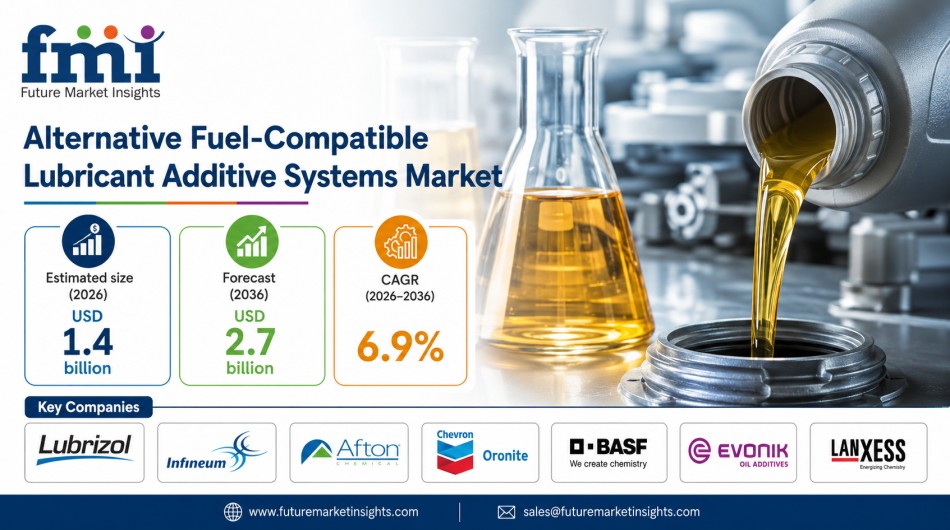
NEWARK, DE / ACCESS Newswire / May 22, 2026 / According to the latest market analysis by Future Market Insights, the global alternative fuel-compatible lubricant additive systems market is projected to grow from USD 1.4 billion in 2026 to USD 2.7 billion by 2036, registering a CAGR of 6.9% during the forecast period.
The market is being shaped by rising biofuel blending mandates, growing hybrid vehicle penetration, and increasing development of hydrogen combustion engines. As fuel systems evolve globally, lubricant additive formulations are becoming essential for oxidation control, corrosion resistance, deposit handling, and fuel compatibility across commercial and passenger vehicle platforms.
Quick Stats for Alternative Fuel-Compatible Lubricant Additive Systems Market Snapshot
Market size (2025): USD 1.3 billion
Estimated size (2026): USD 1.4 billion
Forecast (2036): USD 2.7 billion
CAGR (2026-2036): 6.9%
Incremental opportunity: USD 1.3 billion
Leading base oil: Synthetic oils (54.0% share in 2026)
Top application: Engine oils (48.0% share in 2026)
Key companies: Lubrizol Corporation, Infineum International Limited, Afton Chemical Corporation, Chevron Oronite, BASF SE, Evonik Oil Additives, LANXESS AG
Get detailed market forecasts, competitive benchmarking, and pricing trends: https://www.futuremarketinsights.com/reports/sample/rep-gb-33186
Market Size and Growth Outlook
The alternative fuel-compatible lubricant additive systems market is expected to more than double over the next decade, reaching USD 2.7 billion by 2036. Growth is being supported by increasing fuel diversity across transportation and industrial sectors, where lubricant systems must withstand biodiesel dilution, ethanol exposure, renewable diesel variability, and hydrogen combustion conditions.
As fleet operators and OEMs move toward low-emission technologies, lubricant additive suppliers are focusing on advanced detergent dispersants, antioxidants, anti-wear agents, and friction modifiers capable of maintaining performance under mixed-fuel operating environments.
Growth Drivers: Fuel Transition Reshaping Lubricant Chemistry
Demand for alternative fuel-compatible lubricant additive systems is accelerating due to several structural industry trends:
Biofuel blend mandates are increasing the need for oxidation stability and deposit control in engine oils.
Hybrid vehicles are extending combustion engine usage under stop-start operating cycles, raising lubricant stress levels.
Hydrogen engine development is creating demand for water management and corrosion-resistant additive chemistries.
Renewable diesel adoption is making fuel dilution management a critical lubricant performance requirement.
Industry growth is increasingly linked to proof-based formulation strategies, where additive systems must demonstrate compatibility across multiple fuel environments while meeting stricter OEM and regulatory standards.
Challenges: Testing Costs and Qualification Complexity
Despite strong long-term demand potential, the industry continues to face several operational and commercial barriers:
Engine oil validation and licensing costs remain high for smaller additive suppliers.
Fuel variability across regions complicates formulation standardization.
Hydrogen combustion platforms require new additive testing protocols and corrosion studies.
Longer OEM approval cycles can delay commercial deployment of new additive technologies.
In addition, regulatory frameworks such as API GF-7 specifications and renewable fuel compliance standards are increasing the documentation burden for additive manufacturers.
Opportunities: Hydrogen Engines and Hybrid Platforms
Emerging fuel technologies are creating new opportunities for lubricant additive innovation:
Hydrogen combustion engines are opening demand for water-handling and anti-corrosion additive systems.
Hybrid powertrains are increasing use of friction modifiers optimized for repeated engine restarts.
Renewable diesel fleets are driving adoption of additives designed for longer drain intervals and cleaner combustion.
Marine and industrial fuel conversion programs are expanding opportunities for fuel-compatible lubricant systems.
As alternative fuels gain wider acceptance, lubricant suppliers capable of validating fuel-neutral performance are expected to strengthen their market position.
Segmentation Insights
By Base Oil
Synthetic oils are projected to account for 54.0% of the market in 2026, supported by low-viscosity formulations requiring stable additive solubility and higher thermal resistance.
Bio-based oils are gradually gaining attention in specialty industrial and low-carbon lubricant applications.
By Application
Engine oils (48.0% share): Leading segment due to direct exposure to fuel dilution and combustion byproducts.
Transmission fluids: Growing use in hybrid driveline systems.
Hydraulic fluids: Increasing demand in industrial and off-highway applications.
Industrial oils: Emerging opportunities tied to fuel-conversion equipment and stationary engines.
Regional Dynamics: Asia Pacific Leads Market Expansion
Asia Pacific continues to dominate demand growth, supported by large automotive production bases, fuel-transition policies, and expanding lubricant manufacturing capacity.
India (8.4% CAGR): Growth driven by ethanol blending programs and expanding vehicle production.
Brazil (7.8% CAGR): Biodiesel mandates are increasing demand for fuel-compatible lubricant formulations.
China (7.5% CAGR): Strong hybrid and new energy vehicle production supports additive demand.
USA (6.8% CAGR): Renewable diesel capacity expansion is boosting fleet lubricant reformulation activity.
Germany (6.4% CAGR): Hybrid vehicle manufacturing and stricter oil specifications are supporting additive innovation.
Customize insights for your business strategy@ https://www.futuremarketinsights.com/customization-available/rep-gb-33186
Competitive Landscape: Validation Capability Becoming a Key Differentiator
The competitive environment is defined by formulation expertise, fuel compatibility testing depth, and OEM approval support. Major companies are strengthening their positions through advanced additive technologies and regional supply expansion.
Key players include:
Lubrizol Corporation
Infineum International Limited
Afton Chemical Corporation
Chevron Oronite
BASF SE
Evonik Oil Additives
LANXESS AG
Competition is increasingly centered on fuel-fit validation, oxidation control performance, and regional supply responsiveness rather than pricing alone.
Strategic Implications for Industry Stakeholders
For lubricant formulators, OEMs, and fleet operators, alternative fuel-compatible additive systems are becoming critical to long-term operational reliability and compliance.
Key strategic priorities include:
Accelerating additive qualification programs for renewable and hydrogen fuels.
Building regional blending and supply partnerships to reduce lead times.
Investing in additive chemistries optimized for hybrid and dual-fuel engines.
Strengthening OEM collaboration to support evolving fuel-performance standards.
Companies capable of demonstrating proven compatibility across biodiesel, ethanol, renewable diesel, and hydrogen environments are expected to secure stronger positions with oil marketers and commercial fleet operators.
Future Outlook: From Conventional Lubrication to Fuel-Adaptive Performance
Over the next decade, the alternative fuel-compatible lubricant additive systems market is expected to evolve into a strategically important segment within the global lubricants industry. Fuel diversity, tighter emissions targets, and hybrid powertrain growth will continue reshaping lubricant chemistry requirements.
Advancements in synthetic base oils, oxidation control technologies, and hydrogen-ready additive systems are expected to improve formulation flexibility while supporting long-term engine durability.
As OEMs and regulators place greater emphasis on fuel adaptability and emissions compliance, lubricant additive systems will increasingly move from a supporting component to a core performance differentiator.
Executive Takeaways
Alternative fuel-compatible lubricant additive systems are becoming essential for biofuel, hybrid, and hydrogen engine platforms.
Market growth is driven by fuel-transition regulations and rising demand for fuel-neutral lubricant performance.
Synthetic oils and engine oils remain the leading formulation and application segments.
India, Brazil, and China are expected to lead long-term demand growth.
Validation capability, OEM approvals, and oxidation control performance are emerging as major competitive advantages.
For industry leaders, the focus is no longer only on lubricant efficiency-but on how quickly additive systems can adapt to the next generation of alternative fuels.
Unlock 360° insights for strategic decision making and investment planning@ https://www.futuremarketinsights.com/checkout/33186
Explore More Related Studies Published by FMI Research:
Lubricant Additives Market: https://www.futuremarketinsights.com/reports/lubricant-additives-market
Phase-Change Material Additives for Thermal Mass Concrete Systems Market: https://www.futuremarketinsights.com/reports/phase-change-material-additives-for-thermal-mass-concrete-systems-market
Additives for Metalworking Fluids Market: https://www.futuremarketinsights.com/reports/additives-for-metalworking-fluids-market
Additive Manufacturing With Metal Powders Market: https://www.futuremarketinsights.com/reports/additive-manufacturing-with-metal-powders-market
Lubricant Market: https://www.futuremarketinsights.com/reports/lubricants-market
About Future Market Insights (FMI)
Future Market Insights (FMI) is a leading provider of market intelligence and consulting services, serving clients in over 150 countries. Headquartered in Delaware, USA, with a global delivery center in India and offices in the UK and UAE, FMI delivers actionable insights to businesses across industries including automotive, technology, consumer products, manufacturing, energy, and chemicals.
An ESOMAR-certified research organization, FMI provides custom and syndicated market reports and consulting services, supporting both Fortune 1,000 companies and SMEs. Its team of 300+ experienced analysts ensures credible, data-driven insights to help clients navigate global markets and identify growth opportunities.
For Press & Corporate Inquiries
Rahul Singh
AVP - Marketing and Growth Strategy
Future Market Insights, Inc.
+91 8600020075
For Sales - sales@futuremarketinsights.com
For Media - Rahul.singh@futuremarketinsights.com
For web - https://www.futuremarketinsights.com/
For Web : https://www.factmr.com/
SOURCE: Future Market Insights, Inc.
View the original press release on ACCESS Newswire