Medical Aesthetic Statistics 2026: Global Market, Treatment Trends, and Clinic Insights
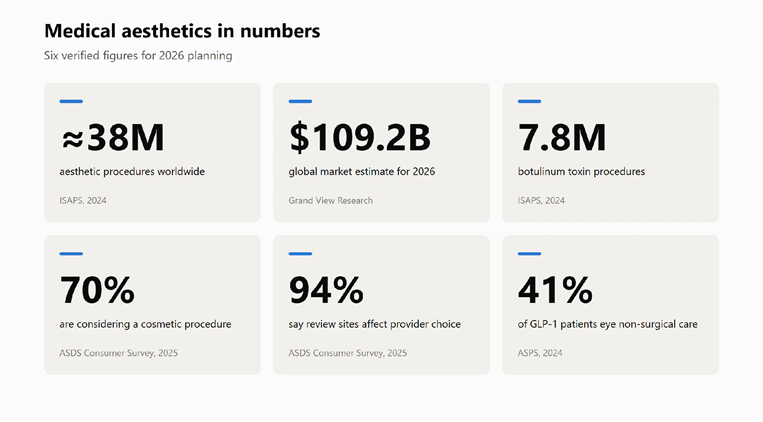
Medical aesthetics is now a market of roughly USD 100 billion, and most of its patient volume comes from treatments that need no operating room. This article collects the figures that matter for clinic owners in 2026, each traced to its original source: ISAPS, ASPS, ASDS, Grand View Research and others.
Global Aesthetic Medicine Market Size in 2026
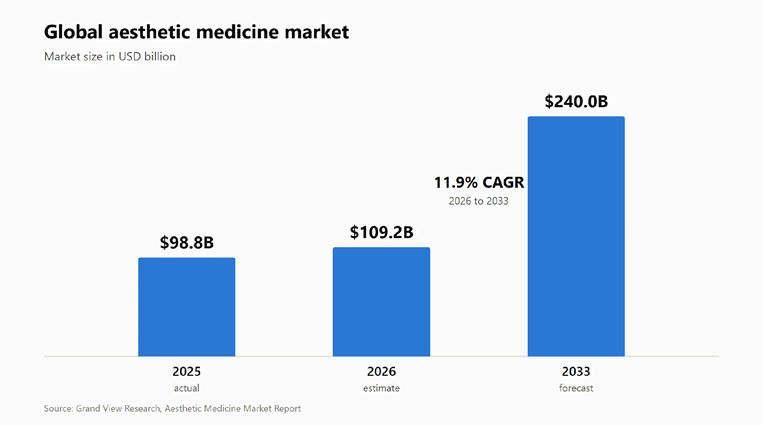
According to Grand View Research, the global aesthetic medicine market was worth USD 98.8 billion in 2025. The firm estimates USD 109.2 billion for 2026 and USD 240.0 billion by 2033, a compound annual growth rate of 11.9% from 2026 to 2033. North America is the largest region with 32.4% of 2025 revenue.
Other analysts land nearby or far away depending on what they count. Fortune Business Insights puts 2026 at USD 113.87 billion, while Global Market Insights uses a much narrower definition and reports USD 25.6 billion. Figures from different firms should never be mixed in one calculation.
One nuance is often missed: by revenue, invasive procedures still held 59.7% of the market in 2025 (Grand View Research). Non-surgical treatments win on volume and growth, surgery still wins on ticket size.
Non-Surgical vs Surgical Procedures
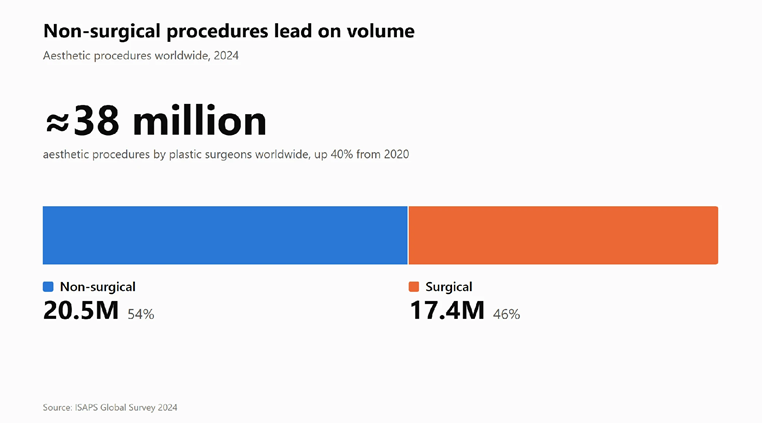
The ISAPS Global Survey counted close to 38 million aesthetic procedures performed by plastic surgeons in 2024, a 40% increase from 2020. Non-surgical procedures made up 20.5 million of them, surgical procedures 17.4 million. The United States led all countries with over 6.1 million procedures, followed by Brazil with 3.1 million.
Eyelid surgery became the most common surgical procedure for the first time, with more than 2.1 million operations (up 13.4%), ahead of liposuction, breast augmentation, scar revision and rhinoplasty. On the non-surgical side the top five were botulinum toxin, hyaluronic acid fillers, hair removal, non-surgical skin tightening and chemical peels.
ISAPS data covers plastic surgeons only, so the real totals, including dermatologists and medical spas, are higher. In the United States alone, ASPS reported about 28.5 million minimally invasive procedures in 2024, including 9.9 million neuromodulator treatments and 3.7 million skin resurfacing treatments.
Injectables: Neuromodulators and Dermal Fillers
Botulinum toxin and hyaluronic acid fillers together account for 14.1 million procedures, about 69% of all non-surgical procedures in the ISAPS survey and 37% of all procedures. In the United States, neuromodulators made up 50% of minimally invasive treatments in 2025 and hyaluronic acid fillers another 30% (ASPS).
Global Market Insights, within its narrower market definition, values injectables at about USD 11.1 billion in 2025 and projects USD 40.8 billion by 2035. Retreatment every 3 to 6 months for neurotoxins and every 6 to 24 months for hyaluronic acid fillers turns injectables into predictable recurring revenue, which is why they sit at the centre of most clinic business models.
Botox Vials Price, Provider Economics, and Sourcing
Botox (onabotulinumtoxinA) remains the market-leading neuromodulator. AbbVie's published wholesale acquisition cost (WAC) for a 100-unit Botox Cosmetic vial is USD 656, or USD 6.56 per unit, and USD 362 for a 50-unit vial (AbbVie price disclosure, February 2024). Practices often pay less than list price through volume discounts, loyalty programs and distributor arrangements.
The challenge for many aesthetic clinics is that product cost is fixed by the supplier while retail treatment prices are held down by local competition. That squeezes margins, especially for smaller practices without negotiating leverage.
Securing reliable, competitively priced supply is therefore a strategic priority. Buying Botox from reputable online distributors such as Filler Supplies can reduce per-unit cost, support consistent stock availability and improve profitability without compromising product authenticity. Filler Supplies offers cold-chain logistics and verified sourcing, helping clinics avoid the risks associated with counterfeit or grey-market products.
A practical example: a clinic that uses ten 100-unit vials per month and saves 10% per vial against list price keeps about USD 656 a month, or roughly USD 7,900 a year. At 20% the figure doubles to about USD 15,700. Across fillers and skin boosters the effect scales further.
Energy-Based Devices and Regenerative Treatments
Energy-based devices (lasers, IPL, radiofrequency, ultrasound) are the second growth engine. Global Market Insights attributes 24.31% of its 2025 market to this segment, with lasers at 35.6% and radiofrequency at 28.3% of energy-device revenue. Equipment is expensive and consumables are cheap, so utilization rate is the metric that decides whether a device pays back.
Alongside devices, clinics are adding biostimulators such as PLLA and CaHA, and skin boosters aimed at skin quality instead of volume. These treatments suit patients who want subtle, natural-looking results and they pair well with laser and RF protocols.
GLP-1 Medications and Body Contouring
The World Health Organization estimates that 890 million adults were living with obesity in 2022, and GLP-1 weight-loss drugs are changing what those patients ask for. ASPS tracked GLP-1 use among its members' patients for the first time in 2024 and counted more than 837,000 patients. Of those, 20% had already had surgery, 39% were considering surgery and 41% were exploring non-surgical options.
Allergan Aesthetics reports that 60% of GLP-1 users now get their medication from providers who also offer aesthetic treatments, up from 49% in late 2024. This is company research and should be read as such, but it explains why weight-loss programs have become a gateway to fillers, skin tightening and body contouring.
Patient Demographics and Demand
Women accounted for 85.5% of aesthetic procedures in the ISAPS survey for 2023, with procedures in men growing faster.
Gen Z grew from 4% of US aesthetic patients in 2017 to 10% in 2024 (Guidepoint Qsight).
70% of respondents in the 2025 ASDS Consumer Survey were considering a cosmetic procedure.
94% said rating and review websites affect their choice of provider, and nearly half said a provider's social media presence affects the decision to book.
US patients spent USD 17.5 billion on non-surgical aesthetics in 2024 (Guidepoint Qsight).
Clinics, Medspas, and the Competitive Landscape
Clinics and aesthetic centers held 48.1% of end-use revenue in 2025 (Grand View Research), while more than half of surgical procedures worldwide (52.6%) are still performed in hospitals (ISAPS). Asia Pacific is the fastest-growing region, at a projected 14.5% CAGR in the Global Market Insights forecast.
On the supplier side, AbbVie, Galderma and Merz compete with device makers and a growing number of consumer beauty groups. In December 2025 L'Oréal agreed to double its Galderma stake to 20%, a clear signal that consumer cosmetics companies see injectables as a core growth market.
For clinics, the KPIs worth tracking are average revenue per patient, patient lifetime value, treatment mix, device utilization, no-show rate and membership penetration. Product inventory, where the Botox vials price and filler costs sit, is one of the few cost lines an owner can directly improve.
Data Sources and Limitations
ISAPS and ASPS count procedures by plastic surgeons only. Market reports use different definitions, which is why 2026 estimates range from USD 25.6 billion to USD 113.87 billion. Consumer surveys reflect respondents, not the whole population. Treat all of these numbers as directional.
"Aesthetic cosmetic surgery is actual surgery that involves risks and possible side effects."
Dr. Naveen Cavale, Chair of the ISAPS Communications Committee (ISAPS, 2025)
Conclusion
The 2026 picture is consistent across sources: a market near USD 110 billion, close to 38 million procedures a year, and non-surgical treatments leading on volume. Clinics that do well will be the ones that match their treatment menu to this demand and control their costs. Cost-effective sourcing of Botox and dermal fillers from trusted partners like Filler Supplies, disciplined device utilization and a measured move into regenerative treatments are the practical levers.
Frequently Asked Questions
How big is the global aesthetic medicine market in 2026?
Grand View Research estimates USD 109.2 billion in 2026, growing at 11.9% a year to USD 240.0 billion by 2033. Fortune Business Insights gives USD 113.87 billion. Exact numbers differ by source and by market definition.
Which aesthetic procedures are most popular?
Botulinum toxin (7.8 million) and hyaluronic acid fillers (6.3 million) lead worldwide. Eyelid surgery, at more than 2.1 million, is the most common surgical procedure (ISAPS, 2024).
How do Botox vials prices affect aesthetic clinics?
Product cost is a large and recurring expense, so it directly shapes margins when local competition limits treatment prices. Optimizing sourcing through reputable online wholesalers like Filler Supplies, negotiating volume discounts and bundling treatments into packages can help maintain profitability. A 10% saving per vial is worth about USD 7,900 a year to a clinic using ten vials a month.
Are non-surgical aesthetic procedures safer than surgery?
They usually involve less downtime and lower systemic risk, but they still carry risks: bruising, infection, vascular events with fillers, burns from energy devices. They must be performed by qualified medical professionals using authentic products.
References
Grand View Research. Aesthetic Medicine Market Size, Share and Trends Report. https://www.grandviewresearch.com/industry-analysis/medical-aesthetics-market
International Society of Aesthetic Plastic Surgery. ISAPS Global Survey 2024, press release, June 19, 2025. https://www.isaps.org/media/sqqoodpf/global-survey-2024-press-release-english.pdf
American Society of Plastic Surgeons. Plastic Surgery Statistics. https://www.plasticsurgery.org/news/plastic-surgery-statistics
American Society for Dermatologic Surgery. 2025 Consumer Survey on Cosmetic Dermatologic Procedures. https://www.asds.net/Consumer-Survey
Global Market Insights. Aesthetic Medicine Market Size and Share 2026-2035. https://www.gminsights.com/industry-analysis/aesthetic-medicine-market
Fortune Business Insights. Aesthetic Medicine Market. https://www.fortunebusinessinsights.com/aesthetic-medicine-market-116387
AbbVie. Botox Cosmetic WAC disclosure, February 2024. https://media.allergan.com/actavis/actavis/media/allergan-pdf-documents/CT_WAC_Botox_Cosmetic_Feb_2024.pdf
Guidepoint Qsight. Gen Z: The Preventive Aesthetics Era. https://qsight.guidepoint.com/blog/gen-z-the-preventive-aesthetics-era-a-generational-shift-in-consumer-behavior/
American Med Spa Association. Allergan Aesthetics Releases New Data on Medical Weight Loss Trends. https://www.americanmedspa.org/news/allergan-aesthetics-releases-new-data-on-medical-weight-loss-trends-and-emerging-aesthetic-needs/
World Health Organization. Obesity and overweight fact sheet. https://www.who.int/news-room/fact-sheets/detail/obesity-and-overweight