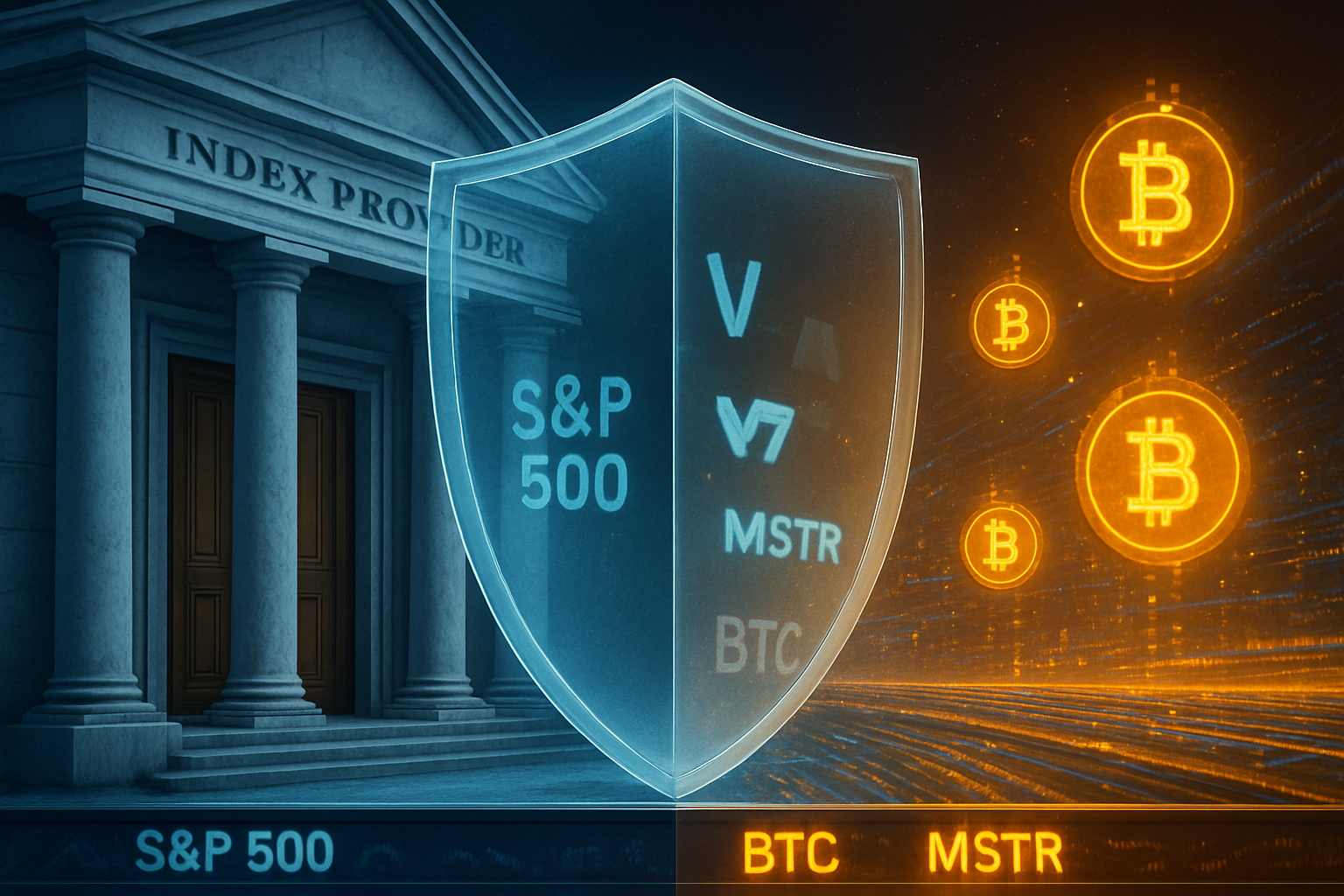
As the final weeks of 2025 approach, a quiet but fierce ideological war is being waged in the boardrooms of the world’s most powerful index providers. At the center of the storm is MicroStrategy (NASDAQ: MSTR), a company that has transformed from a legacy enterprise software firm into a multi-billion-dollar Bitcoin treasury. Despite meeting all quantitative requirements for inclusion in the S&P 500—including a massive market capitalization and a record-breaking $10 billion GAAP net income in Q2 2025—the company remains conspicuously absent from the flagship index. This exclusion has sparked a global debate over whether massive crypto-exposure has become an insurmountable hurdle for institutional index inclusion.
The tension reached a boiling point during the September 2025 rebalancing, when S&P Dow Jones Indices opted to add Robinhood Markets, Inc. (NASDAQ: HOOD) and AppLovin Corp. (NASDAQ: APP) to the S&P 500, while passing over MicroStrategy for the third consecutive quarter. The "September Snub," as it has been dubbed by market analysts, highlights a growing rift between the "new economy" of digital asset treasuries and the "old guard" of index committees who serve as the gatekeepers of trillions of dollars in passive investment capital. For the S&P Index Committee, the question is no longer just about profitability or size; it is an existential query regarding what constitutes an "operating company" in the age of decentralized finance.
The Earnings Paradox and the September Snub
The road to this standoff was paved by the Financial Accounting Standards Board (FASB), which implemented new fair value accounting rules for digital assets in late 2024. These rules, which became mandatory for fiscal years beginning after December 15, 2024, allowed MicroStrategy to report its Bitcoin holdings at current market prices rather than historical cost. The result was a financial earthquake: in its Q2 2025 earnings report, MicroStrategy posted a staggering $10 billion in net income, driven primarily by the appreciation of its 250,000+ Bitcoin. This move theoretically cleared the final hurdle for S&P 500 eligibility—the requirement for cumulative positive earnings over the previous four quarters.
However, the S&P Index Committee, a secretive group that exercises subjective discretion over the index’s composition, has remained hesitant. Internal reports and analyst commentary suggest the committee views MicroStrategy’s "paper profits" as fundamentally different from the operational cash flows of a traditional manufacturer or service provider. The timeline of events leading to this December 19, 2025, impasse shows a company that has outgrown its "software" label, with Bitcoin now representing over 85% of its total enterprise value. This concentration has led index providers to fear that adding MSTR would effectively turn the S&P 500 into a partial Bitcoin proxy, introducing a level of volatility that the committee has historically sought to avoid.
The Winners, the Losers, and the Proxy War
The primary "loser" in this ongoing exclusion is the passive investor who seeks exposure to the largest and most successful U.S. companies. By excluding MicroStrategy, the S&P 500 is arguably failing to represent a significant portion of the modern market's value. Conversely, the "winners" have been the traditional fintech and tech-service firms like Robinhood Markets, Inc. (NASDAQ: HOOD) and AppLovin Corp. (NASDAQ: APP), which have secured their spots in the index by maintaining more traditional business models that the committee finds "representative" of the broader economy.
Other crypto-adjacent firms are watching the MicroStrategy saga with bated breath. Coinbase Global, Inc. (NASDAQ: COIN) and Marathon Digital Holdings, Inc. (NASDAQ: MARA) face similar hurdles; though their market caps are substantial, their inclusion in major benchmarks remains a point of contention. If the S&P 500 continues to shut its doors to "Digital Asset Treasury" (DAT) companies, these firms may find themselves permanently relegated to secondary indices, missing out on the massive "forced" buying that occurs when a stock is added to a major benchmark. For MicroStrategy, the stakes are even higher: an inclusion could trigger an estimated $10 billion to $15 billion in immediate passive inflows, a move that would likely send the stock—and potentially the price of Bitcoin itself—into a new stratosphere.
A Regulatory Civil War: The 50% Rule
The tension is not limited to the S&P. In late 2025, MSCI (the provider of the MSCI World Index) launched a controversial consultation to redefine the eligibility of companies where digital assets exceed 50% of total assets. This "50% Rule" would reclassify such firms as investment vehicles rather than operating equities, potentially leading to their removal from all MSCI equity benchmarks. This move is deeply rooted in the Investment Company Act of 1940, a legacy regulation designed to govern mutual funds. Index providers argue that when a company raises billions in debt to buy a single commodity, it is no longer an operating business but an unregistered investment fund.
This debate fits into a broader industry trend where the lines between "software company" and "financial entity" are blurring. Historically, companies like Berkshire Hathaway Inc. (NYSE: BRK.B) have navigated this line, but the volatility of Bitcoin makes the comparison difficult for regulators. Michael Saylor, the founder of MicroStrategy, has fought back, arguing in a December 2025 letter to MSCI that Bitcoin is a commodity, not a security, and that holding it should be no different than an oil company holding vast petroleum reserves. The outcome of this regulatory "civil war" will set a precedent for how the traditional financial world treats the next generation of corporate treasuries.
The Path Forward: A Separate Bucket or a Strategic Pivot?
As we look toward 2026, two primary scenarios emerge. The first is the "Ghettoization" of crypto-equities. S&P Dow Jones Indices recently launched the S&P Digital Markets 50 Index, a hybrid product that blends cryptocurrencies with crypto-linked stocks. This suggests that the index giants may be creating a "separate bucket" for firms like MicroStrategy, effectively signaling that they will never be allowed into the flagship S&P 500. This would force institutional investors to seek out specialized products rather than relying on standard benchmarks for crypto exposure.
The second scenario involves a strategic pivot by the companies themselves. To appease index committees, firms like MicroStrategy might eventually spin off their software divisions or restructure into a "holding company" model that explicitly separates their operational and treasury arms. However, such a move would be a significant departure from the "Bitcoin Maxima" strategy that has driven MicroStrategy’s stock price to record highs. In the short term, the market will focus on the January 15, 2026, decision from MSCI, which will serve as a bellwether for whether the institutional doors are truly closing on the Bitcoin treasury model.
The New Definition of "Representative"
The standoff between MicroStrategy and the index providers is more than a technical dispute; it is a battle over the definition of value in the 21st century. For decades, the S&P 500 has been the gold standard for "representative" U.S. equities, but its refusal to adapt to the reality of digital asset treasuries may eventually undermine its own relevance. If the largest and most profitable companies are excluded because their balance sheets don't look like those of the 20th century, the index risks becoming a relic of the past rather than a mirror of the present.
For investors, the coming months are critical. Watch for the December 2025 S&P rebalancing announcement and the MSCI ruling in January. These decisions will determine whether "crypto-exposure" remains a permanent hurdle for index inclusion or if the gatekeepers will finally be forced to open the doors. Regardless of the outcome, the MicroStrategy saga has permanently altered the landscape of corporate finance, proving that while a company can buy its way into the history books with Bitcoin, buying its way into the S&P 500 is a much more complicated endeavor.
This content is intended for informational purposes only and is not financial advice.