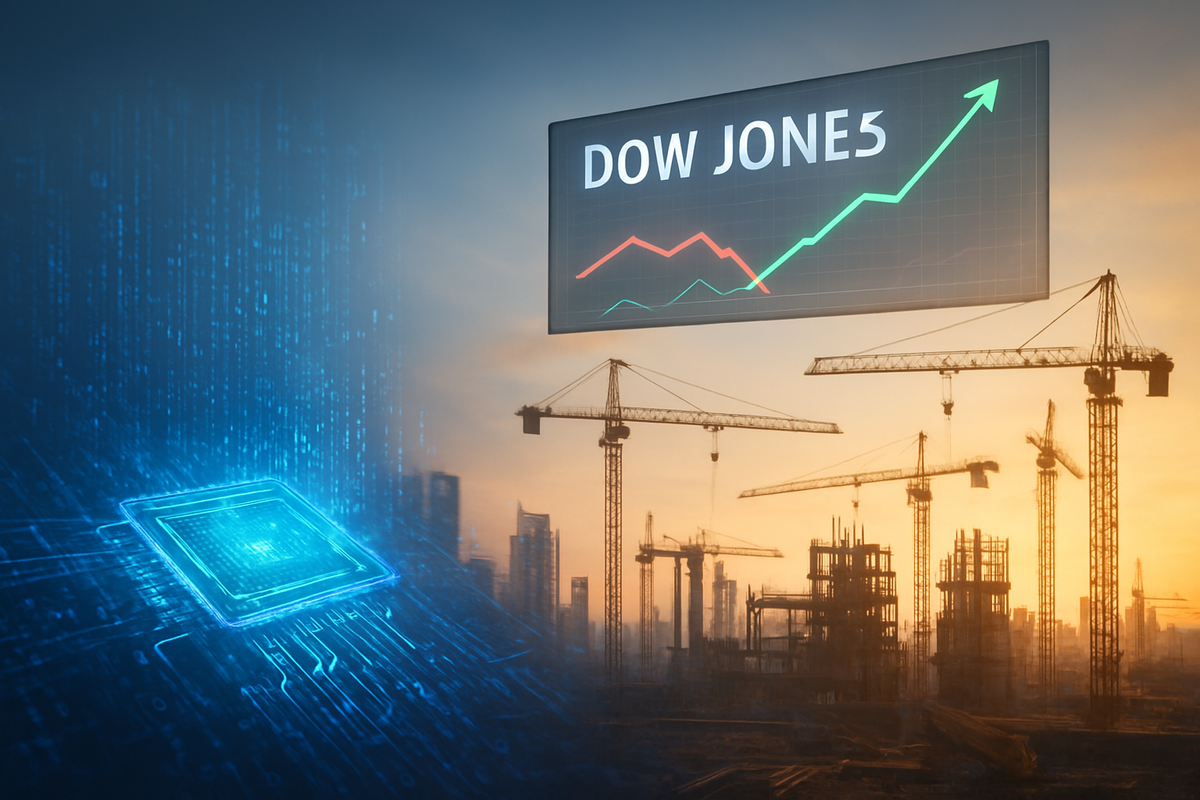
In a week defined by dramatic market divergence, the U.S. stock market has undergone one of its most significant structural shifts in years. As of January 16, 2026, a massive migration of capital is underway, moving from the high-flying technology giants that dominated the previous three years into "old economy" blue-chip companies and industrial stalwarts. The rotation reached a fever pitch mid-week when the Dow Jones Industrial Average surged more than 400 points intraday, even as the tech-heavy Nasdaq Composite struggled to find its footing amid rising Treasury yields and shifting Federal Reserve expectations.
This shift, dubbed the "Efficiency Era Pivot" by Wall Street analysts, marks a maturing phase of the post-AI boom. Investors are increasingly demanding tangible bottom-line results over long-term growth promises, leading to a "valuation reset" for mega-cap tech. While the broader indices remain near record levels, the underlying leadership has fundamentally changed, signaling a transition from a momentum-driven market to one focused on physical infrastructure, domestic manufacturing, and cyclical resilience.
The Catalysts: Treasury Yields, Fed Rumors, and a Policy Shock
The rotation began in earnest during the second trading week of January 2026, triggered by a confluence of macroeconomic signals and political maneuvers. On January 14, the Nasdaq Composite (IXIC) suffered its steepest one-day decline in a month, dropping 1.0% as the 10-year Treasury yield climbed toward a four-month high of 4.23%. The spike in yields was fueled by better-than-expected retail sales growth of 0.6% and weekly jobless claims falling to a lean 198,000, reinforcing the "higher-for-longer" interest rate narrative that typically penalizes high-growth tech valuations.
Adding to the volatility was a cloud of uncertainty hanging over the Federal Reserve. With Chair Jerome Powell’s term set to expire in May 2026, speculation reached a boiling point regarding his successor. Market jitters intensified following reports of a Department of Justice probe into Powell’s tenure, alongside rumors that President Trump might bypass advisor Kevin Hassett in favor of Kevin Warsh—a move seen by many as a shift toward a more hawkish or independent central bank. This leadership transition has forced institutional managers to de-risk their growth portfolios and seek shelter in value-oriented sectors.
The most dramatic moment occurred on Thursday, January 15, when the Dow Jones Industrial Average (DJI) staged a stunning reversal. After opening in negative territory, the index surged over 400 points intraday, eventually closing up 292.81 points at 49,442.44. This move was propelled by "bargain hunting" in industrials and financials, even as investors digested a major policy shock: a proposed 10% cap on credit card interest rates. While the news initially sent bank stocks reeling, the broader market interpreted the rotation as a sign of economic health outside of the "Magnificent Seven" tech cluster.
Winners and Losers: From 'AI Fatigue' to 'Physical Infrastructure'
The clear winners in this rotation are the companies tied to the "physical buildout" of the modern economy. Caterpillar (NYSE: CAT) has emerged as a primary beneficiary, hitting all-time highs with a year-to-date return of over 11%. Analysts point to the massive demand for heavy machinery required for AI data center construction and global reshoring efforts as a primary driver. Similarly, Boeing (NYSE: BA) has seen a resurgence, with shares surging nearly 14% in early 2026 as production stabilizes and its 5,900-aircraft backlog is viewed as a durable source of cash flow.
In the retail and defensive sectors, Home Depot (NYSE: HD) and UnitedHealth Group (NYSE: UNH) have broken out of long-term trading ranges. Home Depot has gained nearly 10% as housing market sentiment improves, while UnitedHealth is being embraced as a "defensive growth" play in an era of margin recovery. Small-cap stocks have also thrived; the Russell 2000 index outperformed the Nasdaq by 4% over a five-day stretch, marking its most dominant performance relative to tech since the mid-2024 rotation.
Conversely, the tech titans are facing "AI fatigue." Microsoft (Nasdaq: MSFT) and Apple (Nasdaq: AAPL) both saw their stock prices dip as investors locked in profits to fund moves into value sectors. Nvidia (Nasdaq: NVDA), the darling of the AI era, has pulled back over 11% from its late-2025 highs, as its 55x forward P/E ratio becomes harder to justify in a rising-yield environment. Salesforce (NYSE: CRM) was among the hardest hit, tumbling 6.10% in early January as analysts questioned the future of per-seat licensing in an autonomous agent economy. Even the banking sector saw a split: while JPMorgan Chase (NYSE: JPM) and Bank of America (NYSE: BAC) are value staples, they faced a 5-7% dip following the 10% interest cap proposal, illustrating how quickly policy can disrupt even the most established "winners."
Broader Significance: A Maturing Bull Market and Historical Precedents
This 2026 rotation mirrors the "Great Rotation" of mid-2024 but with a key difference: it is occurring in a maturing bull market rather than a speculative frenzy. Unlike the tech-to-value shift of 2022, which was a systemic collapse driven by rampant inflation, the current movement represents a "broadening" of market leadership. Institutional investors are no longer exiting the market; they are simply diversifying their exposure. This suggests that while Big Tech may see multiple compression, the overall economy remains resilient enough to support a wider array of sectors.
The policy implications of the proposed credit card interest rate cap are also significant. If implemented, analysts estimate a $100 billion annual revenue hit to the banking industry. This has created a unique "dispersion" where value stocks like industrials are rising while value stocks like financials are stumbling. Historically, such dispersion is a hallmark of an "Efficiency Era," where the market begins to separate companies with real pricing power and operational efficiency from those reliant on high-interest margins or speculative growth multiples.
The Road Ahead: Fed Transitions and Monetization Tests
In the short term, the market will remain hyper-focused on the Federal Reserve’s leadership transition. The potential nomination of a new Fed Chair in the coming months will likely keep Treasury yields volatile, further encouraging the rotation out of "duration" assets like tech and into "short-duration" cash-flow-positive value stocks. Investors should also watch for the 2026 Q1 earnings season, which will serve as a "monetization stress test" for AI. Companies that cannot show clear revenue gains from their AI investments will likely see further sell-offs, regardless of their historical dominance.
Strategically, the 10% credit card interest cap proposal—if it moves toward implementation on January 20—could trigger a wave of litigation from the banking sector. Major players like Wells Fargo (NYSE: WFC) and JPMorgan have already signaled that "everything is on the table" to block what they term "unjustified price controls." This legal battle could create a headwind for the financial sector through the first half of 2026, even as the rest of the "old economy" thrives.
Wrap-Up: What to Watch in the Coming Months
The recent 400-point surge in the Dow amidst a tech slump is more than a one-week anomaly; it is a signal that the "AI-only" trade has reached a point of exhaustion. The market is entering a phase where "physicality" matters—where the companies that build the data centers, manufacture the aircraft, and provide the healthcare are being valued as much as the companies writing the software.
As we move deeper into 2026, investors should keep a close eye on the 10-year Treasury yield and the Federal Reserve’s succession plan. The "Great Rotation" has provided a much-needed cooling of tech valuations, which may eventually create a buying opportunity for the "Magnificent Seven," but for now, the momentum remains firmly with the blue-chips. The coming months will likely be defined by a "flight to quality," where bottom-line results and domestic resilience are the primary metrics for success.
This content is intended for informational purposes only and is not financial advice.