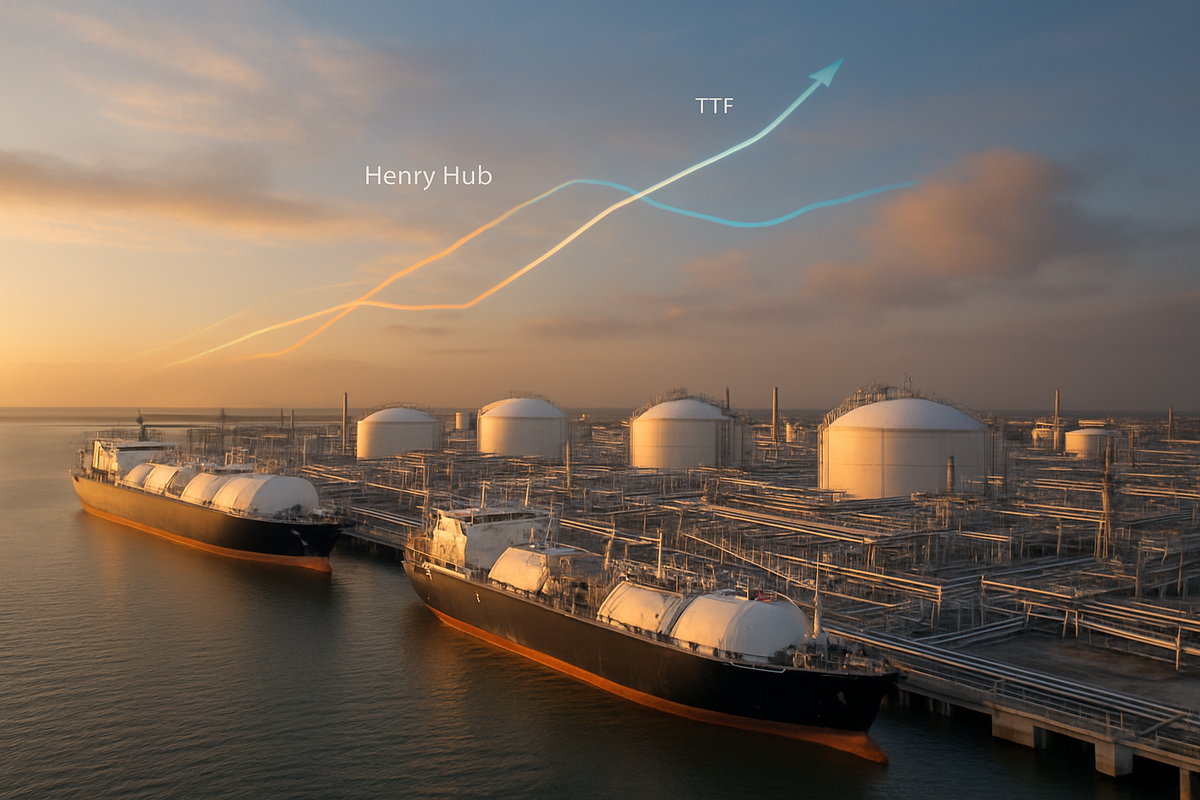
As of early January 2026, the global liquefied natural gas (LNG) market has reached a critical inflection point, marking the end of the hyper-volatile era that defined the first half of the decade. The once-gaping price chasm between United States domestic gas and international benchmarks in Europe and Asia has narrowed to its tightest levels in years. This convergence is driven by a long-anticipated "tsunami" of new supply from North America and the Middle East, effectively erasing the massive arbitrage profits that transformed the U.S. into an energy export superpower.
The immediate implications are profound: the global energy market is shifting from a desperate search for molecules to a fiercely competitive battle for market share. While the narrowing spreads provide much-needed relief to energy-intensive industries in Europe and Asia, they are exposing the profit margins of U.S. exporters who have become accustomed to record-breaking windfalls. As the "spot arbitrage" window shrinks, the industry is moving toward a more commoditized, lower-margin reality that rewards operational scale over speculative trading.
The Tsunami Arrives: A Timeline of the Global Supply Glut
The current market saturation is the result of a massive investment cycle triggered by the 2022 global energy crisis. Between 2022 and late 2025, over 100 million tonnes per annum (Mtpa) of new liquefaction capacity received Final Investment Decisions (FIDs). As we enter 2026, these projects are finally hitting the water. Key developments include the full commissioning of Venture Global’s Plaquemines LNG Phase 1 and 2, which added roughly 20 Mtpa to the U.S. Gulf Coast capacity, and the initial ramp-up of the Golden Pass LNG project—a joint venture between ExxonMobil (NYSE: XOM) and QatarEnergy.
The impact on pricing has been swift. In late 2025, the European Title Transfer Facility (TTF) and the Asian Japan Korea Marker (JKM) began a steady decline from their historical highs. By early January 2026, both benchmarks have converged near the $9.00–$9.50 per million British thermal units (MMBtu) range. Simultaneously, U.S. domestic prices at the Henry Hub have faced upward pressure due to record feed-gas demand, trading between $4.00 and $5.20/MMBtu. This has compressed the spread from over $30/MMBtu during the 2022 crisis to a mere $4.50/MMBtu today. Once liquefaction fees and transatlantic shipping costs—averaging $3.50 to $4.50 combined—are factored in, the profit margin for uncontracted "spot" cargoes has virtually evaporated.
Winners and Losers in the New Low-Margin Era
The primary beneficiary of this price convergence is the global industrial consumer. Companies in Europe and East Asia, which faced existential threats from high energy costs just three years ago, are now seeing stabilized input prices. However, the corporate landscape for energy producers is becoming bifurcated. Cheniere Energy (NYSE: LNG), the largest U.S. exporter, remains a dominant force but is navigating a shift from "super-profits" to "volume-driven stability." While 90% of Cheniere’s volumes are protected by long-term take-or-pay contracts, its marketing arm, which previously captured massive spot market gains, is seeing its margins squeezed significantly. Cheniere's net profit margins have moderated toward 20% in early 2026, down from peaks near 28% during the height of the crisis.
Conversely, Sempra (NYSE: SRE) appears well-positioned due to its "utility-model" approach. By selling a 45% stake in its infrastructure unit to institutional investors like KKR and CPP Investments in late 2025, Sempra successfully de-risked its balance sheet before the supply wave hit. Meanwhile, integrated majors like Shell plc (NYSE: SHEL) are utilizing their massive global portfolios to optimize shipping routes and minimize costs, a strategy that is becoming essential as per-unit margins shrink. The "losers" in this environment are speculative traders and smaller, uncontracted U.S. developers who lack the scale to absorb higher shipping costs or the credit backing to secure long-term buyers in a saturated market.
A Fundamental Shift in Global Energy Dynamics
The convergence of global LNG prices represents more than just a temporary market correction; it signifies the "commoditization" of natural gas on a global scale. Historically, gas markets were regional and fragmented, but the expansion of the global LNG fleet and the proliferation of flexible U.S. contracts have created a truly globalized market. This event mirrors the historical development of the global oil market, where regional price differences are eventually smoothed out by arbitrage and infrastructure.
This shift has significant regulatory and policy implications. With the "energy security" panic of 2022 fading, European and Asian regulators are shifting their focus back to carbon intensity and methane emissions. In the U.S., the narrowing profit margins may lead to a slowdown in new project approvals, as the economic case for "next-gen" LNG terminals becomes harder to justify to investors. This period of convergence serves as a reminder that the energy transition is not just about moving away from fossil fuels, but also about the maturation and eventual price-leveling of the bridge fuels that facilitate that transition.
Navigating the "Buyer's Market" of 2026 and Beyond
Looking ahead to the remainder of 2026, the market is expected to remain in a "buyer’s market" state. Short-term, we may see U.S. exporters voluntarily "shutting in" or slowing production if Henry Hub prices spike or international spot prices dip further, as the variable cost of shipping may exceed the potential sale price. Long-term, the industry will likely see a wave of consolidation. Smaller players who entered the market during the high-margin years may become acquisition targets for majors like TotalEnergies (NYSE: TTE) or ConocoPhillips (NYSE: COP), who are looking to consolidate low-cost supply.
Strategic pivots are already underway. Many U.S. developers are now focusing on "Green LNG" initiatives—carbon capture and storage (CCS) and electric-drive turbines—to differentiate their product in a crowded market. As price ceases to be the primary differentiator, the "carbon footprint" of a cargo is becoming the new frontier for competition. Investors should expect a period of lower capital expenditure (CAPEX) as companies prioritize returning cash to shareholders over ambitious new expansion projects that were conceived in a high-spread environment.
Summary and Investor Outlook
The great convergence of 2026 marks a maturing of the global LNG market. The era of easy arbitrage is over, replaced by a regime where operational excellence and contract security are paramount. The "supply wave" has successfully rebalanced a broken market, but it has also stripped away the massive premiums that U.S. exporters once enjoyed. For the market moving forward, this stability is a net positive for global economic growth, providing a predictable energy floor for the world's largest economies.
Investors should keep a close eye on the "feed-gas" demand in the U.S. Gulf Coast and any potential delays in Qatari expansion projects, which could provide temporary price support. The key metric to watch in the coming months will be the "utilization rates" of U.S. terminals; if spreads remain below $4.00/MMBtu, we may see the first significant test of the U.S. export model's resilience in a low-margin world.
This content is intended for informational purposes only and is not financial advice.