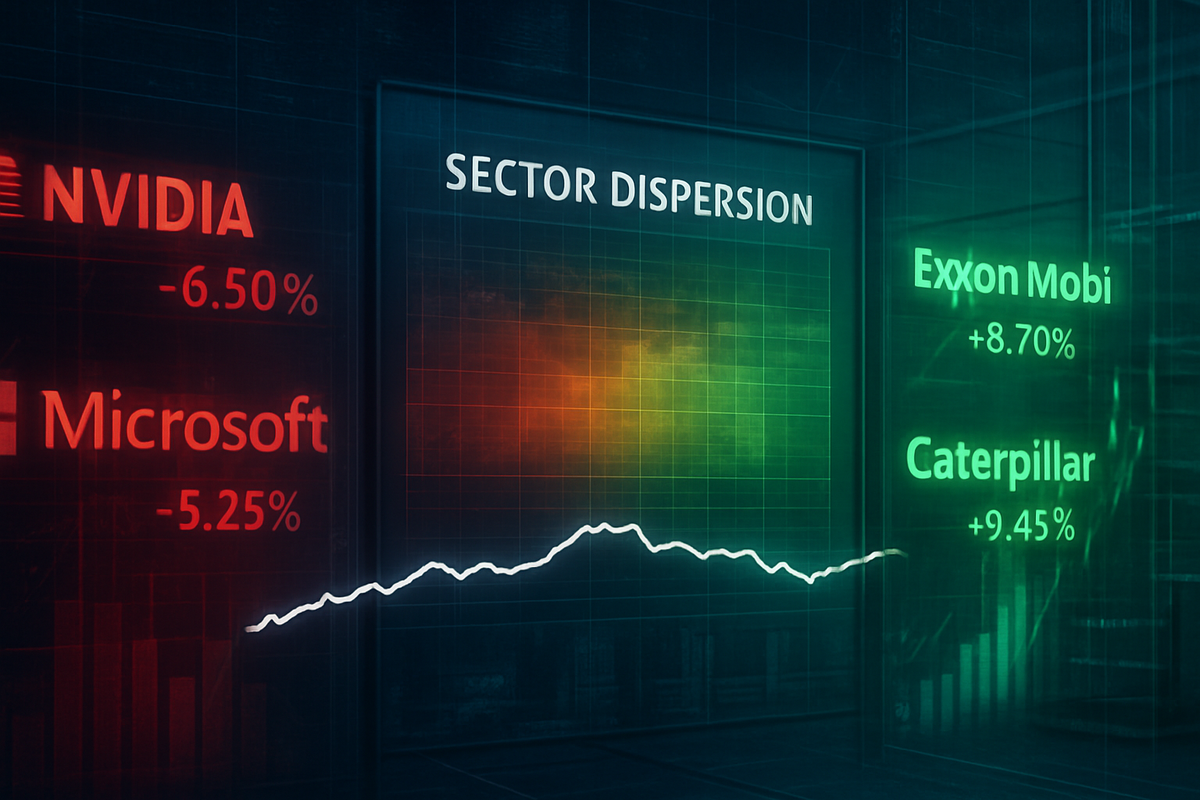
As of February 27, 2026, the broad market appears to be in a state of tranquil suspended animation. The S&P 500 has crawled to a modest year-to-date gain of approximately 0.7%, a figure that suggests a lack of conviction from investors. However, this surface-level serenity is an illusion. Beneath the placid waters of the market-cap-weighted index, a violent and historic rotation is taking place, pitting the former darlings of the Artificial Intelligence era against the "old economy" stalwarts of energy, industrials, and consumer staples.
This massive underlying sector dispersion has reached the 99th percentile of historical norms, creating a "bifurcated" market where the average stock is performing significantly better than the index itself. For investors in passive, cap-weighted vehicles, the stagnation of the "Magnificent Seven" has effectively neutralized the double-digit gains seen in the broader market, raising urgent questions about the risks of index concentration and the return of active management.
The Reversal of the AI Trade and the Rise of the Physical Buildout
The first two months of 2026 have been defined by what analysts are calling the "AI Scare Trade." After years of rewarding potential, the market has pivoted to a stance of aggressive skepticism regarding the return on investment for massive AI capital expenditures. This shift began in early January, following a series of earnings reports from software giants that suggested AI capabilities were disrupting existing revenue streams faster than they were creating new ones. By mid-February, this narrative had solidified, causing a significant pullback in the Information Technology sector, which is down nearly 3.8% year-to-date.
In contrast, the "Physical Buildout" trade has surged. Investors are no longer chasing the software "brains" of AI, but rather the "brawn"—the physical infrastructure required to power it. This has funneled billions of dollars into Energy and Industrials. Energy has been the undisputed leader this year, soaring over 22% YTD as geopolitical tensions in the Middle East and South America have tightened global supply. Meanwhile, the industrial sector has benefited from a domestic construction boom, driven by the need for advanced data centers and a strained electrical grid.
Winners and Losers: A Tale of Two Economies
The divergence is perhaps most visible in the performance of individual blue-chip stocks. On the losing side, previous market leaders like NVIDIA (Nasdaq: NVDA) and Microsoft (Nasdaq: MSFT) have faced significant headwinds. NVIDIA, the poster child for the AI revolution, has seen its stock decline by roughly 7.6% YTD as investors question the sustainability of triple-digit growth in GPU demand. Similarly, Microsoft has struggled to convince the street that its multi-billion-dollar investments in Copilot and OpenAI are yielding sufficient margin expansion. Other software-heavy names, such as Shopify (NYSE: SHOP) and The Trade Desk (Nasdaq: TTD), have been hit even harder, with the former tumbling nearly 29% as AI-driven automation threatens their traditional service-fee models.
Conversely, the winners' circle is dominated by companies that produce tangible goods and essential services. Caterpillar (NYSE: CAT) has emerged as a primary beneficiary of the data center expansion, with its heavy machinery and power generation units in record demand. In the energy sector, Exxon Mobil (NYSE: XOM) and Chevron (NYSE: CVX) have capitalized on rising crude prices, while GE Vernova (NYSE: GEV) has seen its valuation swell as it leads the charge in grid electrification. Even the retail sector has seen a "flight to safety," with Walmart (NYSE: WMT) and Costco (Nasdaq: COST) outperforming as consumers prioritize value in a "less-dovish" interest rate environment.
The Cost of Concentration and the Active Renaissance
The current state of the market highlights the inherent risks of market-cap-weighted indexing. Because the largest seven companies in the S&P 500 now represent nearly 40% of the index's total value, their collective stumble has anchored the entire benchmark. While the S&P 500 is up only 0.7%, the Invesco S&P 500 Equal Weight ETF (NYSE Arca: RSP)—which gives the same weight to a small utility as it does to a tech giant—is up an impressive 7.1% YTD. This 6.4-percentage-point gap is one of the widest on record for the first two months of a year.
This environment fits into a broader historical trend where periods of extreme concentration eventually give way to "mean reversion," where the laggards catch up and the leaders consolidate. The current dispersion is reminiscent of the early 2000s, following the dot-com bubble, when "value" stocks began a multi-year run of outperformance against "growth." Furthermore, the recent legislative landscape, including the "One Big Beautiful Bill Act" (OBBBA) and discussions of a flat 15% tariff on imports, has favored domestically anchored industrial firms over multinational tech companies, further fueling this structural shift.
Navigating the Volatility: What Lies Ahead
As we move into the spring of 2026, the short-term outlook remains clouded by policy uncertainty and the Federal Reserve's response to a resilient labor market. With the 10-year Treasury yield hovering around 4.25%, interest-rate-sensitive sectors like Real Estate continue to struggle, though they remain a potential area for a "relief rally" if the Fed signals a more definitive pivot toward easing. The primary strategic challenge for investors will be deciding whether to "buy the dip" in beaten-down tech giants or to follow the momentum into the "Real Economy" sectors.
Potential scenarios for the remainder of the year include a "broadening out" of the market, where tech stabilizes while energy and industrials continue to climb, potentially pushing the S&P 500 toward new highs. However, a more bearish scenario exists where the drag from the mega-cap tech sector eventually pulls the rest of the market down, leading to a broader correction. Strategic pivots toward "Heavy Asset, Low Obsolescence" (HALO) business models appear to be the dominant trend for institutional managers seeking to hedge against AI-driven disruption.
Closing Thoughts: A Wake-Up Call for Index Investors
The primary takeaway from February 2026 is that the headline index no longer tells the full story of the American economy. A 0.7% YTD return masks a vibrant and volatile market where massive wealth is being created in traditional sectors while being erased in the digital ones. The "Mag-7" era of easy, concentrated gains appears to be transitioning into a "Stock-Picker’s Market," where understanding sector fundamentals is more important than simply owning the benchmark.
Moving forward, investors should closely watch the progress of the OBBBA legislation and the sequential earnings reports from the industrial and power sectors. The ability of the electrical grid to keep pace with AI demand will be a crucial "canary in the coal mine" for the sustainability of the current rotation. While passive indexing has served investors well for over a decade, the 2026 dispersion serves as a stark reminder that diversification involves more than just owning 500 names—it requires a balance that a cap-weighted index may no longer provide.
This content is intended for informational purposes only and is not financial advice