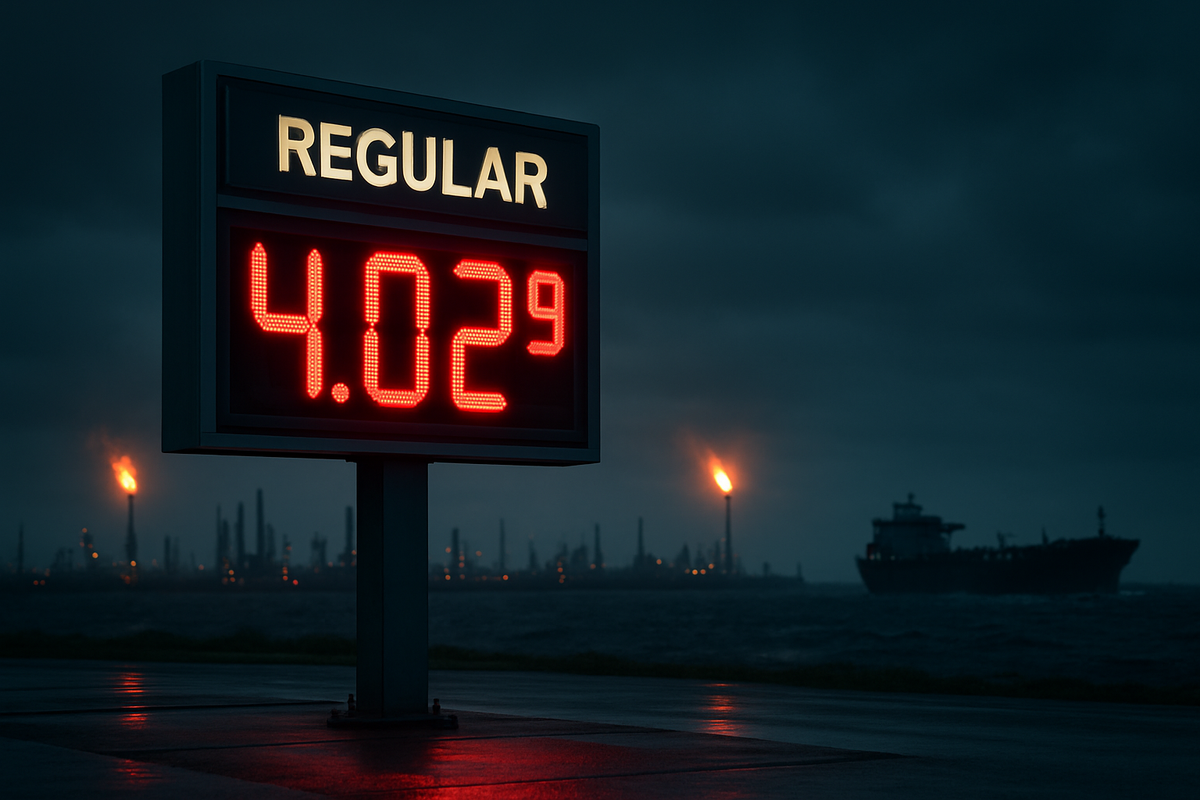
For the first time since the summer of 2022, American motorists are facing a stark reality at the pump as the national average for retail gasoline officially surpassed the $4.00 per gallon mark today, March 31, 2026. The psychological and economic barrier was breached following weeks of relentless upward pressure on global energy markets, driven primarily by the deepening military conflict between the United States and Iran. As of this morning, the national average stands at $4.02, with several West Coast metropolitan areas reporting prices well north of $6.00.
The surge is a direct reflection of a 40% rally in West Texas Intermediate (WTI) crude oil prices since the onset of hostilities in late 2025. With WTI now trading near $103.40 per barrel, the market is pricing in a severe "geopolitical risk premium." Beyond the raw cost of crude, the crisis has been exacerbated by a systemic breakdown in energy logistics, characterized by record-high maritime insurance premiums and the near-total closure of the Strait of Hormuz, through which roughly 20% of the world’s oil supply typically flows.
The Perfect Storm: Conflict, Insurance, and Supply Shocks
The road to $4.00 gasoline began in late 2025 as diplomatic efforts to revive regional security agreements collapsed, leading to a series of maritime skirmishes in the Persian Gulf. By early 2026, the situation transitioned into a full-scale regional conflict. The most immediate impact was felt in the maritime insurance market. War-risk premiums for tankers transiting the Middle East surged from a standard 0.1% to a staggering 7.5% of vessel hull value. For a Very Large Crude Carrier (VLCC), this translates to an insurance cost jump from roughly $600,000 to nearly $9 million per voyage.
These astronomical insurance costs, coupled with the threat of drone and missile strikes on energy infrastructure, have forced major shipping lines to abandon the Suez Canal route in favor of the Cape of Good Hope. This detour adds 10 to 14 days to transit times and costs upwards of $1 million in additional fuel per journey. The International Energy Agency (IEA) estimates that approximately 10 million barrels per day (bpd) of production have been "shut in" or rendered unreachable due to the blockade of the Strait of Hormuz and damage to key facilities like Saudi Arabia’s Ras Tanura.
The initial market reaction has been one of high volatility and "panic buying" in the futures market. While the U.S. has tapped the Strategic Petroleum Reserve (SPR) to mitigate the shock, the volume of the disruption—the largest in modern history—has overwhelmed domestic supply measures. US refiners are operating at near-maximum capacity to compensate for the loss of Middle Eastern refined products, pushing "crack spreads" to record levels and directly inflating the price of consumer-grade gasoline and diesel.
Winners and Losers in a High-Octane Economy
The sudden shift in the energy landscape has created a sharp divide between those positioned to profit from scarcity and those crippled by rising input costs. Domestic "pure-play" energy producers have emerged as the primary beneficiaries. ExxonMobil (NYSE: XOM) and Chevron (NYSE: CVX) have seen their margins expand as their significant Permian Basin assets provide a stable supply of crude at globally inflated prices. Similarly, U.S. shale specialists like SM Energy (NYSE: SM) and Chord Energy (NASDAQ: CHRD) are reaping the rewards of their high leverage to WTI spot prices, which have decoupled from the lower production costs of the U.S. interior.
In the natural gas space, Cheniere Energy (NYSE: LNG) has become a critical lifeline for global markets. As Qatari LNG exports remain blocked, Cheniere’s export terminals on the Gulf Coast are operating at 100% capacity, commanding premium prices from European and Asian buyers desperate for non-Middle Eastern energy. On the maritime front, tanker operators like Frontline (NYSE: FRO) have seen freight rates skyrocket as the global fleet is stretched thin by the longer routes around Africa.
Conversely, the transport and consumer sectors are reeling. The airline industry, already struggling with post-pandemic debt, is facing a fuel crisis. Delta Air Lines (NYSE: DAL), United Airlines (NASDAQ: UAL), and American Airlines (NASDAQ: AAL) have all issued profit warnings, noting that fuel expenses for 2026 are projected to be at least 15% higher than previous estimates. Logistics giants FedEx (NYSE: FDX) and United Parcel Service (NYSE: UPS) are also under pressure, as fuel surcharges—while helpful—cannot fully offset the combined impact of higher operating costs and slowing consumer demand.
Broader Significance and Historical Precedents
This breach of the $4.00 mark is more than just a headline; it signifies a potential shift in the Federal Reserve's battle against inflation. After nearly two years of stabilizing prices, the energy-led spike threatens to reignite inflationary expectations, potentially forcing the Fed to maintain higher interest rates for longer. This event mirrors the 1973 oil embargo and the 2022 price spike following the invasion of Ukraine, but with a more complex maritime insurance component that makes the "cost of doing business" globally more expensive.
The regulatory environment is also expected to shift rapidly. We are already seeing renewed calls in Washington for aggressive "windfall profit" taxes on energy companies, alongside increased subsidies for the electric vehicle (EV) sector. For companies like Tesla (NASDAQ: TSLA) and traditional automakers transitioning to electric fleets, $4.00 gas serves as the ultimate marketing tool. However, the supply chain for EV batteries, much like the oil market, remains vulnerable to the same geopolitical instabilities currently affecting global trade routes.
Furthermore, the "reshoring" trend is likely to accelerate. Companies that relied on "just-in-time" manufacturing from Asia are finding that the combination of $100+ oil and $9 million insurance premiums makes domestic production not just a strategic choice, but a financial necessity. The "geopolitical risk premium" is no longer a theoretical concept—it is now a permanent line item on corporate balance sheets.
The Road Ahead: Scenarios and Strategic Pivots
In the short term, the market is bracing for even higher prices. If the conflict in the Persian Gulf persists into the peak summer driving season, analysts warn that WTI could test the $150 per barrel mark, which would push U.S. gasoline prices toward $5.50 or even $6.00 nationally. This would likely trigger a significant "demand destruction" event, where consumer spending on non-essential goods drops sharply, potentially tipping the U.S. economy into a recession by late 2026.
Strategic pivots are already underway. Energy companies are expected to redirect capital expenditure toward offshore drilling in the Gulf of Mexico and Guyana, seeking to diversify away from the volatile Middle East. Logistics firms may increasingly turn to autonomous trucking and rail to reduce the "fuel-per-mile" cost of freight. For investors, the coming months will require a defensive posture, favoring companies with strong pricing power and minimal exposure to international shipping lanes.
A Market in Flux: Key Takeaways
The return of $4.00 gasoline marks a turning point for the 2026 economy. It underscores the fragility of the global energy supply chain and the profound impact that a localized conflict can have on the wallet of the average American. The key takeaways for the market are clear: energy security has returned as the paramount concern for both policymakers and corporate leaders, and the era of "cheap" global logistics may be over for the foreseeable future.
Moving forward, investors should keep a close eye on the weekly EIA inventory reports and the "war-risk" ratings issued by maritime insurers. Any de-escalation in the Iran conflict would likely lead to a rapid, albeit partial, retracement in oil prices. However, the structural changes—higher insurance costs and rerouted trade—may take years to normalize. For now, the "four-dollar gallon" is a stark reminder that in a globalized economy, the price of peace is often reflected at the pump.
This content is intended for informational purposes only and is not financial advice