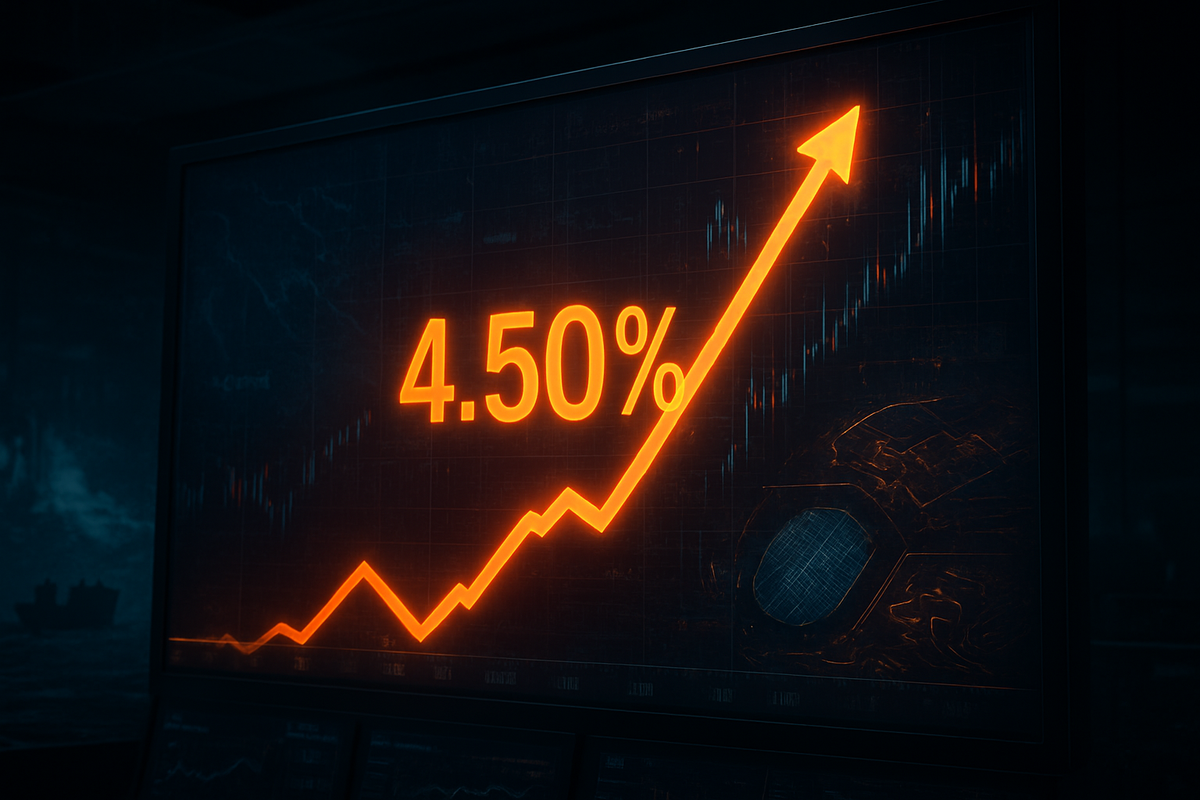
NEW YORK — The global financial landscape shifted violently today, March 9, 2026, as the yield on the benchmark 10-year U.S. Treasury note surged toward the psychologically significant 4.50% mark. This aggressive move follows a technical breakout above the 4.20% resistance level earlier this month, a development that chartists warn could signal a prolonged regime of "higher-for-longer" interest rates. The spike is being fueled by a toxic combination of "sticky" core inflation and a dramatic escalation in Middle Eastern conflict, which has sent energy prices soaring and upended expectations of a Federal Reserve pivot.
As the 10-year yield hit 4.42% in early morning trading, the immediate implications were felt across equity markets. Growth-oriented sectors, particularly technology, have entered a tailspin as the rising "risk-free rate" forces analysts to discount future earnings more aggressively. The Nasdaq Composite is down 2.4% on the day, marking its worst session of the year so far, as investors grapple with the reality that the cheap-money era of early 2025 is firmly in the rearview mirror.
A Technical Breakdown and a Geopolitical Spark
The current crisis traces its roots to late February 2026, when a series of military escalations in the Persian Gulf threatened the critical Strait of Hormuz. By March 2, the effectively shuttered chokepoint had sent Brent Crude oil prices skyrocketing above $100 per barrel. This supply shock immediately bled into inflation expectations, with the 10-year breakeven inflation rate jumping to 2.75%, its highest level in two years. This fundamental pressure provided the fuel for a massive technical breakout; once the 10-year yield cleared the 4.20% ceiling on March 4, a flood of algorithmic selling in the bond market was triggered, clearing the path for the current 4.50% target.
The Federal Reserve, led by Chair Jerome Powell, now finds itself in a precarious "wait-and-see" posture. Just three months ago, market participants were pricing in at least two rate cuts for the first half of 2026. Those hopes have evaporated. With Core PCE (Personal Consumption Expenditures) remaining stubbornly near 3.0%, the bond market is now pricing in a 70% probability that the Fed may actually have to raise rates later this year to combat energy-driven price pressures. This "bear steepening" of the yield curve suggests that investors are demanding a higher premium for long-term debt, fearing that inflation is becoming structural rather than transitory.
Growth Under Pressure: Winners and Losers
The primary casualties of this yield surge are the "Long Duration" tech giants that have led the market for years. NVIDIA Corporation (NASDAQ: NVDA), which had been buoyed by the release of its new AI architectures earlier this year, saw its shares tumble 4.8% today. As interest rates rise, the present value of NVIDIA's projected 2028 and 2030 cash flows diminishes, leading to significant multiple compression. Similarly, Microsoft Corporation (NASDAQ: MSFT) and Apple Inc. (NASDAQ: AAPL) are facing headwinds as their premium valuations are tested against a 4.5% guaranteed return in government bonds.
Tesla, Inc. (NASDAQ: TSLA) has been hit particularly hard, falling 5.5% as the yield spike translates directly into higher auto loan rates. With 30-year mortgages also climbing toward 7%, the broader consumer discretionary sector is under siege. Conversely, the energy sector has emerged as a rare sanctuary. Exxon Mobil Corporation (NYSE: XOM) and Chevron Corporation (NYSE: CVX) have seen their stock prices climb as they reap the benefits of $110-per-barrel oil. Financial institutions like JPMorgan Chase & Co. (NYSE: JPM) are seeing a mixed bag; while higher rates can improve net interest margins, the threat of a "hard landing" and a slowdown in mortgage originations is dampening the sector's overall gains.
The End of the "Soft Landing" Narrative
This event marks a significant departure from the "soft landing" consensus that dominated the 2025 outlook. For much of last year, investors believed that the Fed had successfully threaded the needle, bringing inflation down without crushing growth. However, the current "re-acceleration" scenario mimics the inflationary waves of the 1970s, where initial successes were undone by secondary energy shocks. The broader industry trend is now shifting toward "capital preservation," as the 60/40 portfolio faces its most rigorous test since the 2022 bear market.
The ripple effects extend far beyond Wall Street. Regulatory bodies and the Treasury Department are now under pressure to manage a massive supply of new debt issuance to fund fiscal deficits. As yields rise, the cost of servicing the U.S. national debt is projected to eclipse defense spending by the end of the fiscal year, a milestone that could trigger further credit rating reviews for U.S. sovereign debt. This creates a feedback loop: higher deficits lead to more bond supply, which pushes yields even higher, further increasing the deficit.
What Comes Next: The Road to 5.00%
In the short term, all eyes are on the upcoming March CPI report. If inflation figures exceed expectations, the 10-year yield could pierce the 4.50% target and move toward 4.75% or even 5.00% by the summer. Market strategists are advising a pivot toward "high-quality" value stocks with strong balance sheets and immediate cash flow, moving away from speculative AI ventures that lack near-term profitability.
Strategic adaptations are already underway at major hedge funds, which are increasingly using "short-duration" strategies to mitigate bond market losses. If the conflict in the Persian Gulf remains unresolved, the possibility of a global recession in late 2026 becomes a base-case scenario for many institutional models. Investors should prepare for continued volatility in the "Magnificent 7" and look for potential entry points in defensive sectors like utilities and healthcare, which historically outperform when growth slows and yields stabilize at higher levels.
Summary and Market Outlook
The surge in US Treasury yields to 4.50% on March 9, 2026, represents a "regime change" for global markets. The technical breakout above 4.20% was not merely a chart pattern but a fundamental realization that inflation is stickier and geopolitical risks are more potent than previously priced. The era of low-cost capital for growth companies is effectively over, replaced by a environment where "earnings execution" is the only metric that matters.
As we move forward, the key indicators to watch will be the stability of energy prices and the Fed's rhetoric regarding a potential rate hike. While the current volatility is painful for growth investors, it is also a "cleansing" moment for the market, stripping away speculative excess and refocusing capital on companies with real-world utility and pricing power. For the coming months, caution is the watchword as the market searches for a new equilibrium in a world of 4.5% yields.
This content is intended for informational purposes only and is not financial advice.