WASHINGTON D.C. — The Federal Reserve’s long-standing quest to bring inflation down to its 2% target has hit a formidable wall. The latest data released this week, showing both the Personal Consumption Expenditures (PCE) price index and the Producer Price Index (PPI) holding steady at 2.9%, has sent a clear signal to Wall Street: the "last mile" of disinflation is proving to be a marathon, not a sprint. This stubbornness in price levels is effectively stripping the central bank of its flexibility, forcing a "higher-for-longer" interest rate regime that few investors expected to see lasting into the first quarter of 2026.
The immediate implications are stark. Market expectations for a series of interest rate cuts throughout 2026 are being aggressively repriced. Treasury yields surged following the announcement, reflecting a growing consensus that Federal Reserve Chair Jerome Powell and the Federal Open Market Committee (FOMC) will maintain the current federal funds rate—presently in the 4.25%–4.50% range—well into the second half of the year. For an economy that had begun to bake in a return to "easy money," the 2.9% reading acts as a bucket of cold water, signaling that the inflation beast is wounded but far from defeated.
The Plateau: Why 2% Remains Just Out of Reach
The 2.9% readings for both PCE and PPI represent a frustrating plateau for policymakers. While inflation has cooled significantly from the peaks of 2022 and 2023, the progress seen in late 2024 and throughout 2025 has effectively stalled. The timeline leading to this moment was marked by a brief period of optimism last summer, when inflation dipped toward 2.5%, prompting the Fed to enact three modest quarter-point cuts. However, a "second wave" of price pressures—driven largely by persistent shelter costs and a spike in services inflation—has halted that momentum.
Key stakeholders, including Fed officials and Treasury Department leadership, now face a "two-speed" economy. While the prices of durable goods have stabilized or even fallen in some sectors, "Supercore" inflation—which excludes housing and energy—remains elevated at over 3.5%. This is fueled by a labor market that, while cooling, still supports wage growth levels that the Fed views as inconsistent with its 2% mandate. The initial market reaction was one of sharp recalibration; the S&P 500 saw its most volatile trading week of the year as traders moved from "risk-on" to a defensive posture, fearing that the Fed might even have to consider a "hawkish pause" or, in the extreme, a return to hikes if the numbers don't trend downward by summer.
Winners and Losers in the "Sticky" Economy
In this environment of high rates and persistent inflation, a clear divide is emerging between corporate titans capable of weathering the storm and those vulnerable to credit cycles. JPMorgan Chase & Co. (NYSE: JPM) continues to stand out as a primary beneficiary. The banking giant recently reported record net interest income (NII) of over $100 billion, as high rates allow it to maintain fat margins on loans while its "fortress balance sheet" protects it from the uptick in consumer defaults seen in smaller regional competitors. Similarly, energy giants like Exxon Mobil Corp. (NYSE: XOM) are acting as a natural hedge for investors, as commodity prices remain elevated due to geopolitical tensions and supply constraints, often a byproduct of the same inflationary pressures.
Conversely, the housing sector is feeling the brunt of the Fed’s restrictive policy. Lennar Corp. (NYSE: LEN) and other major homebuilders are seeing their profit margins squeezed as they are forced to offer significant mortgage rate buy-downs and incentives to lure buyers who are otherwise priced out by 7% mortgage rates. Even tech behemoths are not immune to the valuation gravity of high interest rates. While Apple Inc. (NASDAQ: AAPL) remains a cash-flow powerhouse, its stock has faced "multiple compression" as investors discount future earnings more heavily against the backdrop of high-yielding 10-year Treasuries. Furthermore, retail players like Target Corp. (NYSE: TGT) are finding it difficult to pass on rising wholesale costs to a consumer base that is increasingly "trading down" to essentials, prioritizing grocery spending over the discretionary home and apparel categories that drive Target’s higher-margin business.
A New Era of Monetary Policy?
The current situation fits into a broader historical trend that some economists compare to the "stop-go" policy cycles of the 1970s. The fear within the Fed is that easing too early could lead to an inflationary rebound, while staying tight for too long could trigger a deep recession. This dilemma is complicated by the "Tariff Wildcard" introduced in 2025, where new trade policies have kept the cost of imported goods higher than they would be in a fully globalized market. The ripple effect on competitors and partners is immense; as U.S. rates stay high, the dollar remains strong, putting immense pressure on emerging markets and multinational corporations that earn revenue in weaker foreign currencies.
Regulatory and policy implications are also coming to the fore. With the 2026 election cycle looming, the "cost of living" has become the central battleground. There is growing pressure on the Fed to potentially redefine its 2% target—perhaps to a more "flexible" 2.5%—though Chair Powell has repeatedly dismissed this as a threat to the central bank's credibility. The historical precedent suggests that once inflation becomes "sticky" at the 3% level, it requires a significant economic slowdown to break the cycle, a scenario the Fed is desperately trying to avoid through its "surgical" approach to rate management.
The Path Forward: Strategic Pivots and Scenarios
Looking ahead, the short-term outlook is one of "data dependency" on steroids. Every consumer confidence report and jobs print will be scrutinized for signs of a break in the inflationary trend. In the long term, companies will likely continue their strategic pivots toward automation and AI-driven efficiency to combat rising labor costs. Microsoft Corp. (NASDAQ: MSFT) and other enterprise software leaders may find increased demand as businesses look for digital solutions to protect their margins against a backdrop of stagnant prices and rising wages.
Potential scenarios for the remainder of 2026 range from a "soft landing," where inflation finally resumes its drift toward 2% without a spike in unemployment, to a "stagflationary" trap where growth stalls while prices remain high. The latter would be the nightmare scenario for the market, likely leading to a prolonged bear market in equities. Investors should prepare for a period where "cash is king," and high-quality companies with low debt and strong pricing power will likely outperform the broader market.
Final Assessment: The 2.9% Tether
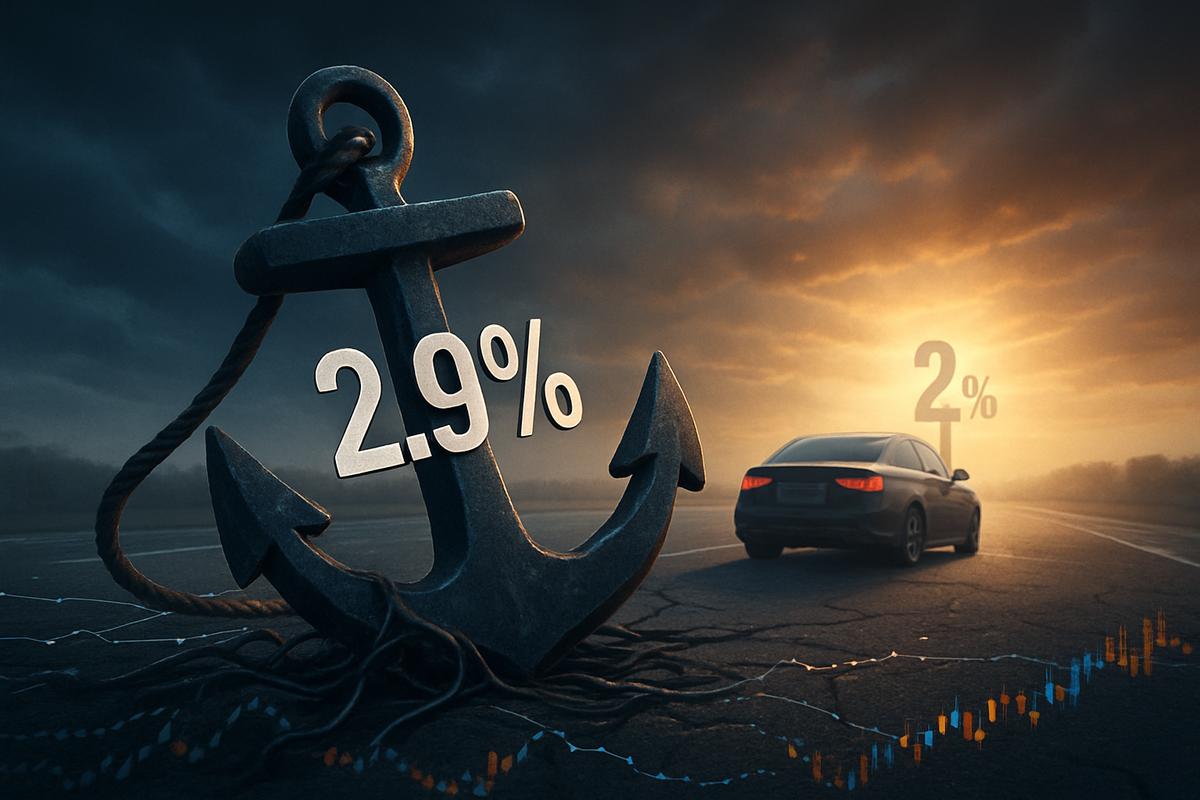
The takeaway from the latest PCE and PPI data is clear: the Federal Reserve is currently tethered to its current rate levels by the 2.9% inflation anchor. The era of predictable, downward-trending inflation has ended, replaced by a period of volatility and "stickiness" that challenges the traditional economic playbook. For the market to move forward, it must accept that the 2% target is a destination that remains several quarters away, rather than an immediate milestone.
In the coming months, investors should watch for any shift in the "Supercore" services data and the Fed’s rhetoric regarding the "neutral rate" of interest. If the neutral rate is indeed higher than previously thought, the current 4.50% federal funds rate might not be as restrictive as intended, suggesting that the "higher-for-longer" narrative is not just a temporary phase, but the new foundation of the 2026 economy.
This content is intended for informational purposes only and is not financial advice.