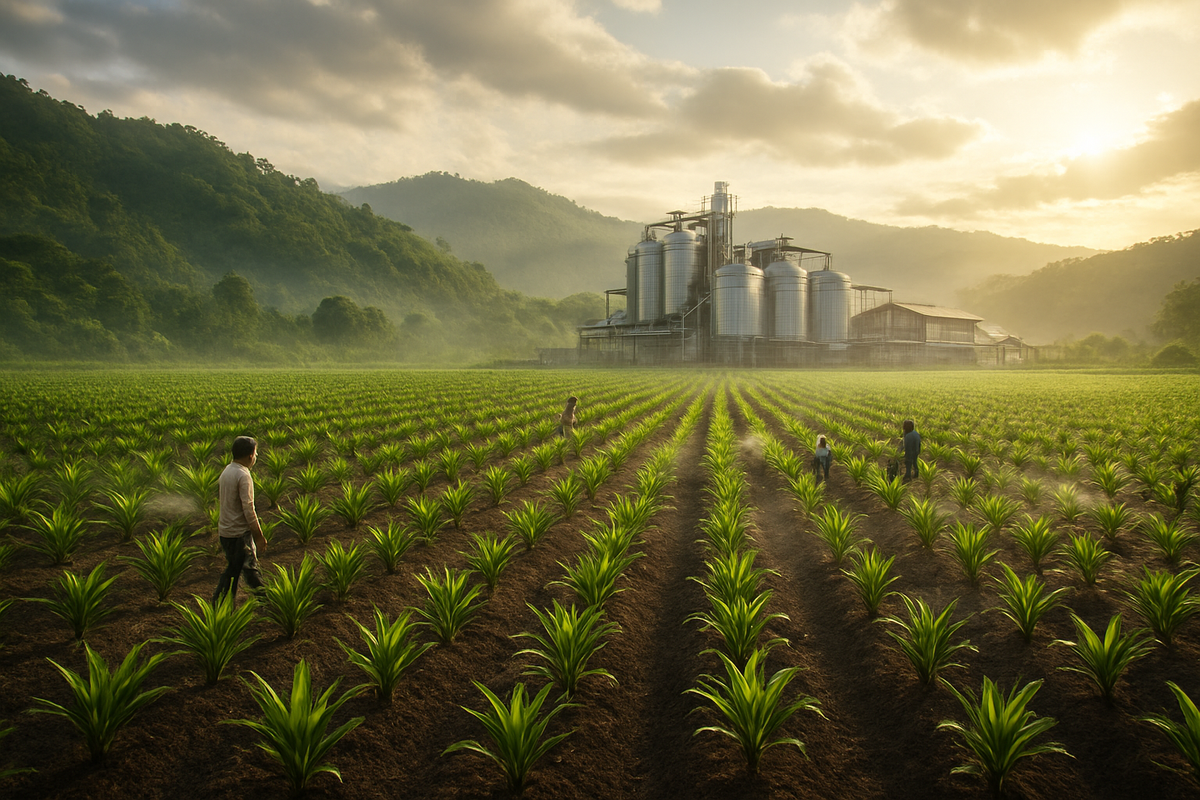
NEW DELHI — In a move that signals a decisive shift toward agricultural self-sufficiency, Patanjali Foods (NSE: PATANJALI) has taken delivery of 1.5 million high-yielding oil palm seeds from the Malaysian state-run Sawit Kinabalu Group. The shipment, part of a massive multi-year procurement strategy, arrives as India aggressively pivots its supply chain to insulate itself from global volatility. However, the operational success of this "Atmanirbharta" (self-reliance) push is currently colliding with a restrictive regulatory environment, as the Indian Vegetable Oil Producers’ Association (IVPA) intensifies its lobbying to lift a long-standing suspension on commodity derivatives.
The delivery marks a critical milestone for the National Mission on Edible Oils – Oil Palm (NMEO-OP), which aims to reduce India’s 60% dependency on imported cooking oils. While Patanjali’s upstream expansion in Northeast India secures its long-term raw material pipeline, the domestic industry remains hamstrung by a lack of hedging tools. With the Securities and Exchange Board of India (SEBI) recently extending the ban on crude palm oil (CPO) futures through March 2027, the sector is effectively flying blind in a global market increasingly defined by protectionism and climate-driven supply shocks.
The Seed Deal: Planting the Foundations of Autonomy
The procurement of 1.5 million seeds is the centerpiece of a five-year agreement signed in mid-2025 between Patanjali Foods and Sawit Kinabalu, representing the first time a Malaysian state agency has directly partnered with an Indian corporate entity for upstream technical development. This collaboration goes beyond simple trade; it includes site visits from Malaysian agronomists and health monitoring for seedlings planted across the rugged terrain of Assam, Arunachal Pradesh, and Manipur. As of early 2026, Patanjali has already operationalized a significant portion of these seeds, with plans to commission a major processing mill in the Northeast by the third quarter of this year to handle the first harvests from its earlier 2023-2024 planting cycles.
This timeline is a direct response to the Indian government’s NMEO-OP targets, which aim to cover one million hectares of oil palm by the end of the 2025-26 fiscal year. Stakeholders including the Ministry of Agriculture and regional state governments have provided tailwinds through increased subsidies for planting materials—rising from ₹12,000 to ₹29,000 per hectare—which facilitated this specific deal. The market reaction has been cautiously optimistic; while Patanjali’s stock has shown resilience due to its vertically integrated model, the broader industry remains wary of the high gestation period for oil palm, which typically takes four to five years to reach peak productivity.
Corporate Winners and the New Competitive Landscape
Patanjali Foods (NSE: PATANJALI) stands as the primary beneficiary of this deal, cementing its first-mover advantage in the Northeast, a region the government has dubbed the "Palm Oil Hub" of India. By controlling its seed supply and technical inputs, Patanjali reduces its exposure to the erratic pricing of Malaysian and Indonesian CPO. Conversely, pure-play refiners like Adani Wilmar (NSE: AWL) and specialized agricultural firms like Godrej Agrovet (NSE: GODREJAGRO) face a more complex landscape. While Godrej also has a strong domestic plantation footprint, any delay in securing similar high-quality genetics from abroad could see them lose ground in the race for acreage.
On the losing side of this shift are the traditional international bulk exporters. As India builds its domestic "Crude Palm Oil" capacity, the long-term volume requirements for refined oil from giants like Wilmar International (SGX: F34) or Sime Darby Plantation (KLSE: SIMEPLT) may begin to plateau. Furthermore, Indian consumers may eventually face a "transition tax" in the form of higher prices during the years it takes for these domestic plantations to mature, especially if the IVPA's warnings about the lack of price discovery tools prove correct.
Global Supply Chain Shifts: The End of Open Markets?
The Patanjali deal is unfolding against a backdrop of a radically altered global trade map. The implementation of the European Union Deforestation Regulation (EUDR) in 2025 has forced Southeast Asian producers to bifurcate their supply chains. Malaysia and Indonesia are increasingly looking to India as a "pragmatic" partner that prioritizes food security over the EU’s stringent traceability requirements. Simultaneously, the 2026 global trade environment is reeling from the introduction of "Section 122" universal baseline tariffs by the United States, which has added an "instability premium" to all cross-border agricultural shipments.
India's push for domestic palm oil is a direct attempt to opt out of this global chaos. Historically, India has been a price-taker, vulnerable to export bans from Indonesia or sunflower oil disruptions in the Black Sea. By importing "upstream technology"—the seeds—rather than just the "downstream product," India is mimicking the industrial policy it used for the semiconductor and EV sectors. This shift suggests that the future of global agriculture will be less about open-market bulk buying and more about bilateral, state-backed corporate alliances that secure the entire lifecycle of a crop.
The Hedging Vacuum: IVPA vs. Regulatory Caution
Despite these strategic gains, the industry is currently at loggerheads with regulators. In March 2026, SEBI extended its suspension of agricultural derivatives for another year, citing the need to curb food inflation. The IVPA has responded with a scathing critique, arguing that the lack of futures trading for CPO and oilseeds has actually increased volatility by removing the "buffer" of transparent price discovery. Without a domestic exchange to hedge risk, Indian processors are forced to use the Bursa Malaysia Derivatives or the Chicago Board of Trade (CBOT), exposing them to significant currency risk and "basis" risk (the price difference between international and local markets).
Looking ahead, the tension between the government’s desire for price control and the industry’s need for risk management tools will likely reach a breaking point. Market analysts suggest that the government may introduce a "hybrid" trading model later in 2026, where derivatives are allowed but subject to strict position limits and "circuit breakers" tied to the Viability Price (VP) mechanism. This would provide the safety net farmers need while giving companies like Patanjali and Godrej the financial tools to manage their multi-billion-rupee investments in the Northeast.
Summary and Investor Outlook
The Patanjali-Sawit Kinabalu deal is more than a simple procurement of seeds; it is a foundational brick in India’s new wall of food security. For investors, the takeaway is clear: the edible oil sector is transitioning from a high-volume trading business to a capital-intensive infrastructure business. The winners will be those who control the "dirt"—the plantations and the processing mills—rather than those who merely trade the finished product.
In the coming months, the market should watch for the commissioning of Patanjali’s first major mill in the Northeast and any potential softening of SEBI’s stance on derivatives. If the IVPA successfully lobbies for even a partial return of futures trading, it could unlock a massive wave of liquidity for the sector. However, until the "hedging vacuum" is filled, the ambitious National Mission on Edible Oils remains a high-stakes gamble on domestic production in an increasingly volatile world.
This content is intended for informational purposes only and is not financial advice.