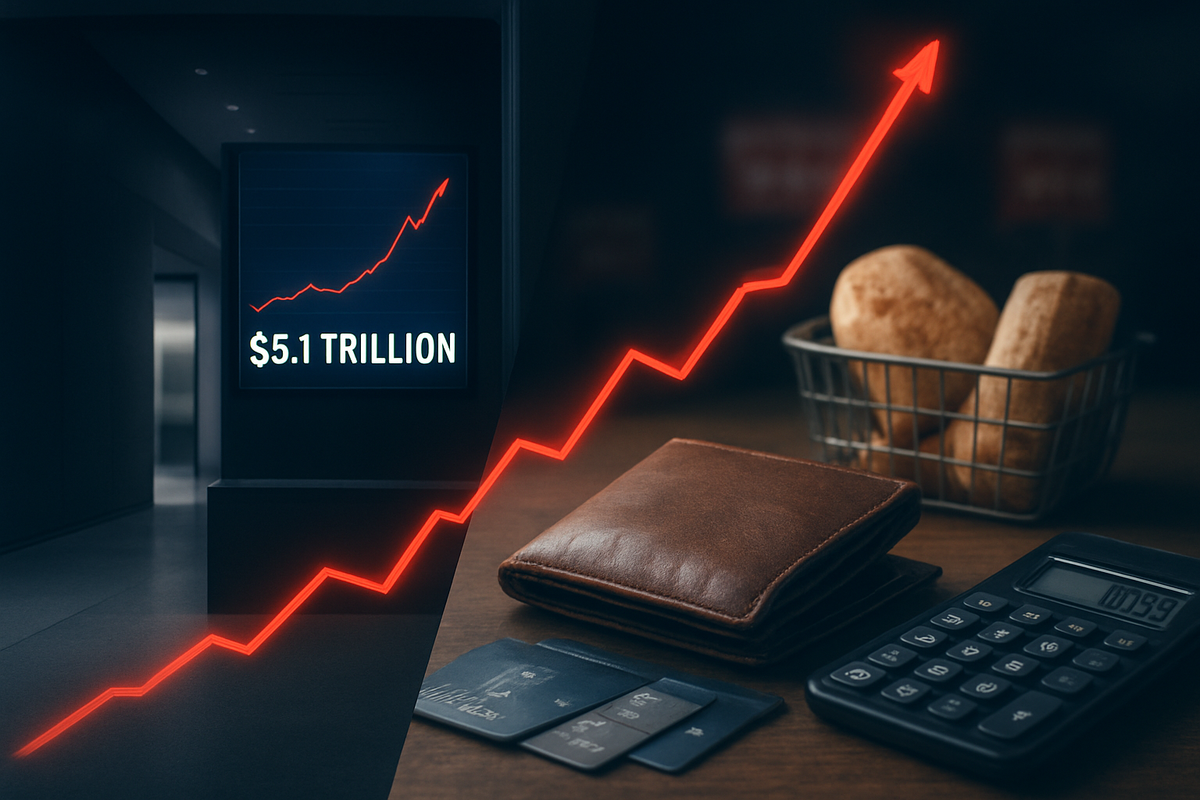
The Federal Reserve’s latest G.19 Consumer Credit report, released on April 7, 2026, paints a stark picture of a "bifurcated" American economy. As total consumer debt climbs past the $5.1 trillion mark, the data reveals a population increasingly reliant on high-interest revolving credit to manage "sticky" inflation and high living costs. While the top tier of earners continues to benefit from record household wealth, lower- and middle-income families are showing signs of severe financial exhaustion, with credit card and student loan delinquencies reaching levels not seen in years.
The immediate implications are clear: the Federal Reserve’s "higher-for-longer" interest rate strategy has finally begun to weigh heavily on the average household's balance sheet. With the federal funds rate currently held at 3.50%–3.75%, the cost of carrying a balance on a credit card has reached an eye-watering average of 21% to 24% APR. This growing debt burden is acting as a significant drag on discretionary spending, forcing a shift in consumer behavior that is likely to ripple through the retail and banking sectors for the remainder of 2026.
The State of the American Wallet: A Deep Dive into the G.19 Report
The Federal Reserve's April release, which covers data through the end of February 2026, shows that total outstanding consumer credit (excluding mortgages) has reached approximately $5.12 trillion, an annual growth rate of 2.0%. Within this total, revolving credit—largely comprised of credit cards—hit $1.33 trillion. While this represents a slight deceleration from the frantic growth seen in 2025, the nominal value remains historically high, reflecting the reality that many households are no longer using credit for rewards or convenience, but as a necessary bridge for essentials like groceries and utilities.
The timeline leading to this moment is characterized by a persistent battle against inflation. Despite the Fed’s aggressive tightening cycle through late 2024 and 2025, consumer prices have stabilized at a stubborn 2.8% to 3.0%, well above the 2.0% target. This has left the Federal Open Market Committee (FOMC) in a difficult position, as noted by Chair Jerome Powell in the March 2026 meeting. Initial market reactions to the report have been cautious; bond yields remained steady as investors digested the possibility that only one rate cut might occur in 2026, given the resilient, yet straining, consumer backdrop.
Perhaps the most alarming detail in the report is the surge in student loan stress. Following the full resumption of payment reporting in late 2025, serious delinquency rates (90+ days past due) for student loans have climbed to between 9.4% and 9.6%. According to data from Equifax Inc. (NYSE: EFX), total household debt, when including mortgages, now stands at a staggering $18.19 trillion. Analysts from S&P Global Inc. (NYSE: SPGI) have pointed out that the "savings buffer" accumulated during the pandemic years has effectively vanished for the bottom 40% of income earners, leaving them vulnerable to any further economic shocks.
Winners and Losers in a High-Rate, High-Debt Environment
The current credit landscape creates a distinct set of winners and losers among public companies. Major financial institutions with a focus on affluent clients, such as JPMorgan Chase & Co. (NYSE: JPM) and American Express Company (NYSE: AXP), appear relatively well-insulated. These companies benefit from a customer base that maintains high spending power and lower delinquency risks. American Express, in particular, continues to see robust travel and entertainment spending among its premium cardholders, who are less impacted by the 24% APR rates that plague lower-tier cards.
Conversely, lenders with significant exposure to subprime or near-prime borrowers are facing mounting pressure. Capital One Financial Corporation (NYSE: COF) and Discover Financial Services (NYSE: DFS) are closely watched by investors as they navigate a landscape where serious delinquency rates in low-income ZIP codes have spiked above 20%. While these companies have increased their loan-loss provisions, the persistent nature of high interest rates poses a long-term threat to their profit margins if default rates continue to trend upward through the summer of 2026.
In the retail sector, the divide is equally apparent. Discount giants like Walmart Inc. (NYSE: WMT) are potentially positioned to "win" as consumers trade down from higher-end retailers to save money on essentials. Walmart’s investment in grocery and private-label brands has made it a primary destination for the credit-strained consumer. On the other hand, Target Corporation (NYSE: TGT), which relies more heavily on discretionary categories like home decor and apparel, has seen a dip in spending intent as consumers prioritize "needs" over "wants" in the face of rising debt service costs.
Wider Significance: The "Stealth Tax" and Historical Precedents
This current event fits into a broader trend of "economic fragmentation." For the first time in decades, the U.S. is seeing a total decoupling of the stock market—which remains near record highs—and the financial health of the working class. This trend is exacerbated by what analysts call a "stealth tax": high energy prices driven by geopolitical tensions in the Middle East. If oil prices continue to rise, the resulting increase in gasoline and shipping costs will further tighten the noose on consumer credit, potentially triggering a broader economic slowdown.
Historically, such levels of credit card utilization and delinquency have been precursors to recessions, such as the period leading up to the 2008 financial crisis. However, the 2026 scenario is unique because of the strength of the labor market and the high level of aggregate household wealth, which totals roughly $181.6 trillion. This "wealth effect" among the top 10% of households provides a significant cushion for the overall economy, even as the bottom 40% face a "hard landing."
Regulatory and policy implications are also coming into focus. With student loan defaults rising, there is renewed political pressure on the administration to implement further relief measures or for the Fed to prioritize rate cuts over inflation targets. The Consumer Financial Protection Bureau (CFPB) is also expected to increase its scrutiny of "junk fees" and credit card interest rate calculations as the public outcry over debt costs grows louder in an election-heavy climate.
The Road Ahead: Tax Refunds and Strategic Pivots
In the short term, the market is looking toward the 2026 tax refund season as a critical liquidity event. An estimated $335 billion in refunds is expected to hit consumer bank accounts this spring. Unlike previous years where these funds might have fueled "revenge spending" on vacations, early data suggests that many Americans are planning to use their refunds to pay down high-interest credit card debt and catch up on delinquent auto loans. This influx of cash may provide a temporary reprieve for lenders like Capital One and Discover, but it is unlikely to solve the underlying structural issue of high living costs.
Long-term, companies will need to pivot their strategies to survive a "zero-savings" environment for a large portion of their customer base. We may see an increase in "Buy Now, Pay Later" (BNPL) integrations at the point of sale for even basic necessities, as retailers try to lower the barrier to entry for cash-strapped shoppers. Banks may also shift toward tighter credit standards, which, while necessary for stability, could further stifle economic growth by making it harder for consumers to access the liquidity they need.
Final Assessment: What Investors Should Watch
The latest consumer credit report is a clear signal that the American consumer is at a breaking point. The key takeaways for investors are the widening gap between income classes and the increasing vulnerability of the subprime credit market. While the overall economy remains resilient for now, the stability is fragile and highly dependent on a cooling of inflation that has yet to fully materialize.
Moving forward, investors should keep a close eye on retail sales data for the second quarter of 2026 and the Q2 earnings calls of major credit card issuers. Watch for any signs of a "credit crunch" where banks begin to significantly pull back on lending. If delinquency rates continue to climb despite the tax refund season, it will be a strong indicator that a more significant economic contraction is on the horizon. For now, the watchword is "caution," as the burden of debt meets the reality of a high-interest world.
This content is intended for informational purposes only and is not financial advice