Computer hardware and IT solutions company Dell (NYSE: DELL) beat Wall Street’s revenue expectations in Q2 CY2026, with sales up 57.7% year on year to $46.97 billion. The company’s full-year revenue guidance of $192 billion came in 10.8% above analysts’ estimates. Its non-GAAP profit of $7.04 per share was 43.1% above analysts’ consensus estimates.
Is now the time to buy Dell? Find out by accessing our full research report, it’s free.
Dell (DELL) Q2 CY2026 Highlights:
- Revenue: $46.97 billion vs analyst estimates of $45.06 billion (57.7% year-on-year growth, 4.2% beat)
- Adjusted EPS: $7.04 vs analyst estimates of $4.92 (43.1% beat)
- The company lifted its revenue guidance for the full year to $192 billion from $167 billion, a 15% increase
- Management raised its full-year Adjusted EPS guidance to $25.50, a 42.5% increase
- Operating Margin: 11.5%, up from 6% in the same quarter last year
- Free Cash Flow was -$3.15 billion, down from $1.87 billion in the same quarter last year
- Market Capitalization: $294.6 billion
“IT environments have shifted from cost centers to value drivers that fuel growth and competitive advantage, and customers are investing accordingly – creating opportunity across our portfolio,” said Jeff Clarke, vice chairman and chief operating officer, Dell Technologies. “That’s clearest in our AI server business where we booked a record $60.9 billion in orders, recognized a record $16.4 billion in revenue and exited the quarter with a record $95 billion backlog. We’re seeing broader revenue growth as well, with traditional servers and networking up 122%, storage up 26% and our client solutions up 20% year over year. Our second quarter results underscore the compounding benefits of our competitive advantages, the breadth of our portfolio and the strength of our operating model.”
Company Overview
Founded by Michael Dell in his University of Texas dorm room in 1984 with just $1,000, Dell Technologies (NYSE: DELL) provides hardware, software, and services that help organizations build their IT infrastructure, manage cloud environments, and enable digital transformation.
Revenue Growth
A company’s long-term sales performance can indicate its overall quality. Even a bad business can shine for one or two quarters, but a top-tier one grows for years.
With $151.2 billion in revenue over the past 12 months, Dell is a behemoth in the business services sector and benefits from economies of scale, giving it an edge in distribution. This also enables it to gain more leverage on its fixed costs than smaller competitors and the flexibility to offer lower prices.
As you can see below, Dell’s sales grew at an impressive 10.3% compounded annual growth rate over the last five years. This is a great starting point for our analysis because it shows Dell’s demand was higher than many business services companies.
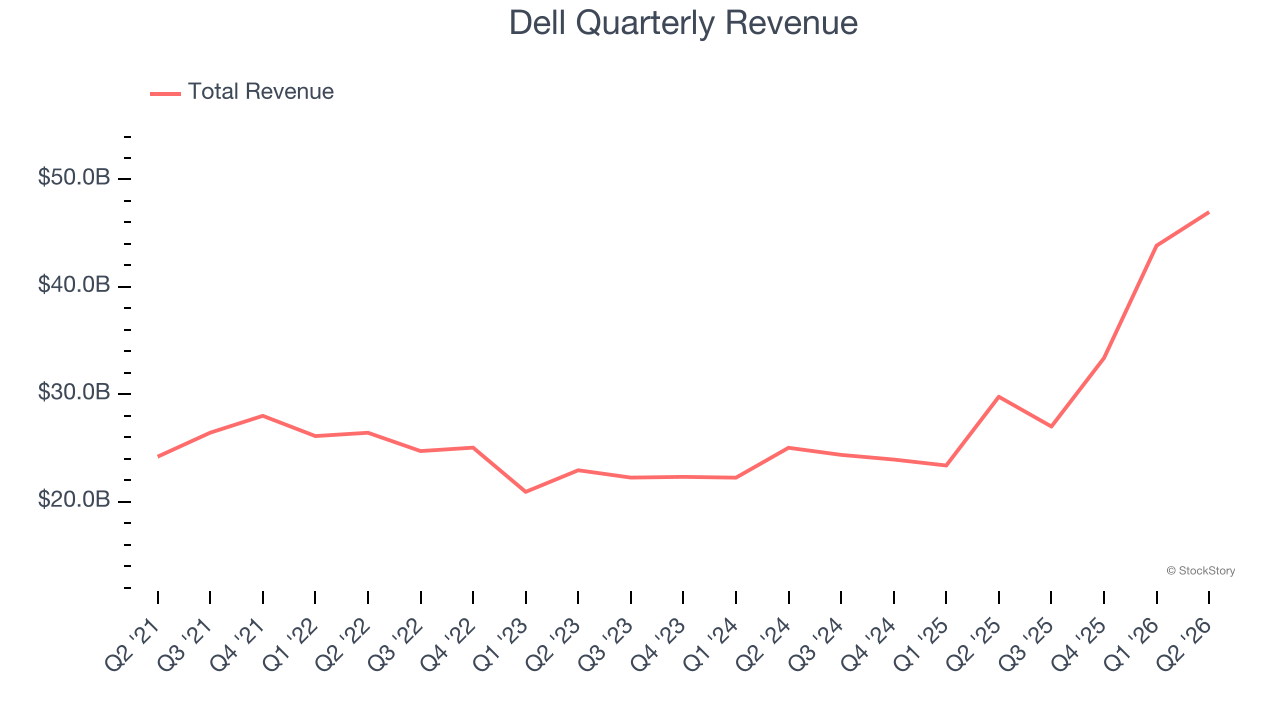
We at StockStory place the most emphasis on long-term growth, but within business services, a half-decade historical view may miss recent innovations or disruptive industry trends. Dell’s annualized revenue growth of 28.3% over the last two years is above its five-year trend, suggesting its demand was strong and recently accelerated. 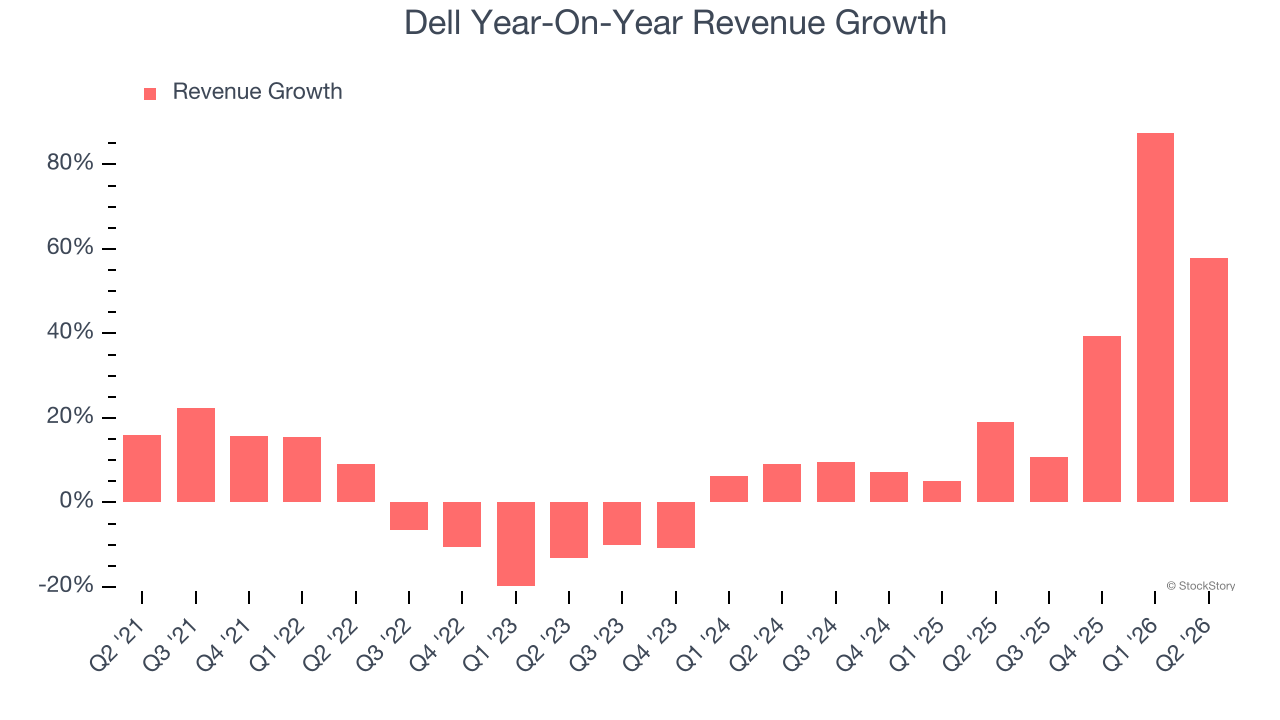
We can better understand the company’s revenue dynamics by analyzing its most important segments, Infrastructure Solutions and Client Solutions, which are 67.7% and 32% of revenue. Over the last two years, Dell’s Infrastructure Solutions revenue (servers and storage) averaged 73.4% year-on-year growth while its Client Solutions revenue (PCs, monitors, displays) averaged 10.7% growth. 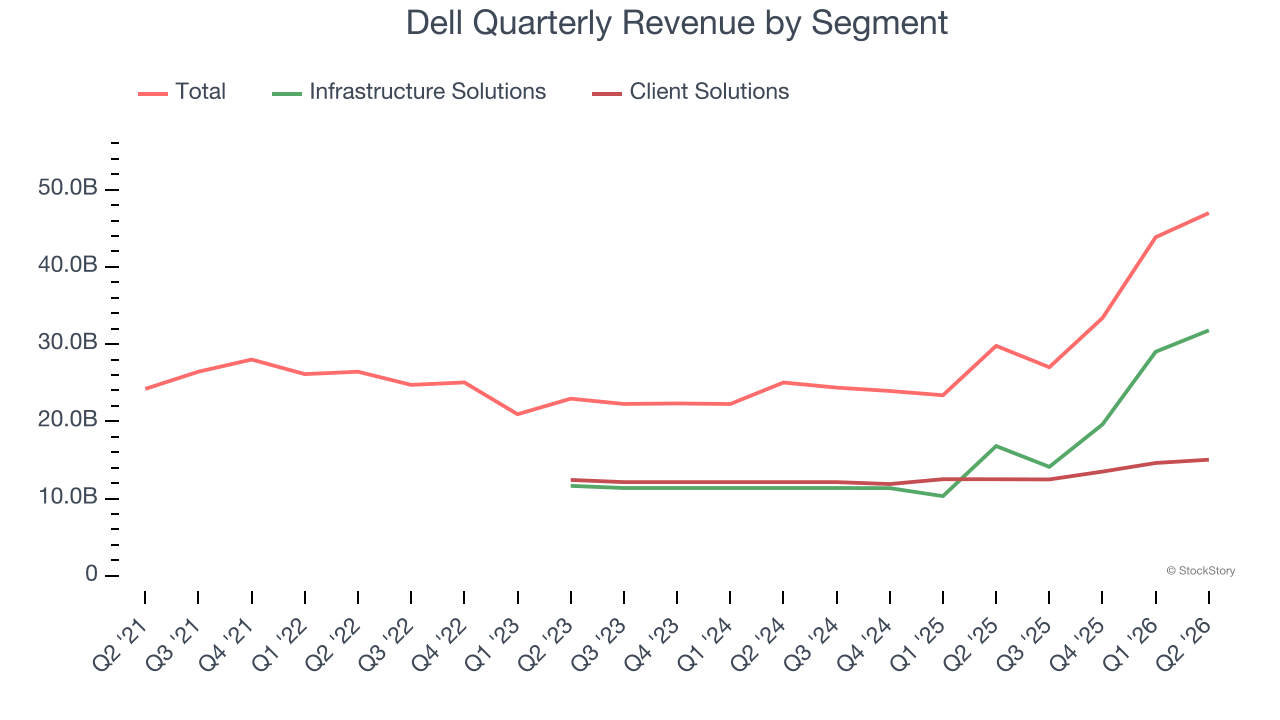
This quarter, Dell reported magnificent year-on-year revenue growth of 57.7%, and its $46.97 billion of revenue beat Wall Street’s estimates by 4.2%.
Looking ahead, sell-side analysts expect revenue to grow 22.5% over the next 12 months, a deceleration versus the last two years. Still, this projection is eye-popping given its scale and implies the market is forecasting success for its products and services.
ONE MORE THING: The $21 AI Application Stock Wall Street Forgot. While Wall Street obsesses over who’s building AI, one company is already using it to print money. And nobody’s paying attention.
AI chip stocks trade at ridiculous valuations. This company processes a trillion consumer signals monthly using AI and trades at a third of the price. The gap won’t last. The institutions will figure it out. You need to see this first. Read the FREE Report Before They Notice.
Adjusted Operating Margin
Dell was profitable over the last five years but held back by its large cost base. Its average adjusted operating margin of 9% was weak for a business services business.
On the plus side, Dell’s adjusted operating margin rose by 2.7 percentage points over the last five years, as its sales growth gave it operating leverage.
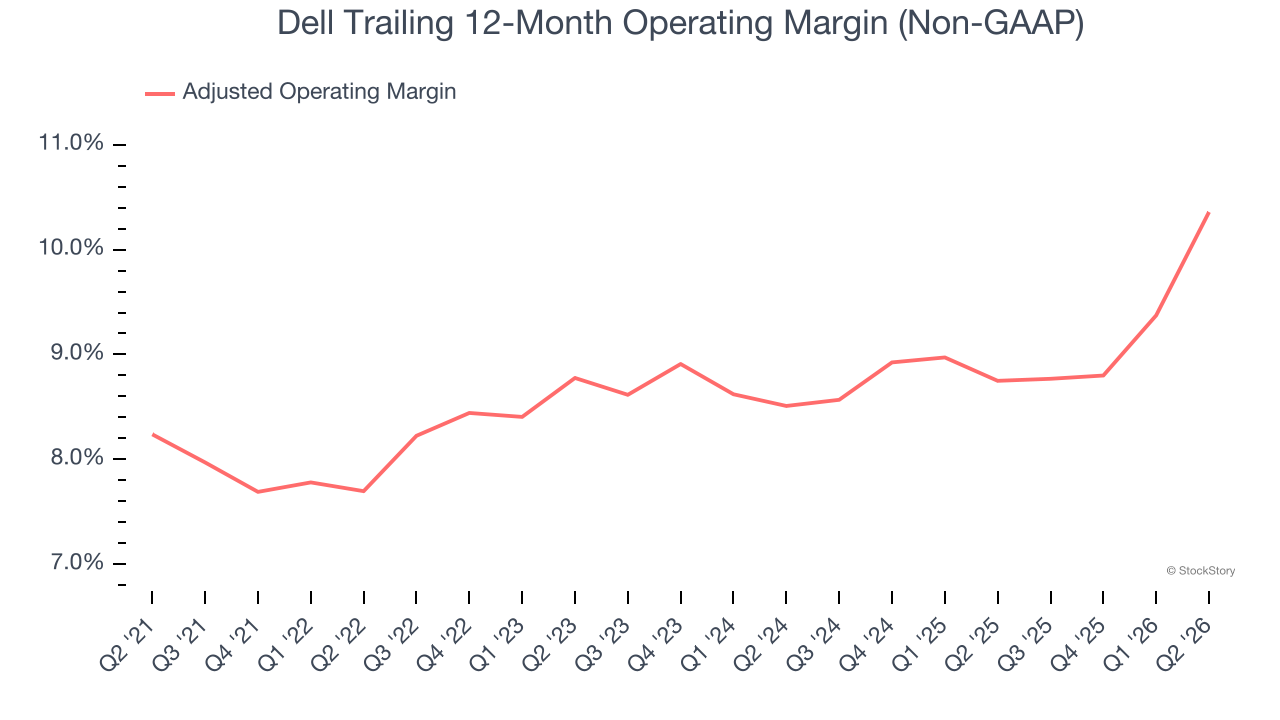
This quarter, Dell generated an adjusted operating margin profit margin of 11.5%, up 3.8 percentage points year on year. This increase was a welcome development and shows it was more efficient.
Earnings Per Share
Revenue trends explain a company’s historical growth, but the long-term change in earnings per share (EPS) points to the profitability of that growth — for example, a company could inflate its sales through excessive spending on advertising and promotions.
Dell’s EPS grew at 15.1% compounded annual growth rate over the last five years, higher than its 10.3% annualized revenue growth. This tells us the company became more profitable on a per-share basis as it expanded.
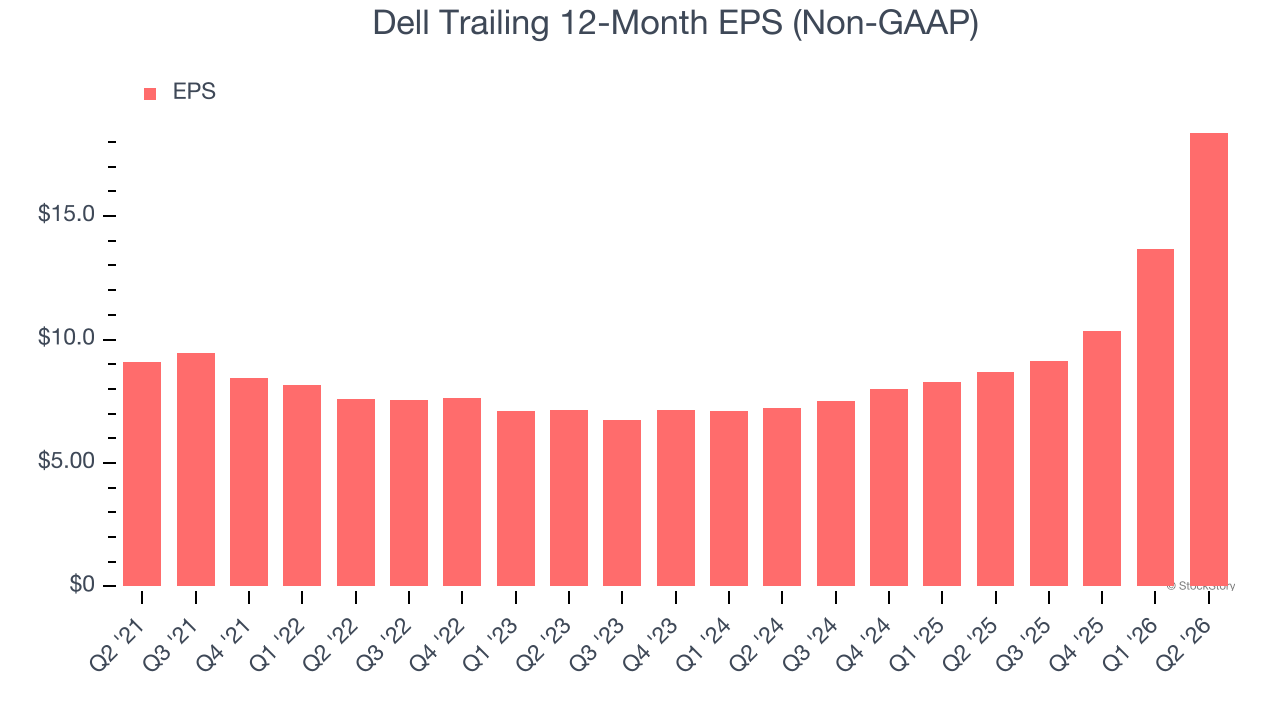
We can take a deeper look into Dell’s earnings quality to better understand the drivers of its performance. As we mentioned earlier, Dell’s adjusted operating margin expanded by 2.7 percentage points over the last five years. On top of that, its share count shrank by 17%. These are positive signs for shareholders because improving profitability and share buybacks turbocharge EPS growth relative to revenue growth. 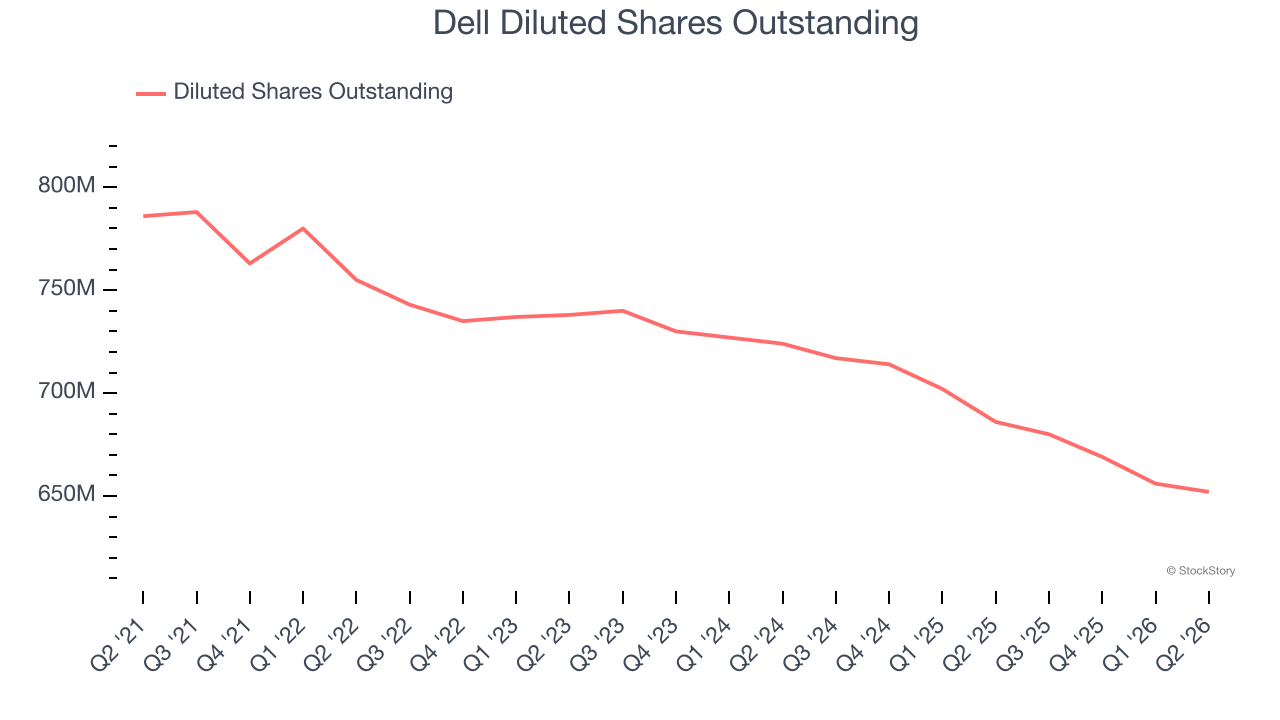
Like with revenue, we analyze EPS over a more recent period because it can provide insight into an emerging theme or development for the business.
For Dell, its two-year annual EPS growth of 59.3% was higher than its five-year trend. We love it when earnings growth accelerates, especially when it accelerates off an already high base.
In Q2, Dell reported adjusted EPS of $7.04, up from $2.32 in the same quarter last year. This print easily cleared analysts’ estimates, and shareholders should be content with the results. Over the next 12 months, Wall Street expects Dell’s full-year EPS to grow 10.3% from $18.38 to $20.27.
Key Takeaways from Dell’s Q2 Results
It was good to see Dell beat analysts’ EPS expectations this quarter. We were also excited its EPS guidance for next quarter outperformed Wall Street’s estimates by a wide margin. Zooming out, we think this was a good print with some key areas of upside. The stock traded up 9.2% to $468.06 immediately after reporting.
Dell put up rock-solid earnings, but one quarter doesn’t necessarily make the stock a buy. Let’s see if this is a good investment. The latest quarter does matter, but not nearly as much as longer-term fundamentals and valuation, when deciding if the stock is a buy. We cover that in our actionable full research report which you can read here (it’s free).