Educational publishing and media company Scholastic (NASDAQ: SCHL) fell short of the market’s revenue expectations in Q3 CY2026, with sales falling 3.9% year on year to $216.8 million. Its non-GAAP loss of $3.63 per share was 6.1% below analysts’ consensus estimates.
Is now the time to buy Scholastic? Find out by accessing our full research report, it’s free.
Scholastic (SCHL) Q3 CY2026 Highlights:
- Revenue: $216.8 million vs analyst estimates of $224.7 million (3.9% year-on-year decline, 3.5% miss)
- Adjusted EPS: -$3.63 vs analyst expectations of -$3.42 (6.1% miss)
- Adjusted EBITDA: -$63.6 million (-29.3% margin, 14.2% year-on-year decline)
- EBITDA guidance for the full year is $140 million at the midpoint, in line with analyst expectations
- Operating Margin: -42.5%, down from -37.3% in the same quarter last year
- Free Cash Flow was -$110.8 million compared to -$100.2 million in the same quarter last year
- Market Capitalization: $667 million
"Our fiscal 2027 priorities remain focused on translating the strategic and operating progress achieved last year to drive further performance gains. We remain confident in the growth trajectory we outlined at year-end and are affirming our full-year guidance as we continue to execute against that plan and create long-term value for shareholders."
Company Overview
Creator of the legendary Scholastic Book Fair, Scholastic (NASDAQ: SCHL) is an international company specializing in children's publishing, education, and media services.
Revenue Growth
A company’s long-term performance is an indicator of its overall quality. Any business can have short-term success, but a top-tier one grows for years. Over the last five years, Scholastic grew its sales at a weak 3.2% compounded annual growth rate. This was below our standard for the consumer discretionary sector and is a tough starting point for our analysis.
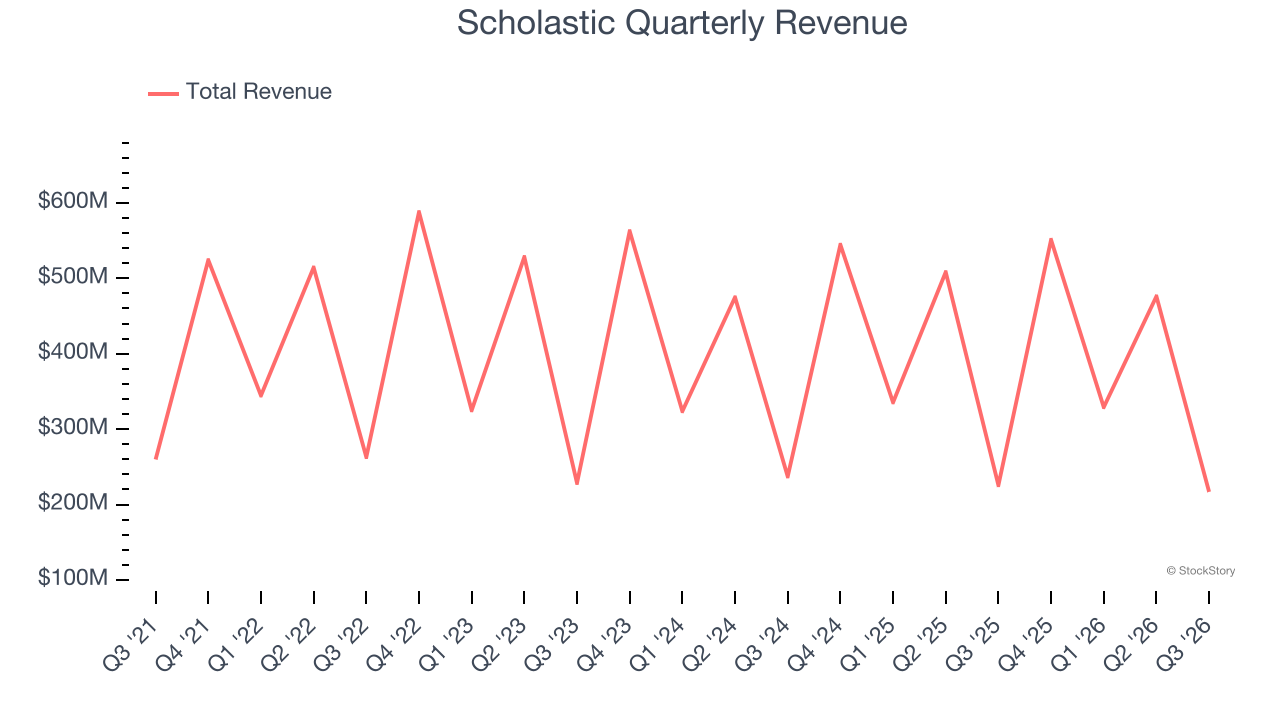
We at StockStory place the most emphasis on long-term growth, but within consumer discretionary, a stretched historical view may miss a company riding a successful new product or trend. Scholastic’s recent performance shows its demand has slowed as its revenue was flat over the last two years. 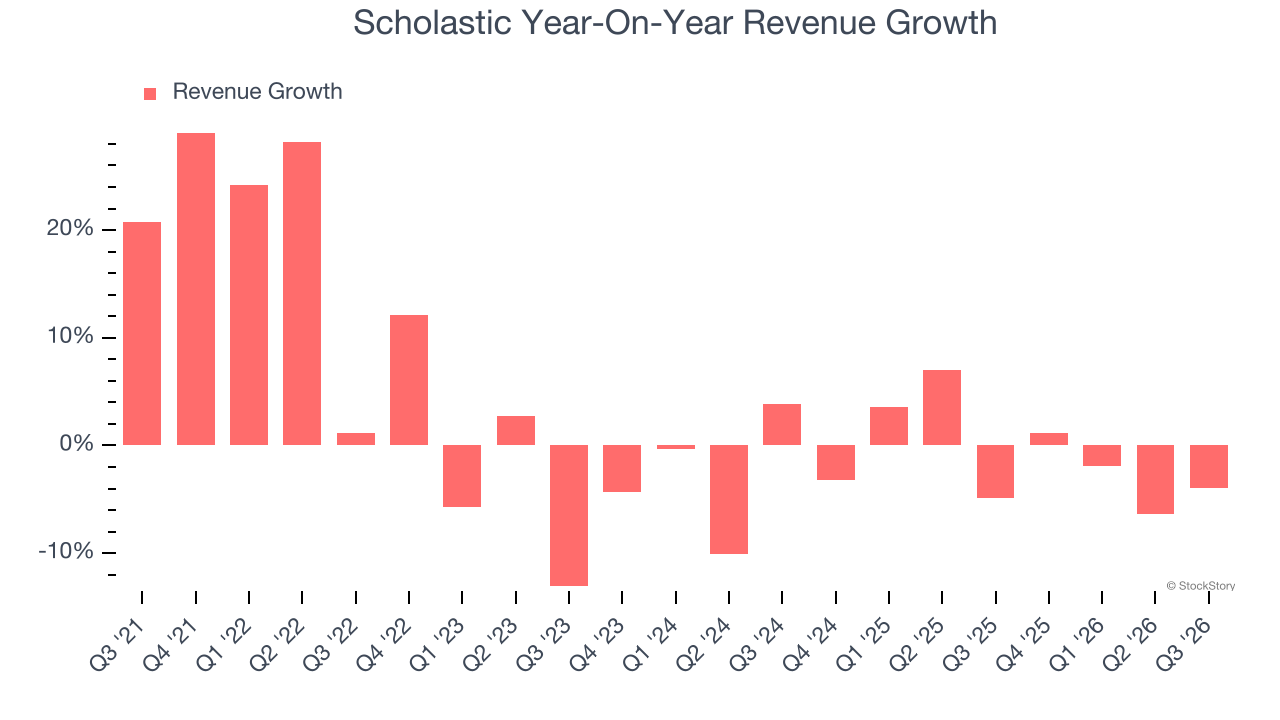
This quarter, Scholastic missed Wall Street’s estimates and reported a rather uninspiring 3.9% year-on-year revenue decline, generating $216.8 million of revenue.
Looking ahead, sell-side analysts expect revenue to grow 4.1% over the next 12 months. While this projection suggests its newer products and services will catalyze better top-line performance, it is still below average for the sector.
ALSO WORTH WATCHING: Nvidia’s Quiet Partner. Nvidia’s chips cost a hundred grand. The connectors that make them work cost even more. One company makes them all.
Every AI server needs specialized infrastructure the chip companies don’t make. High-speed cables. Power connectors. Thermal sensors. This 90-year-old company built a monopoly on it. The AI boom just started. This stock is still flying under the radar. Claim The Stock Ticker Here for FREE.
Operating Margin
Operating margin is an important measure of profitability as it shows the portion of revenue left after accounting for all core expenses — everything from the cost of goods sold to advertising and wages. It’s also useful for comparing profitability across companies with different levels of debt and tax rates because it excludes interest and taxes.
Scholastic’s operating margin has been trending up over the last 12 months and averaged 2% over the last two years. The company’s higher efficiency is a breath of fresh air, but its suboptimal cost structure means it still sports inadequate profitability for a consumer discretionary business.
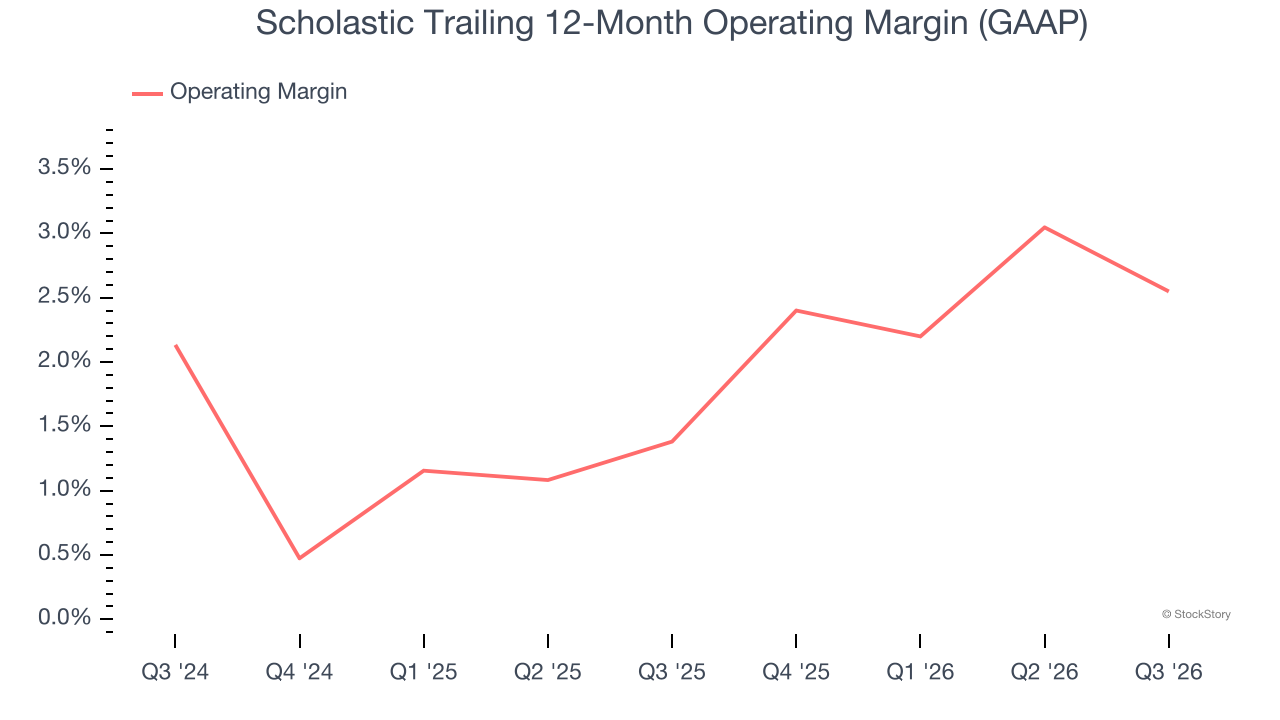
In Q3, Scholastic generated an operating margin profit margin of negative 42.5%, down 5.2 percentage points year on year. This contraction shows it was less efficient because its expenses increased relative to its revenue.
Cash Is King
If you’ve followed StockStory for a while, you know we emphasize free cash flow. Why, you ask? We believe that in the end, cash is king, and you can’t use accounting profits to pay the bills.
Scholastic has shown poor cash profitability relative to peers over the last two years, giving the company fewer opportunities to return capital to shareholders. Its free cash flow margin averaged 13.3%, below what we’d expect for a consumer discretionary business.
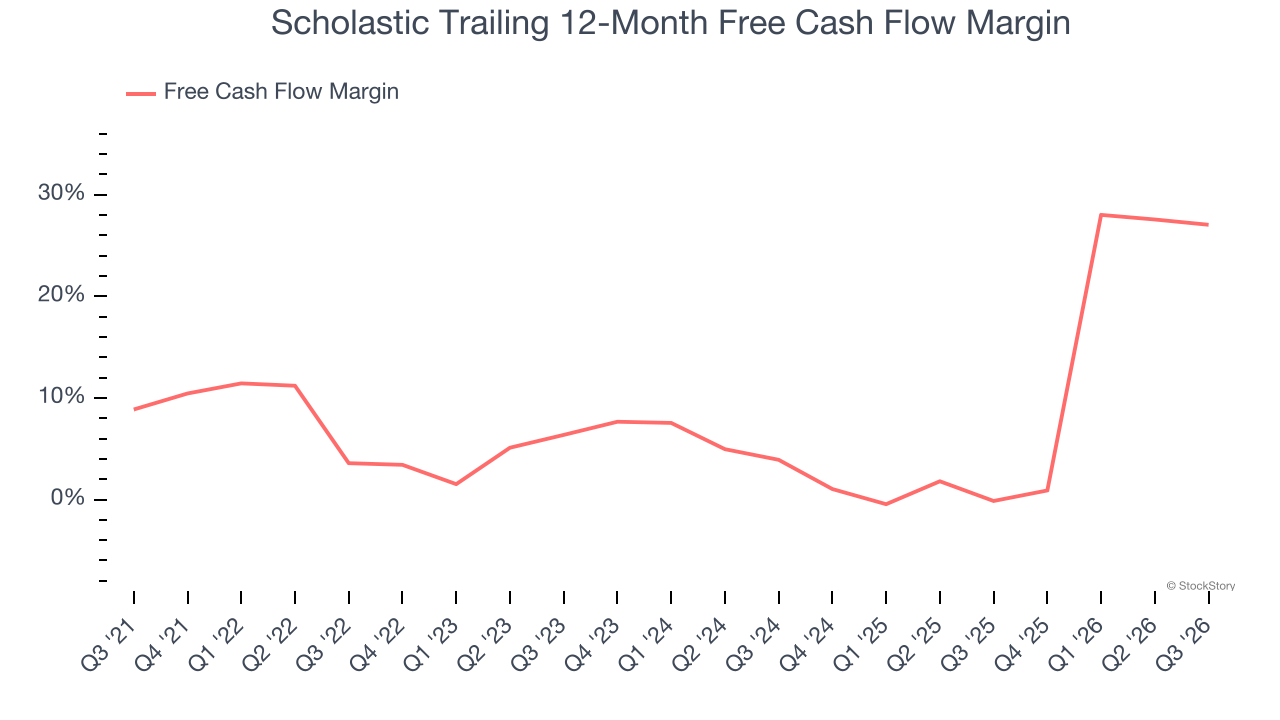
Scholastic burned through $110.8 million of cash in Q3, equivalent to a negative 51.1% margin. The company’s cash burn was similar to its $100.2 million of lost cash in the same quarter last year. These numbers deviate from its longer-term margin, indicating it is a seasonal business that must build up inventory during certain quarters.
Key Takeaways from Scholastic’s Q3 Results
It was encouraging to see Scholastic beat analysts’ EBITDA expectations this quarter. On the other hand, its revenue missed and its EPS fell short of Wall Street’s estimates. Overall, this was a softer quarter. The stock traded down 10% to $31.40 immediately after reporting.
Scholastic didn’t show its best hand this quarter, but does that create an opportunity to buy the stock right now? We think that the latest quarter is only one piece of the longer-term business quality puzzle. Quality, when combined with valuation, can help determine if the stock is a buy. We cover that in our actionable full research report which you can read here (it’s free).