There’s a moment that repeats itself every summer.
You step outside, expecting to relax. The weather is right, the space is ready, and the pool should be the easiest part of the day.
But it isn’t.
Something always needs attention.
Why Pool Maintenance Feels Like a Never-Ending Summer Chore
The problem isn’t that pool maintenance is difficult.
It’s that it never fully disappears.
Leaves settle overnight. Fine debris collects in corners. The waterline dulls just enough to notice. Each issue is small, but together they create a cycle that repeats every few days.
This repetition is what turns a small task into a persistent annoyance.
In many residential settings, inconsistent pool cleaning can increase maintenance time by up to 30–40% over a single week, especially during peak summer usage.
Over time, the task becomes expected.
Not optional—just part of the routine.
How Small Pool Issues Disrupt Daily Outdoor Use
What starts as minor upkeep quickly affects how the space is used.
Instead of stepping outside and getting into the pool, there’s always a pause. A quick check. A small adjustment. A decision about whether something needs to be handled first.
These interruptions are subtle, but they change behavior.
Swimming becomes something you plan around rather than something you do naturally.
The space stops feeling effortless.
Why Traditional Pool Cleaning Methods Fail in Summer
Traditional cleaning methods were designed for occasional use.
Manual skimming, periodic vacuuming, and reactive maintenance all assume that conditions stay relatively stable between cleaning cycles.
But in summer, that assumption breaks down.
Heat accelerates debris buildup. Increased usage disturbs water balance. Wind and organic matter introduce new variables daily.
Cleaning becomes reactive.
And reactive systems always lag behind the problem.
How Artificial Intelligence Transforms Pool Maintenance Systems
This shift didn’t happen all at once—it became noticeable only after traditional methods consistently failed under real-world conditions.
Artificial intelligence changes pool maintenance by removing that delay.
Instead of waiting for visible issues, systems operate continuously, adjusting to conditions in real time. They track movement, adapt to debris patterns, and maintain coverage without relying on repetition alone.
This is where automatic pool vacuums begin to function as continuous maintenance systems rather than occasional tools.
Rather than cleaning in cycles, they maintain conditions.
That difference is what breaks the pattern.
Why Automatic Pool Vacuums Improve Cleaning Consistency
Consistency is what traditional systems lack.
When cleaning happens only at specific times, debris accumulates unevenly. Certain areas are missed. Problems build gradually until they become noticeable.
Automatic systems remove that gap.
This is where a swimming pool robot operates as a continuous system rather than a reactive cleaning tool.
By operating continuously, they prevent buildup before it becomes visible. Surfaces stay clean, water remains stable, and the system no longer depends on manual timing.
The result is not just better performance—it’s predictability.
How Smart Pool Systems Reduce Maintenance Awareness
The most noticeable change is not what you see.
It’s what you stop thinking about.
When the system is working consistently, there’s no need to check the pool before using it. No need to plan cleaning around the day. No need to monitor whether something was missed.
The awareness disappears.
And with it, the sense that the pool requires management.
Why Full Coverage Matters More Than Suction Power
Many traditional systems focus on power.
But power alone doesn’t solve the problem.
Coverage does.
Debris doesn’t settle evenly. It collects in specific areas—corners, slopes, steps, and along the waterline. Without consistent coverage, these areas remain untreated.
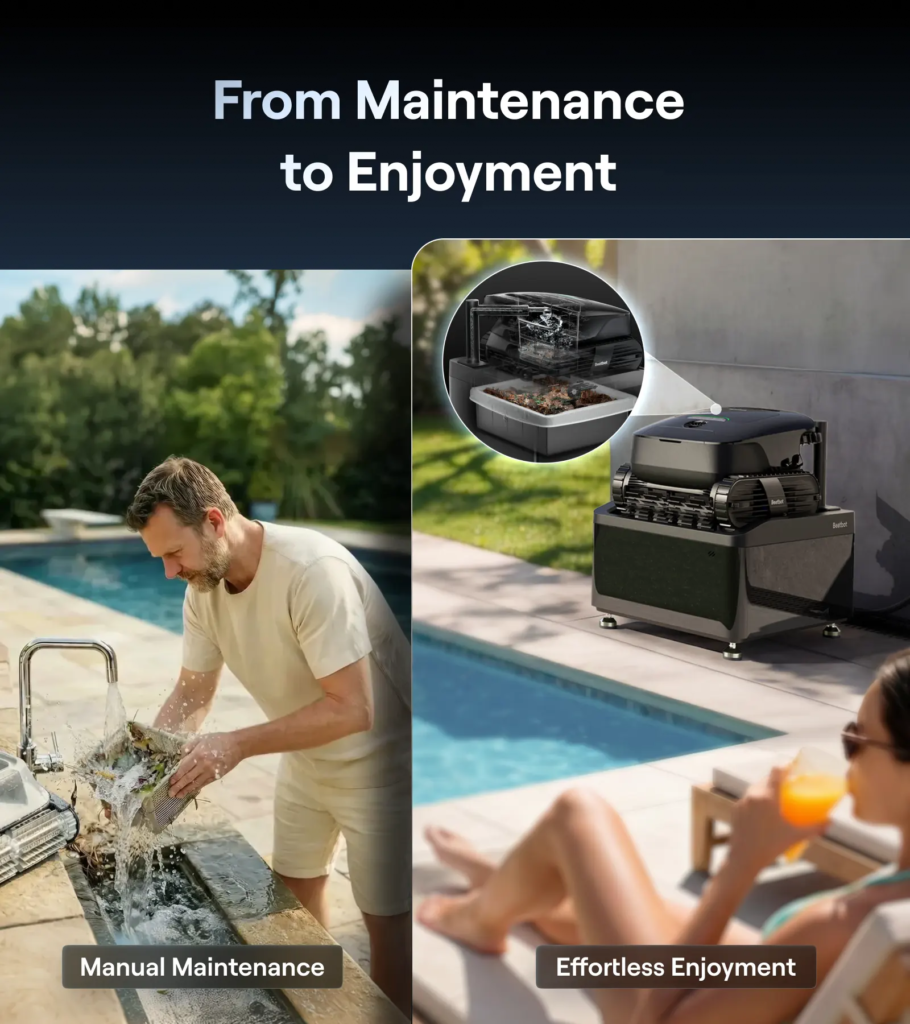
In practical use, systems like the Beatbot AquaSense 2 Ultra show how a swimming pool robot maintains consistent full-surface coverage without requiring manual correction.
Instead of relying on force, it relies on consistency and positioning.
That’s what keeps the system balanced over time.
How a Swimming Pool Robot Turns Cleaning Into a Background Process
The final shift is not technical—it’s behavioral.
When cleaning becomes continuous, it stops being an activity.
There’s no start, no interruption, no “before” and “after.” The system runs in the background, maintaining conditions without drawing attention to itself.
For homeowners, this changes how the pool fits into daily life.
It’s no longer something you prepare.
It’s something that’s already ready.
Conclusion
The most frustrating part of pool maintenance was never the effort itself.
It was the repetition.
The constant return of small problems that required attention just often enough to disrupt the experience.
Automatic systems break that cycle.
By shifting from reactive cleaning to continuous maintenance, they remove the need for repeated intervention and restore the pool to its intended role.
This shift toward automatic pool vacuums and intelligent pool systems is rapidly becoming the baseline expectation for modern residential environments.