The U.S. stock market entered uncharted territory on Wednesday, January 7, 2026, as the S&P 500 and the Dow Jones Industrial Average both climbed to fresh all-time intraday highs. Driven by a potent combination of cooling inflation data, a surprise resilience in the labor market, and a geopolitical breakthrough in South America, the rally underscored the "Goldilocks" sentiment currently gripping global investors. While the indices retreated slightly from their peaks toward the closing bell, the milestones reached during the session signal a market that is increasingly eyeing psychologically significant barriers.
The momentum of the rally suggests that the "AI Infrastructure" supercycle has moved into a new, more hardware-intensive phase, while domestic energy concerns have been significantly eased by shifting geopolitical tides. However, the record-breaking day was not without its undercurrents of caution, as a notable divergence between tech winners and traditional energy laggards emerged, highlighting a "tale of two markets" that investors must navigate in the opening weeks of 2026.
A Historic Morning on the Floor
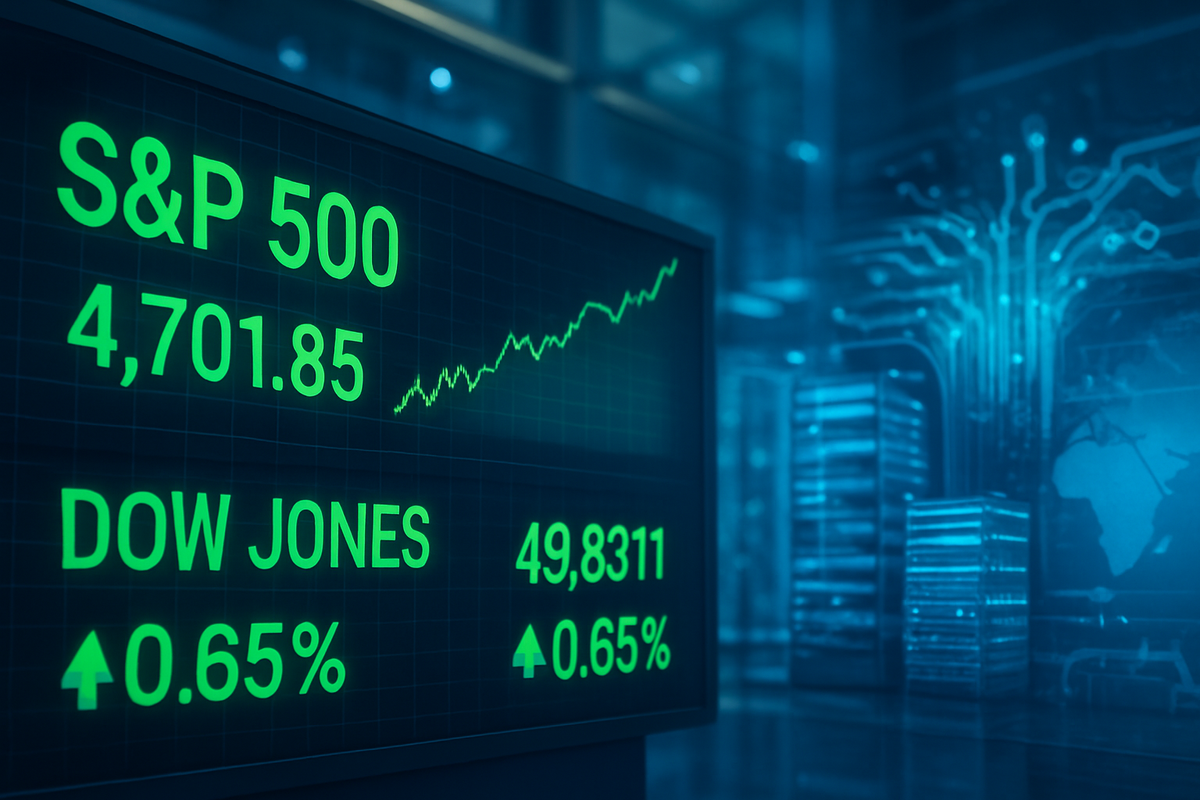
The trading session on January 7, 2026, was defined by early-morning exuberance. The S&P 500 surged to an all-time intraday high of 6,953.00, coming within striking distance of the elusive 7,000 mark. Simultaneously, the Dow Jones Industrial Average reached a fresh intraday record of 49,509.92, building on the momentum of the previous day, which saw the index close above 49,000 for the first time in history. The rally was catalyzed by the ADP National Employment Report, which showed the private sector added 41,000 jobs in December—a modest but critical figure that averted fears of a labor market contraction following a sluggish November.
Beyond domestic data, the market was electrified by developments in Venezuela. Following the recent ousting of Nicolás Maduro, President Trump announced a landmark energy agreement with the interim Venezuelan authorities to provide the U.S. with 30 to 50 million barrels of crude oil. This "supply shock" immediately lowered energy price expectations and bolstered the outlook for U.S. refiners. Furthermore, the ISM services data released during the session indicated that a key measure of inflation had cooled to its lowest level since March 2024, reinforcing the market’s belief that the Federal Reserve would maintain its easing trajectory after 175 basis points of cuts over the last two years.
The timeline of this rally can be traced back to the Consumer Electronics Show (CES) 2026, where Nvidia (NASDAQ: NVDA) CEO Jensen Huang’s commentary on a "new layer of storage technology" sparked a massive rotation into memory and infrastructure stocks. By mid-morning on January 7, the "picks and shovels" of the AI era were leading the charge, even as some of the larger "Magnificent Seven" names began to see technical resistance.
Winners and Losers in a Narrowing Rally
The day’s gains were led by a explosive surge in the semiconductor and storage sectors. Sandisk (NASDAQ: SNDK) led the S&P 500 gainers, soaring nearly 28% following breakthroughs in AI-optimized storage solutions. This momentum carried over to Western Digital (NASDAQ: WDC) and Seagate (NASDAQ: STX), which rose 17% and 14% respectively, as investors bet on the hardware requirements of the next generation of agentic AI. Micron Technology (NASDAQ: MU) also benefited from this rotation, climbing 10% on the day.
In the energy sector, the Venezuela oil deal created a clear divide. U.S.-based refiners like Valero Energy (NYSE: VLO) and Phillips 66 (NYSE: PSX) hit all-time highs as they prepared to process the influx of high-quality Venezuelan crude. Conversely, integrated oil giants like Exxon Mobil (NYSE: XOM) and Chevron (NYSE: CVX) saw their geopolitical risk premiums evaporate, with Chevron leading the Dow’s decliners.
Other notable winners included Palantir Technologies (NYSE: PLTR), which gained 3% on analyst upgrades regarding its agentic AI platforms, and Moderna (NASDAQ: MRNA), which jumped 10.9% following a major bullish upgrade from Bank of America. However, the rally was notably narrow; Apple (NASDAQ: AAPL) hit a new three-month low, and Tesla (NASDAQ: TSLA) declined 4%, breaking below its 50-day moving average. Even Nvidia (NASDAQ: NVDA) finished the day slightly lower as investors questioned its current premium valuation relative to the emerging storage and memory players.
The Broader Significance: AI Supercycles and Geopolitical Shifts
The record-setting performance of the S&P 500 and the Dow fits into a broader industry trend where the focus of the AI trade is shifting from software and LLMs to the physical infrastructure required to sustain them. This "AI Infrastructure Supercycle" is increasingly seen as the primary engine of market growth for 2026. The historical precedent for this can be found in the mid-1990s internet boom, where networking hardware companies often outperformed the early dot-com service providers.
However, the geopolitical implications of the day cannot be overstated. The sudden shift in Venezuelan policy represents a significant pivot in global energy markets, potentially stabilizing U.S. energy costs for the long term but also introducing new diplomatic frictions. Analysts are already pointing to "European red lines" being drawn as the U.S. expands its influence in Latin America and expresses renewed interest in strategic territories like Greenland. These geopolitical ripple effects could eventually create headwinds for multinational companies sensitive to transatlantic trade alliances.
Furthermore, the cooling inflation data has put the Federal Reserve in a delicate position. While the market is celebrating the "Goldilocks" environment, some analysts warn of "tail risk" associated with Fed independence. There is a growing concern that aggressive, potentially politically motivated rate cuts in 2026 could reignite inflation, making the current all-time highs a potential "blow-off top" if not handled with precision by central bankers.
What Lies Ahead: The Road to 50,000
In the short term, all eyes are on the psychological milestones of 7,000 for the S&P 500 and 50,000 for the Dow. For these levels to be breached and sustained, the market will likely need to see a broadening of the rally. If the "Mag 7" laggards like Apple (NASDAQ: AAPL) and Amazon (NASDAQ: AMZN) can find their footing and join the semiconductor-led surge, the indices could easily surpass these marks before the end of the first quarter.
However, strategic pivots may be required for investors who have been overly concentrated in pure-play AI software. The market is clearly rewarding companies that provide the physical "picks and shovels," such as high-capacity storage and advanced cooling systems. Additionally, the private credit market remains a looming challenge; as higher-for-longer rates from previous years continue to filter through the system, a potential liquidity crunch in private equity could emerge as a disruptive force later in the year.
The potential scenarios for the coming months range from a continued "melt-up" driven by AI productivity gains to a sharp correction if the "Greenland Gambit" or trade frictions with China escalate. Investors should watch for the upcoming earnings season to see if "hyperscalers" are seeing a return on their massive infrastructure investments, which will be the ultimate litmus test for the sustainability of this rally.
Final Assessment and Market Outlook
The record-breaking session of January 7, 2026, serves as a testament to the resilience of the U.S. economy and the transformative power of technological innovation. The S&P 500’s climb toward 7,000 and the Dow’s proximity to 50,000 represent more than just numbers; they reflect a market that has successfully navigated a period of high interest rates and is now looking toward a future of increased productivity and energy stability.
The key takeaway for investors is that while the headline numbers are historic, the underlying market remains fragmented. Success in 2026 will likely depend on identifying the next leg of the AI trade and monitoring the shifting geopolitical landscape that is currently reshaping the energy and materials sectors. As we move forward, the focus will remain on the Federal Reserve's next moves and the ability of the labor market to maintain its "just right" pace of growth.
For now, Wall Street is in a celebratory mood, but the narrowing breadth of the rally and the persistence of "black swan" risks—from geopolitical friction to private credit opacity—suggest that the road to 50,000 may be more volatile than the recent record-breaking days would imply.
This content is intended for informational purposes only and is not financial advice.