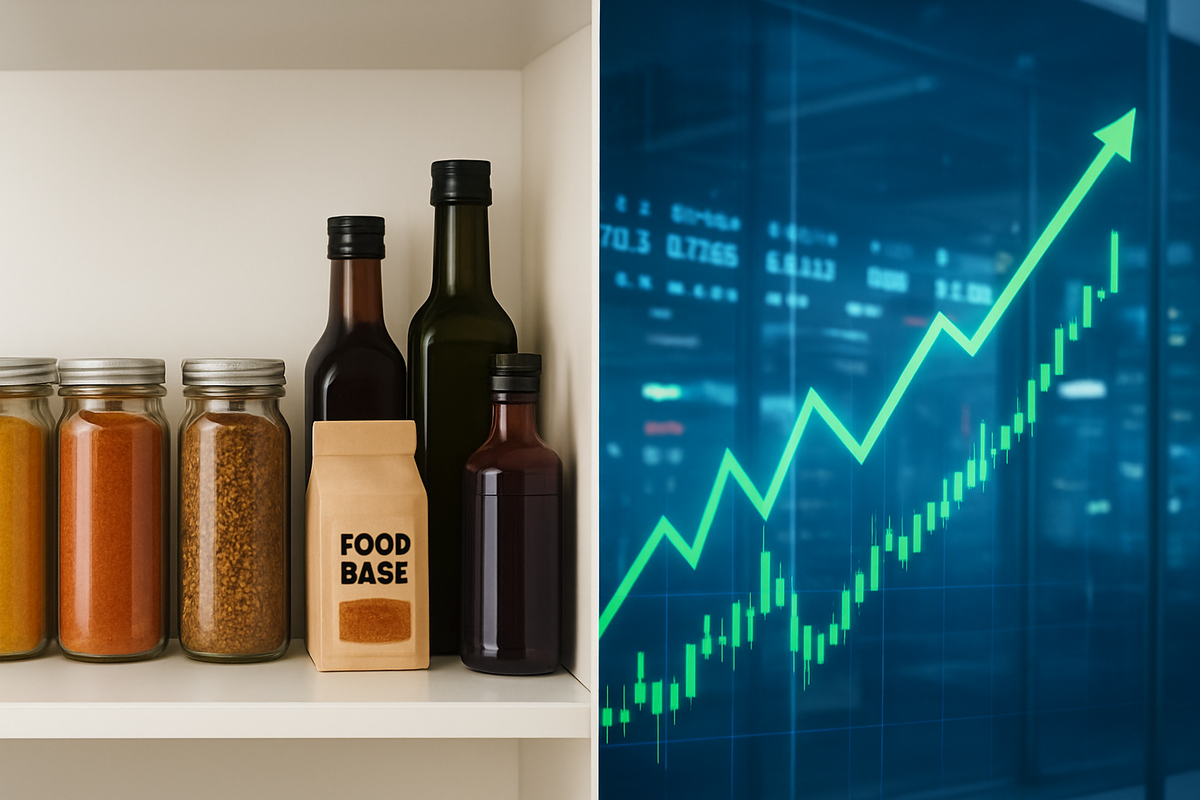
BALTIMORE & LONDON — In a move that could redefine the global pantry, McCormick & Company (NYSE: MKC) has officially expressed interest in acquiring the sprawling food business of consumer goods titan Unilever PLC (NYSE: UL). The potential deal, valued between $33 billion and $37 billion, represents one of the most significant consolidations in the consumer staples sector in decades. As of March 20, 2026, both companies have confirmed they are in preliminary discussions, sent ripples through the New York and London stock exchanges, and signaled a tectonic shift in investor sentiment away from the volatile technology sector toward "defensive" heavyweights.
The proposed transaction would see McCormick, a leader in spices and flavors, absorb a portfolio that includes iconic household names such as Hellmann’s mayonnaise and Knorr soups. For McCormick, the acquisition is an audacious attempt to move beyond the spice rack and dominate the broader condiments and "center-of-aisle" categories. For Unilever, the divestiture marks the final stage of its multi-year pivot toward becoming a pure-play beauty and personal care company, shedding the slower-growth food assets that have long anchored its valuation.
A "Reverse Morris Trust" to Bridge the Valuation Gap
The discussions, which first leaked via The Wall Street Journal late on March 19, 2026, were formally acknowledged by both parties this morning. The scale of the deal is particularly noteworthy given that Unilever’s food division is valued significantly higher than McCormick’s own market capitalization, which currently sits at approximately $16 billion. To bridge this gap, financial advisors have proposed a "Reverse Morris Trust" structure. Under this arrangement, Unilever would spin off its food business into a separate entity, which would then immediately merge with McCormick. This structure allows for a tax-free transition for shareholders and would likely result in Unilever investors owning a majority stake—estimated at 55% to 65%—of the newly combined entity.
The timeline leading up to this moment has been defined by strategic pressure on both CEOs. Unilever’s Fernando Fernandez has faced mounting calls from activist investors to streamline operations, while McCormick’s leadership has been aggressively hunting for international growth after successfully deleveraging its balance sheet following the 2020 acquisition of Cholula. By late 2025, McCormick had reduced its debt-to-EBITDA ratio to below 2.7x, providing the financial runway needed to pursue a deal of this magnitude. Market reaction on the news saw McCormick shares jump 4.5% in early trading, while Unilever’s ADRs rose 3.2% as investors cheered the prospect of a cleaner corporate structure.
Key stakeholders in the negotiation include major institutional holders like BlackRock and Vanguard, who have recently increased their weightings in consumer staples. Analysts at Barclays have noted that the "strategic fit is nearly perfect," combining McCormick's dominance in "dry" flavorings with Unilever’s "wet" condiments. However, the complexity of the deal means that a final agreement might not be reached until late 2026, with full integration stretching into 2027.
Winners and Losers in a Reshaped Grocery Aisle
Should the deal finalize, McCormick & Company (NYSE: MKC) emerges as the clear strategic winner, instantly transforming from a niche flavor specialist into a global food powerhouse with an estimated $21 billion in annual revenue. The addition of Hellmann’s and Knorr gives McCormick unprecedented leverage with global retailers, allowing them to bundle spice contracts with essential pantry staples. Conversely, Unilever PLC (NYSE: UL) wins by offloading a division that, while profitable, had seen its underlying sales growth (2.5%) lag behind the company’s higher-margin Beauty & Wellbeing segment (4.3%).
The primary "losers" in this scenario are likely competitors who lack the scale to match this new behemoth. The Kraft Heinz Company (NASDAQ: KHC) stands to lose the most, as a combined McCormick-Unilever entity would directly challenge Kraft’s dominance in the mayonnaise and condiments category. Kraft Heinz may be forced to respond with its own defensive acquisitions or face a price war as the new McCormick entity seeks to gain market share. Similarly, smaller players like Conagra Brands (NYSE: CAG) and Campbell Soup Company (NYSE: CPB) may find themselves squeezed on supermarket shelves as the consolidated "Flavor Giant" commands better positioning and promotional slots.
The "Great Rotation": Tech Fatigue Fuels Staples Surge
The timing of this potential mega-merger is not coincidental. It fits into a broader market trend emerging in early 2026 known as the "Great Rotation." After years of "AI euphoria" that drove tech valuations to dizzying heights, investors have grown weary of the massive capital expenditures required by tech hyperscalers that have yet to produce consistent margin expansion. By mid-March 2026, the tech-heavy Nasdaq-100 began to underperform, while the Consumer Staples Select Sector SPDR Fund (XLP) surged 13.2% year-to-date.
This flight to safety is driven by a desire for tangible cash flows and predictable earnings in an era of stabilizing but persistent inflation. A McCormick-Unilever merger represents the ultimate defensive play. Historically, when high-growth sectors cool, investors look for "fortress" balance sheets and companies with "pricing power"—the ability to raise prices without losing customers. Both McCormick and Unilever’s food brands possess high brand loyalty, making them ideal vehicles for this capital shift.
Furthermore, the deal echoes past consolidation waves in the industry, such as the Kraft-Heinz merger of 2015, but with a key difference: rather than focusing solely on cost-cutting (the "3G Capital" model), McCormick appears focused on "growth-through-flavor," betting that the global trend toward home cooking and premiumization will sustain long-term margins. Regulatory scrutiny, however, remains a significant hurdle. Antitrust authorities in both the U.S. and the European Union are expected to look closely at the combined company’s control over the global condiments market, potentially requiring some brand divestitures to satisfy competition laws.
Navigating the Path to Integration
Looking ahead, the road to a "New McCormick" is fraught with operational challenges. Integrating a $37 billion business is a multi-year endeavor that requires merging disparate corporate cultures and global supply chains. In the short term, McCormick will need to convince shareholders that the added debt load—even if managed through a Reverse Morris Trust—will not hamper its ability to continue its long-standing tradition of dividend increases.
Strategic pivots will be required, particularly in the digital and e-commerce space. As grocery shopping increasingly moves online, the combined entity must leverage its data to dominate the "digital shelf." If successful, the deal could trigger a secondary wave of consolidation among mid-sized CPG companies looking to survive in the shadow of this new giant. We may see a scenario where the "Flavor Giant" successfully cross-pollinates its brands—imagine Knorr bouillon infused with McCormick’s proprietary seasoning blends—creating entirely new product categories.
Market opportunities will emerge in developing markets, where Unilever’s existing distribution networks in Asia and Africa can be used to introduce McCormick’s spices to millions of new consumers. However, the challenge will be maintaining the premium status of these brands in the face of rising private-label competition from retailers like Walmart (NYSE: WMT) and Amazon (NASDAQ: AMZN).
A New Era for Consumer Staples
The reported interest from McCormick & Company (NYSE: MKC) in Unilever’s food assets is more than just a corporate transaction; it is a declaration that the era of "growth at any cost" in technology is being challenged by a return to the fundamentals of the global consumer. The scale of this deal—potentially the largest in the sector this decade—underscores a strategic bet that flavor and food security are the most resilient assets in a volatile global economy.
As we move deeper into 2026, investors should keep a close watch on the formal filing of the merger documents and any signals from the Department of Justice regarding antitrust concerns. The "Great Rotation" suggests that the consumer staples sector is no longer just a boring haven for retirees, but a dynamic battlefield where the world’s largest companies are fighting for every inch of the kitchen pantry.
The key takeaway for the market is clear: consolidation is the new growth strategy. In a world where organic growth is hard to find, buying market share and brand loyalty is the most efficient path forward. Whether McCormick can successfully digest this $37 billion "meal" remains to be seen, but the bold attempt has already changed the landscape of the 2026 stock market.
This content is intended for informational purposes only and is not financial advice.