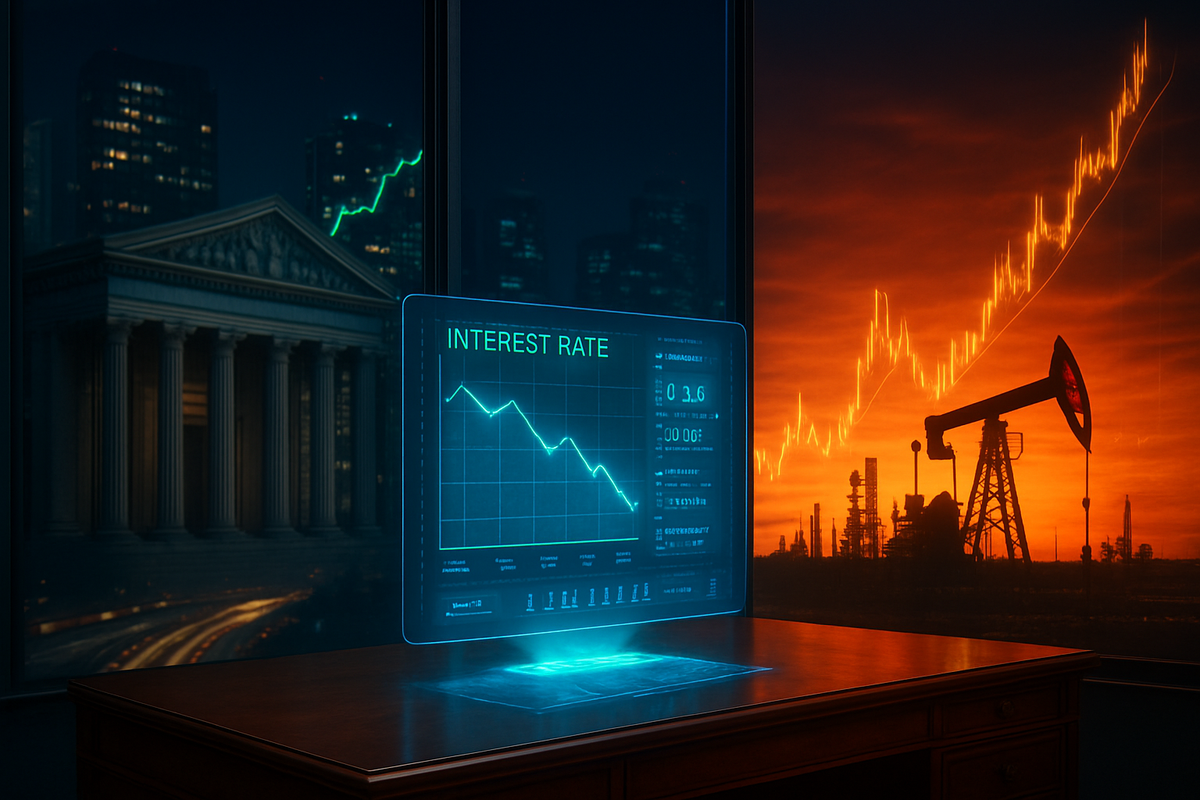
As we cross the threshold into late March 2026, the global financial landscape finds itself at a critical crossroads. The "Great Easing" narrative that fueled much of 2025 has encountered a formidable obstacle in the form of a geopolitical energy shock, forcing the Federal Reserve to adopt a "hawkish pause" that has sent shockwaves through the equities and bond markets. Despite these "January Jitters"—which evolved into a more pronounced March volatility—the broader market trajectory remains surprisingly resilient as investors bet on the structural strength of a "manufacturing renaissance" and the eventual resumption of rate cuts once the current inflationary spike subsides.
The Federal Open Market Committee (FOMC) concluded its March 2026 meeting by holding the federal funds rate steady at the 3.50% to 3.75% range. While early 2026 projections from Wall Street analysts had penciled in as many as four rate cuts for the year, the "dot plot" has been radically recalibrated. The median expectation now sits at a single 25-basis-point reduction, likely not occurring until the fourth quarter. This pivot has been necessitated by Brent crude oil prices surging past $119 per barrel following the closure of the Strait of Hormuz, a development that has pushed the Fed’s 2026 PCE inflation forecast back up to 2.7%.
The 2026 Shift: From Optimism to Realism
The timeline of early 2026 has been a study in rapid narrative shifts. The year began with a burst of optimism in January, with the S&P 500 rising 1.4% as investors initially looked past regional tensions. However, as the energy crisis deepened in February, the "January Jitters" transformed into a widespread valuation reset. This was further complicated by the impending leadership change at the Federal Reserve; with Jerome Powell’s term set to expire in May 2026, the nomination of Kevin Warsh as his successor has introduced a more hawkish tone into the central bank’s communication strategy. Analysts suggest that the "Powell Era" of transparent guidance is giving way to a more rules-based, inflation-focused regime.
Initial market reactions to this shift were stark. The Nasdaq Composite, highly sensitive to the discount rates applied to future earnings, bore the brunt of the "higher-for-longer" reality, dropping nearly 4.8% year-to-date by mid-March. Conversely, the "January Barometer" pointed to a massive rotation into value and cyclical sectors. This move into "real assets" has provided a floor for the market, preventing a full-scale correction. The Federal Reserve’s updated GDP growth projection of 2.4% for 2026 suggests that while the "energy tax" is painful, the underlying economy is far more robust than it was during the stagflationary periods of decades past.
Winners and Losers in the 'Energy Tax' Economy
The current environment has created a clear divide between companies with "natural hedges" and those exposed to escalating input costs. In the energy sector, Exxon Mobil Corp (NYSE: XOM) has emerged as a primary beneficiary, with its diversified global production and heavy investment in Guyana insulating it from Middle Eastern supply disruptions. Similarly, Chevron Corp (NYSE: CVX) has maintained its aggressive $20 billion buyback program, buoyed by record cash flows from $100+ oil. The rush for energy security has also benefited the nuclear sector, with Uranium Energy Corp (NYSE American: UEC) seeing a 55% surge in Q1 as domestic power demand for AI data centers forces a move away from volatile fossil fuels.
On the losing side, the airline industry is facing its most significant challenge since the pandemic. American Airlines (NASDAQ: AAL) has seen its 2026 profit forecasts slashed due to its unhedged fuel strategy and a significant $16.5 billion debt load that becomes harder to service in a "hawkish pause" environment. United Airlines (NASDAQ: UAL) followed suit, announcing capacity reductions to manage jet fuel prices that have exceeded $1,000 per tonne. Beyond travel, the retail sector is also feeling the pinch. Five Below (NASDAQ: FIVE) and Estee Lauder (NYSE: EL) have reported a "spending breather" as consumers grapple with the secondary inflationary effects of the oil shock, leading to a "K-shaped" recovery where luxury remains resilient while discount retail struggles.
A New Macroeconomic Paradigm
The significance of the 2026 market dynamics lies in the structural shift of the "neutral rate." For years, the market operated under the assumption of a 2.5% long-run rate; that figure has now been revised upward to 3.0%. This suggests that the era of ultra-cheap money is firmly in the rearview mirror. This event fits into a broader trend of "onshoring" and the "manufacturing renaissance," where companies like GE Vernova (NYSE: GEV) and Eaton Corporation (NYSE: ETN) are seeing their gas turbines and grid infrastructure sold out through 2028. The Fed is essentially betting that the productivity gains from the AI buildout will eventually allow the economy to absorb these higher interest rates.
Furthermore, the "January Jitters" have triggered a much-needed cooling of the "Magnificent Seven" tech trade. Companies like Oracle (NYSE: ORCL) and Micron (NASDAQ: MU) are facing a valuation reset as the 10-year Treasury yield hovers near 4.5%. This ripple effect is forcing a strategic pivot across the tech landscape, where the focus has shifted from "growth at any cost" to margin preservation and capital efficiency. Historically, this mirrors the early 2000s energy shocks, but with the added complexity of a global logistics network that is significantly more integrated and sensitive to fuel surcharges from carriers like FedEx (NYSE: FDX) and UPS (NYSE: UPS).
The Road Ahead: May 2026 and Beyond
Looking toward the remainder of 2026, the primary catalyst will be the transition at the Federal Reserve. The "Warsh Fed" is expected to prioritize a "lean and mean" balance sheet, which could lead to further quantitative tightening even if rate cuts are on the table. In the short term, the market will remain hostage to the headlines coming out of the Middle East. If oil prices stabilize below $100, the "one-and-done" rate cut projected for the fourth quarter could potentially be moved forward to September, providing a late-summer rally for risk assets.
Strategic pivots will be required for companies currently caught in the "middle ground" of the K-shaped recovery. We expect to see a surge in M&A activity as cash-rich industrial firms and energy giants look to consolidate smaller competitors that are struggling under the weight of high debt servicing costs. The "January Jitters" may have been a warning shot, but for the savvy investor, they have also created a more rational entry point for sectors that are set to thrive in a structurally higher-rate environment.
Market Outlook and Final Thoughts
The key takeaway from the first quarter of 2026 is that while the "easy money" phase of the bull market is over, the upward trajectory is being sustained by fundamental earnings growth rather than Fed liquidity. The resilience of the U.S. consumer and the explosive demand for energy and infrastructure have provided a robust counter-narrative to the "hawkish pause." Investors should remain focused on companies with strong pricing power and low debt-to-equity ratios, as these will be the ultimate victors in a year defined by geopolitical volatility.
Moving forward, the primary metric to watch is the "secondary inflation" ripple—how quickly the oil shock bleeds into services and wages. If the Fed can successfully navigate the Powell-to-Warsh transition without a major policy error, the 2026 market may yet finish the year in positive territory, albeit with a significantly different leadership profile than the tech-dominated years of the early 2020s. The "January Jitters" were not a sign of an ending, but rather the birth pangs of a more mature, value-driven market cycle.
This content is intended for informational purposes only and is not financial advice.