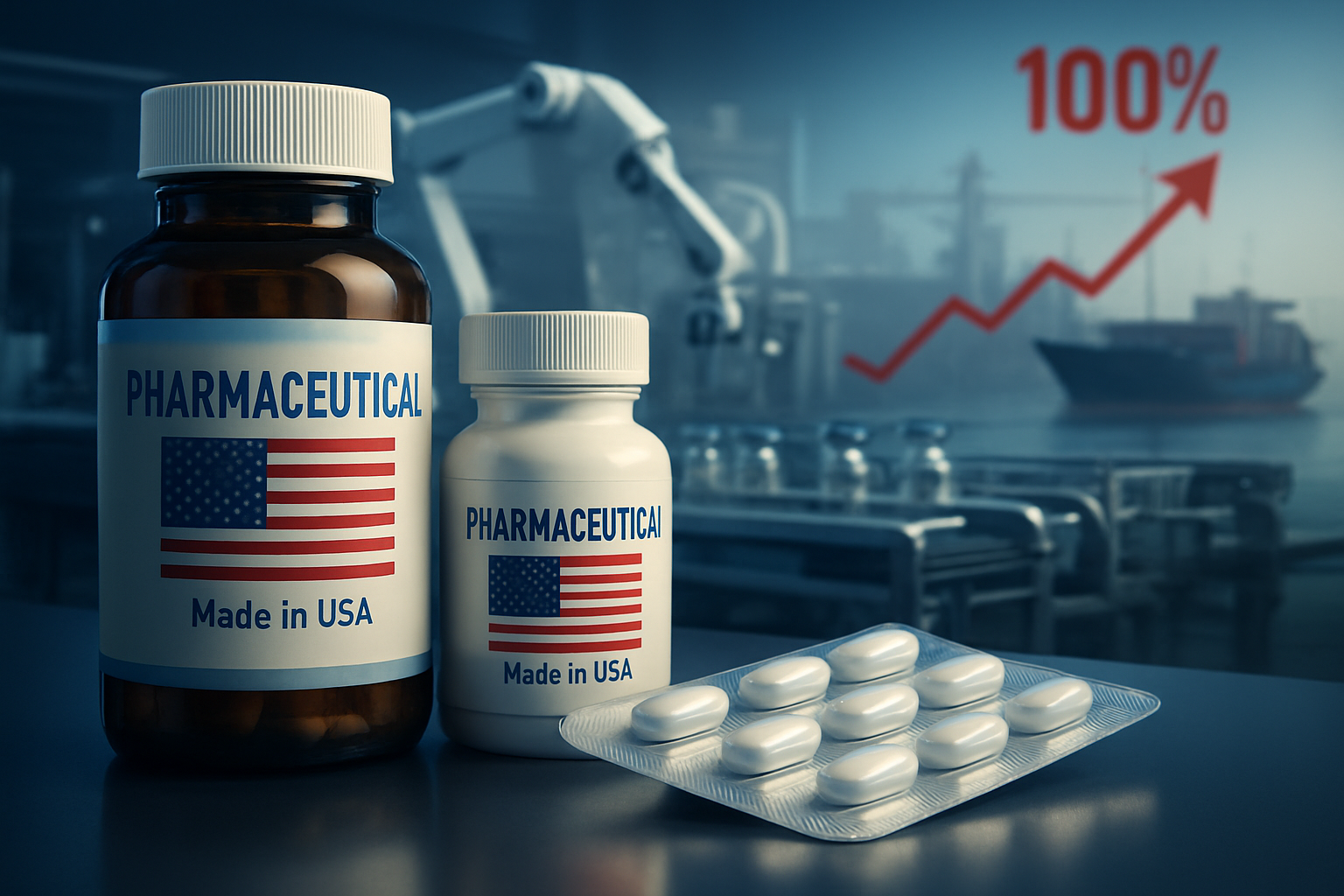
In a move that has sent shockwaves through the global healthcare industry, the U.S. Administration officially finalized a sweeping new trade policy on April 6, 2026, imposing 100% tariffs on branded (patented) pharmaceutical imports. The announcement, timed to coincide with the first anniversary of "Liberation Day"—the administration's 2025 declaration of trade independence—marks the most aggressive effort to date to force the "onshoring" of medicine manufacturing. While the administration frames the policy as a national security necessity and a blow against "predatory" global pricing, the sudden finalization of these duties has triggered a radical bifurcation in the stock market between pharmaceutical giants and smaller biotechnology firms.
The immediate implications of this policy are profound. By leveraging Section 232 of the Trade Expansion Act, the administration has bypassed traditional trade hurdles, categorizing reliance on foreign-made drug ingredients as a threat to national security. For companies that have not yet reached "Most Favored Nation" (MFN) pricing agreements or committed to massive domestic manufacturing investments, the 100% duty effectively doubles the cost of bringing innovative medicines into the world's largest healthcare market. While many "Big Pharma" companies have already insulated themselves through private deals, the broader healthcare sector is bracing for a period of intense volatility and supply chain reorganization.
A Targeted Strike for National Security and Price Parity
The journey to this moment began on April 2, 2025, when the administration first introduced the concept of "Liberation Day," a policy platform aimed at decoupling U.S. critical infrastructure from foreign supply chains. Following a year of legal battles and a Supreme Court setback in early 2026, the executive branch refined its strategy, moving away from universal tariffs toward a more surgical application under Section 232. Today, April 6, 2026, serves as the final procedural deadline, where the administration confirmed compliance windows and finalized the tariff rates that will take effect by July 31, 2026.
Under the new framework, the 100% tariff is the "baseline" penalty for non-cooperative entities. However, the policy is designed as a system of "carrots and sticks." Countries with existing trade frameworks, such as the European Union and Japan, face a capped rate of 15%, while the United Kingdom secured a 0% rate through a unique deal involving higher payments for U.S. innovative drugs. The ultimate goal, as stated by administration officials, is to ensure that Active Pharmaceutical Ingredients (APIs) and finished branded drugs are "Made in America" and sold to U.S. patients at the lowest prices available globally.
The reaction from industry leaders has been swift and polarized. Stephen J. Ubl, CEO of the trade group PhRMA, warned that these "punitive" measures would inevitably raise costs for patients and divert critical R&D funds toward tax payments. Conversely, proponents of the policy argue that the U.S. has been "subsidizing" the rest of the world's drug development for too long and that the threat of a 100% tariff is the only leverage strong enough to force multi-national corporations to prioritize American supply resilience.
Winners, Losers, and the Great "Big Pharma" Divide
The stock market reaction on April 6 has highlighted a clear divide between the haves and the have-nots of the "Liberation Day" era. The "winners" are largely the blue-chip pharmaceutical companies that preemptively signed voluntary agreements with the administration. Pfizer (NYSE: PFE) led the pack, securing a 0% tariff rate in exchange for a staggering $70 billion commitment to domestic manufacturing and a promise to adopt MFN pricing for its entire U.S. portfolio. Similarly, Eli Lilly and Company (NYSE: LLY) saw its stock remain resilient after committing over $50 billion to U.S. projects, including the distribution of its blockbuster weight-loss drug, Zepbound, through the federal TrumpRx.gov discount portal.
Other international giants like Sanofi (NASDAQ: SNY) and Novo Nordisk (NYSE: NVO) have also managed to dodge the 100% duty. Novo Nordisk reached a deal in late 2025, slashing the price of Ozempic and Wegovy to $350 per month for Medicare and TrumpRx.gov users to maintain tariff-free access. Johnson & Johnson (NYSE: JNJ) and AbbVie Inc. (NYSE: ABBV) followed suit, pledging $55 billion and $100 billion respectively in domestic R&D and capital investments. For these companies, the finalization of the tariffs on April 6 represents "policy certainty"—a signal to investors that their U.S. market share is protected from the 100% levy.
The "losers" in this scenario are the smaller, mid-cap biotechnology firms and companies based in "non-cooperative" nations like China and India. These firms often lack the massive capital required to build U.S.-based manufacturing hubs and rely heavily on foreign Contract Development and Manufacturing Organizations (CDMOs). Without the leverage to negotiate individual "0% deals" with the administration, many of these innovative firms are now facing a 100% cost increase on their imports, leading to a sharp sell-off in the biotech indices. Investors are concerned that this will stifle innovation in rare diseases and oncology, where smaller firms play a vital role.
A Paradigm Shift in Global Healthcare Economics
This event is not merely a trade dispute; it represents a fundamental shift in how the global healthcare industry operates. For decades, the pharmaceutical sector has relied on a globalized supply chain that prioritized cost-efficiency and specialized regional hubs. The April 6 finalization marks the end of that era. By linking market access to domestic manufacturing and "Most Favored Nation" pricing, the U.S. is effectively attempting to end global price discrimination and re-establish itself as the world's primary pharmaceutical manufacturing hub.
The ripple effects are already being felt among competitors and partners. Many European firms, such as Novartis AG (NYSE: NVS) and Roche Holding AG (OTC: RHHBY), have entered into shared investment commitments (totaling $50 billion) to build new manufacturing hubs in states like North Carolina. This "forced migration" of capital is expected to create a temporary glut in U.S. construction and high-tech manufacturing jobs but could also lead to retaliatory measures from foreign governments. Historically, similar protectionist moves in the early 20th century led to decades of trade friction, and experts are closely watching the European Union's response to see if a "pharma trade war" is on the horizon.
Regulatory implications are also mounting. The administration’s reliance on Section 232 suggests that the Food and Drug Administration (FDA) and the Department of Commerce will now have overlapping jurisdictions regarding drug supply. This could lead to a more politicized approval process where a company's manufacturing footprint is weighed alongside its clinical data. The long-term impact on the speed of drug approvals and the entry of new competitors remains a major point of concern for healthcare analysts.
The Road Ahead: 120 Days to Comply
In the short term, the pharmaceutical industry enters a frantic "compliance window." Large companies have 120 days from the April 2 announcement (roughly until early August) to finalize their onshoring plans or face the full brunt of the tariffs. Smaller firms have been granted a slightly longer 180-day grace period, acknowledging their more precarious financial positions. We can expect a flurry of "quid pro quo" deals between mid-cap biotechs and the administration over the coming months as companies scramble to secure their 0% tariff status.
Strategic pivots are already underway. Many companies that cannot afford to build their own factories are likely to seek partnerships with domestic CDMOs or merge with larger firms like GSK plc (NYSE: GSK), which has already built a strategic API stockpile for the U.S. government. Market opportunities may emerge for U.S.-based generic manufacturers and domestic logistics firms that specialize in specialized medical transport, as the "Made in America" requirement creates a premium on domestic supply chain infrastructure.
However, the risk of supply disruptions is real. If enough companies fail to reach agreements by the July 31 deadline, certain branded medications could see immediate shortages or massive out-of-pocket price hikes. The administration is banking on the "TrumpRx.gov" platform to absorb some of this shock by providing discounted access to drugs from compliant companies, but the scalability of this portal remains a significant question mark for the remainder of 2026.
Final Assessment: A High-Stakes Gamble for the Market
The finalization of the 100% pharmaceutical tariffs on April 6, 2026, will be remembered as a watershed moment in economic history. By forcing a choice between the U.S. market and a globalized supply chain, the administration has fundamentally rewritten the rules of engagement for one of the world's most profitable industries. The key takeaway for investors is that the "Large-Cap Pharma" space has effectively been "nationalized" in terms of its strategic goals, trading high profit margins for market stability and domestic protection.
As we move forward, the market will likely continue its bifurcation. Investors should watch for the July 31 "effective date" as a critical milestone. If the transition happens smoothly without significant drug shortages, the administration's gamble may be seen as a success for domestic industry. However, any supply chain breakdown or a surge in retaliatory tariffs from the EU or China could quickly sour market sentiment.
For now, the era of the "global drug" is in retreat, replaced by a "Fortress America" approach to healthcare. What remains to be seen is whether this policy will truly lower costs for the American patient or if it will simply replace foreign dependence with a domestic monopoly controlled by a few massive, compliant giants. Investors should remain cautious, keeping a close eye on the mid-cap biotech sector and any further expansion of the Section 232 "national security" logic into other sectors of the economy.
This content is intended for informational purposes only and is not financial advice.